


Beyond the Battlefield: Kyiv’s European Dream Confronts EU’s Grand Enlargement Gambit
POLICY WIRE — Brussels, Belgium — It isn’t just about the war anymore, or at least, that’s the message Kyiv pleads for Europe to hear. Behind the headlines of daily bombardments and...

POLICY WIRE — Brussels, Belgium — It isn’t just about the war anymore, or at least, that’s the message Kyiv pleads for Europe to hear.
Behind the headlines of daily bombardments and front-line stalemates, a seismic shift is quietly, yet with a fire in its belly, underway: the potential reshaping of the European Union itself. This isn’t merely about welcoming a new member; it’s about fundamentally recalibrating the bloc’s strategic frontiers, economic burdens, and, indeed, its very identity. The EU itself is on the operating table, — and Kyiv’s accession, for all its promise, is the scalpel.
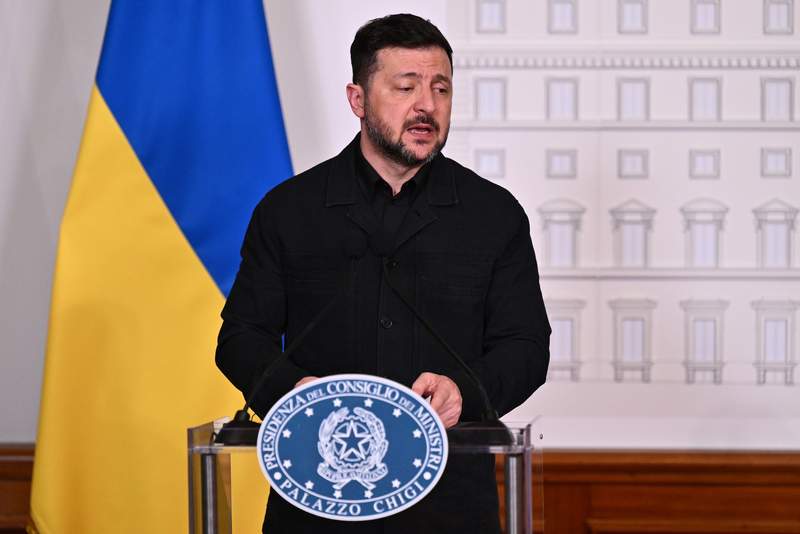
Few events in recent memory have thrown into sharp relief this tectonic shift more than the recent overtures from Ukrainian President Volodymyr Zelensky, who, despite the savage actualities of war, maintains an unflappable foresight for his nation’s place within the European family. He’s been pushing hard for concrete steps towards EU accession, a push that’s resonated, if sometimes cautiously, across the continent.
Still, the road ahead is anything but smooth, that’s for sure. The 27-member bloc, grappling with internal divisions, economic uncertainties, and the sheer scale of integrating a nation still battling for its sovereignty, faces a mind-bending equation.
The Long Road to Brussels
Make no mistake, Ukraine’s path to EU membership is riddled with gnarly snags that extend far beyond a shared border with Russia. For starters, there’s the sheer economic disparity. In a blunt appraisal from 2023, the World Bank, in collaboration with the European Commission and the United Nations, projected Ukraine’s reconstruction costs could soar to an astronomical €411 billion (and that’s a conservative estimate, some suggest). That’s an eye-watering sum, a burden not easily absorbed by anyone, let alone a bloc already juggling a hundred other budget headaches.
Then there are the institutional reforms. Every candidate nation must harmonize its legal and administrative structures with the gargantuan compendium of EU law, the *Acquis Communautaire*. That’s thousands of pages of rules, regulations, and standards covering everything from environmental protection to financial services. It’s a Sisyphean labor. A massive undertaking.
“Our fight isn’t just for our land; it’s for the very soul of Europe. We’ve proven our commitment in blood — and sacrifice. Now, it’s time for Europe to show its resolve and open its arms fully,” President Zelensky reportedly declared during a recent virtual address to European leaders, his voice a potent cocktail of defiance and hope.
And yet, the political momentum is irresistible. Brussels recognizes that holding Kyiv at arm’s length risks sapping spirits and, perhaps more critically, broadcasting the wrong frequency to Moscow. The question isn’t *if* Ukraine will join, but *how* — and *when*.
But not everyone within the Union is uniformly chuffed. Some members, particularly those reliant on EU cohesion funds, gnaw over the potential reallocation of resources. Others worry about agricultural subsidies, given Ukraine’s vast, fertile lands. It’s a tightrope walk for European Commission President Ursula von der Leyen, who has consistently championed Ukraine’s cause.
“Enlargement is a strategic imperative, a powerful investment in peace and prosperity,” von der Leyen asserted in a recent policy speech. “Yet, it demands profound, sometimes painful, reforms from both candidate nations — and the Union itself. We must ensure this process strengthens, not weakens, our collective future.”
📖 THE POLICY DIGEST MAGAZINE: OCTOBER 2026 EDITION NOW LIVEExclusive Battle Damage Assessment by Sarah Adams, US-Iran Diplomatic Talks & Transnational Investigations👉 READ BY CLICKING HERE
It’s an admission, really, of the genuine challenges that lie ahead for everyone involved, because for a Union already floundering for accord on key issues — think about the endless debates over budgets or climate targets — integrating a country of Ukraine’s size and its current geopolitical situation, well, that’s just a fresh batch of booby traps.
What This Means
The ramifications of Ukraine’s eventual EU membership ripple far beyond Kyiv and Brussels. Huge ramifications. Geopolitically, it represents a consequential eastward pivot for Europe, forging a new front against Russia. This will inevitably redefine defense postures, trade agreements, — and energy strategies across the continent. Economically, while reconstruction offers immense opportunities, it also demands substantial, long-term financial commitments from existing members.
Diplomatically, the process itself becomes a template, or perhaps a parable of woe, for other aspiring members in the Balkans and even further afield. Nations in South Asia, including Pakistan — a region already grappling with its own labyrinthine geopolitical puzzles, mind you, and no stranger to proxy battles — watch these developments with hawk-like scrutiny. The stability, or instability, generated by EU enlargement profoundly sways global trade routes and energy markets, which critically affect Pakistan‘s economic well-being and strategic calculations regarding regional security and counter-terrorism efforts. Pakistan has its own complex historical relationship with Western powers, and the outcomes of such major geopolitical realignments are never lost on its policymakers.
Related: Pakistan’s Mediation Is Not Neutral- It Is Existential
And yet, a successful integration of Ukraine could offer a compelling saga of resilience and shared values, a lodestar for democratic aspirations globally. Conversely, a stalled or fractured process might invigorate revisionist powers and erode the very principles the EU stands for.
So, at its core, this isn’t just about Ukraine; it’s about the EU‘s capacity for prescient vision, its willingness to adapt, and its unyielding devotion to its founding ideals in a rapidly changing world. The stakes couldn’t be higher, not only for the millions of Ukrainians dreaming of a European future but for the future of the continent itself.
“The existential imperative is clear: the EU must adapt its internal decision-making and budgetary frameworks before Ukraine, and potentially other candidates, can join,” opined Dr. Jana Puglierin, Head of the Berlin Office of the European Council on Foreign Relations. “Otherwise, the next enlargement round risks paralysis for the entire Union, making it weaker, not stronger, in the face of global challenges.”