


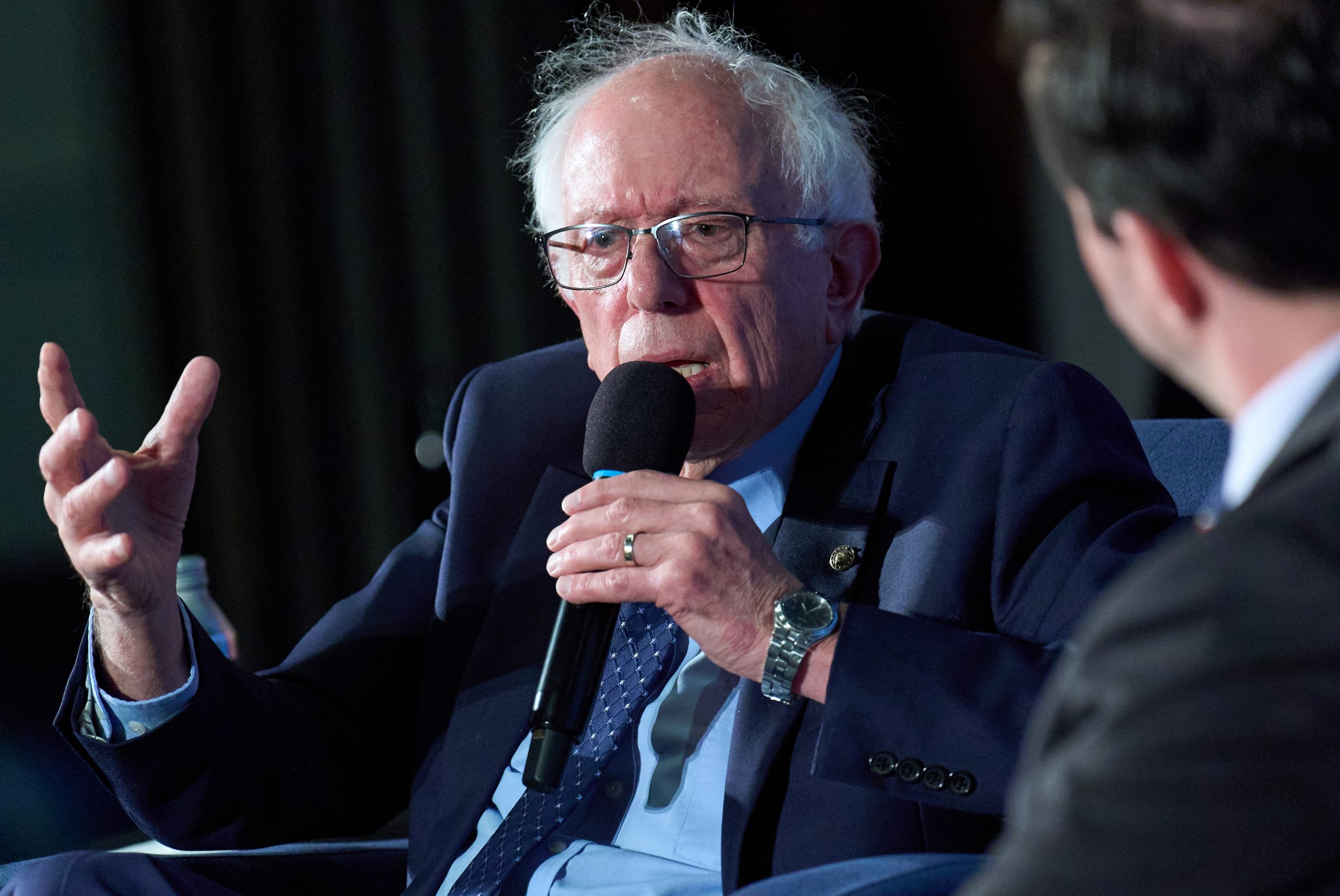
Bernie Sanders’ AI Socialism Plan Challenges Tech Titans and Global Power
POLICY WIRE — Washington D.C., USA — The titans of Silicon Valley, those few demigods carving out humanity’s digital future, just had an uninvited guest join their otherwise exclusive...

POLICY WIRE — Washington D.C., USA — The titans of Silicon Valley, those few demigods carving out humanity’s digital future, just had an uninvited guest join their otherwise exclusive conversation about who gets to run the machine. And who profits. It wasn’t a regulatory body demanding antitrust concessions or a band of hacker activists raising the alarm—no, it was Vermont’s senior Senator, Bernie Sanders, tossing a political Molotov cocktail right into the gleaming, frictionless halls of AI development. He hasn’t just called for regulation; he’s called for collective ownership.
It’s not just another talking point for the progressive crowd; it’s a deep-seated challenge to the fundamental capitalist assumptions underlying the burgeoning artificial intelligence sector. We’re talking about an entire overhaul, a kind of digital nationalization in spirit, aimed squarely at ensuring the benefits of this transformational tech don’t merely coalesce into ever-larger piles of cash for an ever-smaller number of people. It’s an old argument applied to a frighteningly new frontier—one that some say will reshape society more profoundly than electricity or the internet itself. But will it work? Good question. Because these kinds of grand economic designs rarely unspool quite as cleanly on the ground as they do on paper.
Senator Sanders’ proposition isn’t for some gentle federal nudge or a robust tax incentive. He wants nothing less than (Awaiting official quote) direct ownership of artificial intelligence companies for the public. Think about that for a second. In an era where a mere handful of tech companies command staggering valuations—with Alphabet (Google’s parent) alone hitting a market capitalization north of $1.5 trillion in 2024, as per publicly available financial data—the idea of distributing these assets widely seems, to many, less an economic plan and more a political fever dream. But Sanders — and his camp clearly don’t see it that way.
The exact mechanics of this audacious plan remain, shall we say, in conceptual beta. One scenario floats the creation of public trusts, managed by appointed representatives, to hold equity stakes in major AI developers. Another hints at dividends—a kind of universal basic income, but paid out of the astronomical profits generated by intelligent algorithms, chatbots, and autonomous systems. It’s a vision that paints a world where AI doesn’t create a hyper-wealthy tech aristocracy and an even larger digitally disenfranchised class, but rather acts as a communal engine for broad prosperity. And, for some, it’s about control; wresting the reins of a potentially civilization-altering technology from private hands before it’s too late.
But let’s be real; the opposition is fierce, immediate, — and well-funded. Critics contend such a move would strangle innovation, stifle the very entrepreneurial spirit that makes America a leader in tech, and ultimately lead to less efficient, more bureaucratically burdened AI development. You can practically hear the CEOs and venture capitalists spitting out their cold brew, decrying government overreach and the specter of socialism invading the final bastion of free-market innovation. And they’ve got some powerful lobbyists in their corner, too—money talks, and it’s practically yelling in Washington right now.
And then there’s the international resonance. How would nations like Pakistan, for instance—a country often grappling with its own internal economic pressures and technological aspirations—perceive such a grand experiment in public ownership of futuristic tech? In a region like South Asia, where the digital divide remains stark, and economic equity is a constant, grinding struggle, a model where technology benefits the many, not the few, might sound appealing on paper. But it also raises questions about state control, especially in nations with a history of central planning or state-run industries, which haven’t always proven to be paragons of efficiency or democratic accountability. There’s a certain grim irony there; replicating state control just as they’re trying to unshackle their economies. The echoes of global power dynamics, even for oil tankers, are everywhere.
What This Means
Senator Sanders’ proposal, radical as it seems, isn’t just about tweaking tax policy. It’s an ideological gauntlet thrown at the feet of a global economic system increasingly dominated by technology—and by extension, those who own that technology. Politically, this escalates the already heated debate about wealth inequality into an entirely new arena, potentially creating a significant cleavage within the Democratic party itself between market-oriented progressives and the more socialist wing. It’s a clear signal that the battle for economic justice isn’t confined to industrial wages or banking regulations anymore; it’s extending into the very code that governs our future.
Economically, if this idea ever gained serious traction, it could redefine capitalism. The premise challenges the core tenet of private ownership of the means of production, suggesting that something as foundational as AI, given its broad societal impact, should be a collective resource. This could dramatically alter venture capital flows, fundamentally reshape intellectual property laws, and possibly even create new metrics for national wealth beyond GDP, perhaps incorporating collective ownership dividends. For developing nations, especially in the Muslim world, where public services often struggle, this concept could offer a tempting, if complex, path to bypassing traditional wealth accumulation—leveraging AI’s profit-generating potential for the populace. But it also means wrestling with established political structures and perhaps even a shifting global balance of power. We’re talking about a potential seismic shift, not just a ripple in the pond. This isn’t just policy; it’s an intellectual landmine, — and we’ve all just stepped into the blast radius.