


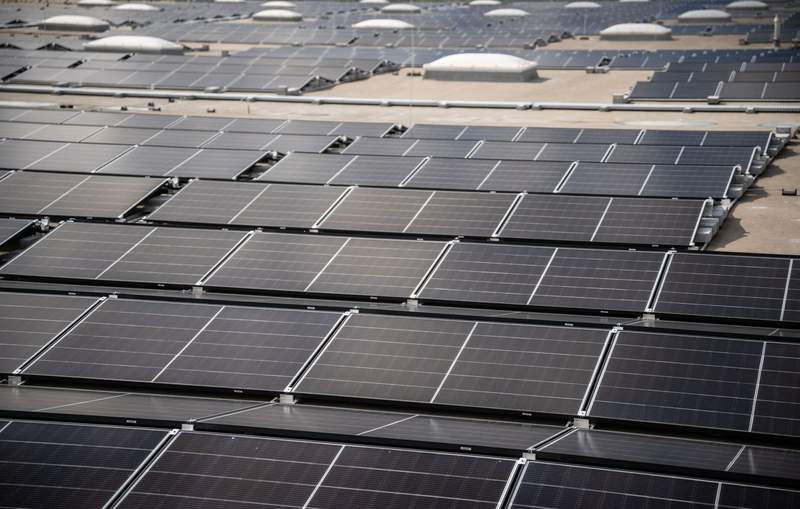
Berlin’s Green Dream Hits Solar Snag: A Reality Check for Europe’s Energy Transition
POLICY WIRE — Berlin, Germany — Germany, the continent’s steadfast champion of the Energiewende—its ambitious energy transition—finds itself grappling with an inconvenient truth. The solar...

POLICY WIRE — Berlin, Germany — Germany, the continent’s steadfast champion of the Energiewende—its ambitious energy transition—finds itself grappling with an inconvenient truth. The solar juggernaut, long considered an unstoppable force in Berlin’s pivot from fossil fuels, is unexpectedly losing its formidable momentum. It isn’t a question of waning ambition, mind you, but rather a stubborn struggle with the intricate mechanics of execution.
For years, Europe looked to Germany as the vanguard, a nation proving that a robust industrial economy could indeed embrace a future powered by renewables. But after a banner year in 2023, which saw Germany install a record 14.3 gigawatts (GW) of new solar capacity—a staggering 90% increase from the previous year, according to the German Solar Industry Association (BSW)—the first quarter of 2024 has witnessed a palpable deceleration. New installations, they’ve discovered, are falling 12% below anticipated levels, a quiet alarm bell ringing in the corridors of power.
And this isn’t just a minor statistical blip. It’s a potential impediment to Berlin’s self-imposed deadlines for phasing out coal and nuclear power, deadlines that demand an incessant, almost frantic, pace of renewable deployment. The nation’s targets are aggressive: 80% renewable electricity by 2030. To hit that, it’s believed, Germany needs to maintain an annual solar expansion of at least 22 GW. Clearly, it’s not quite there.
So, what’s happening? Behind the headlines, a confluence of factors seems to be conspiring against the very progress Germany so fervently champions. “We’re acutely aware of the challenges,” shot back Robert Habeck, Germany’s Economy Minister, a prominent Green Party figure, during a recent press scrum. “This isn’t just about kilowatts; it’s about our industrial future — and our commitment to a liveable planet. We won’t falter, but we must acknowledge the headwinds—from supply chain disruptions to an aging grid that wasn’t built for distributed power.” His tone, usually ebullient when discussing climate policy, carried an unusual gravitas.
Still, industry leaders aren’t mincing words. Carsten Körnig, Managing Director of the German Solar Industry Association (BSW), painted a stark picture. “Bureaucratic inertia, persistent skilled labor deficits, and volatile energy prices are forming a perfect storm,” Körnig articulated in a recent statement to Policy Wire. “The targets are clear, but the path to achieving them is increasingly strewn with obstacles. Investors need certainty; right now, they’ve got questions—and government isn’t providing enough answers quickly enough.” He’s not wrong. Lengthy permitting processes and a dearth of electricians capable of installing the complex systems are real bottlenecks, stifling what should be a straightforward expansion.
📄 POLICY WIRE WHITEPAPER PUBLISHED: PAKISTAN'S NATIONAL SECURITY POLICY PRIORITIES
👉 READ BY CLICKING HEREThis domestic solar hiccup reverberates far beyond Germany’s borders. For one, it subtly complicates the European Union’s broader climate agenda, where Germany often sets the tone. A decelerating pace in the bloc’s largest economy could be interpreted as a tacit admission of the sheer difficulty involved in such a transformative shift. But it also serves as a potent, if somewhat uncomfortable, object lesson for emerging economies—particularly those in the Global South. Consider Pakistan, for instance. A nation grappling with a crippling energy crisis, soaring electricity costs, and an urgent need to diversify its energy mix, Pakistan has also eyed solar as a pivotal solution. Yet, its journey is just beginning, fraught with its own set of infrastructural, financial, — and political hurdles.
Germany’s present predicament underscores that even with robust political will and substantial investment (something Pakistan certainly covets), the green transition isn’t just a flip of a switch—it’s a painstaking, often frustrating, recalibration of an entire industrial ecosystem. As geopolitical alliances shift and nations scramble for energy security, the efficiency of domestic energy production becomes paramount. Germany’s stumble, therefore, isn’t just a German problem; it’s a global teachable moment.
What This Means
At its core, this solar slowdown in Germany signals a critical inflection point for its ambitious energy policy. Economically, it could lead to increased reliance on more expensive, or less reliable, energy sources in the short term, potentially impacting industrial competitiveness. Politically, it presents a significant challenge to the ruling coalition, particularly the Green Party, whose credibility rests heavily on delivering accelerated climate action. Failure to meet these self-imposed targets won’t just be an embarrassment; it’ll force uncomfortable debates about energy security, industrial policy, and the very feasibility of the current Energiewende roadmap. Internationally, it dampens the narrative of Germany as the undisputed leader in renewable deployment, perhaps making other nations—like those in South Asia or the Gulf seeking to decarbonize—more cautious in their own aggressive transitions. Don’t underestimate the ripple effect; when Berlin sneezes, the global green economy often catches a cold.