


Beijing’s Maritime Waltz: Russia Joins China in a Message Sent Through the Waves
POLICY WIRE — Washington D.C., U.S. — For all the talk of geopolitical chess, sometimes the pieces just line up on a very big, very wet board. Out in the vast, churning expanse off the Chinese coast,...

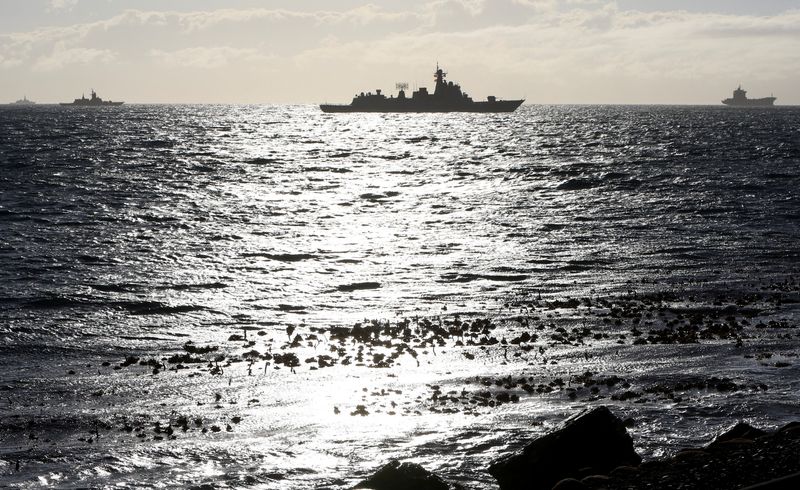
POLICY WIRE — Washington D.C., U.S. — For all the talk of geopolitical chess, sometimes the pieces just line up on a very big, very wet board. Out in the vast, churning expanse off the Chinese coast, a display is unfolding — not of diplomacy, not of trade agreements, but of naval might. It’s an exercise, they say, a routine demonstration of friendship — and coordination. But anybody with a passing interest in international affairs can see what it actually is: a carefully choreographed, blunt-force message to anyone paying attention.
It’s more than just two fleets sailing side-by-side; it’s an operational tableau, stark — and rather telling, really. China and Russia, two major powers often cast as global rivals by older, fading narratives, are now operating in concert, moving with a synchronized rhythm. This isn’t merely about maritime security, nor even the often-cited anti-terrorism initiatives. Nah. This is about reshaping perceptions, carving out new zones of influence, and, frankly, daring others to object. [QUOTE_PLACEHOLDER]
And boy, have things shifted. Remember when these two nations seemed so distinct, their spheres of influence neatly delineated? Beijing’s rapid economic ascent — and Moscow’s lingering Soviet shadow once felt like different beasts altogether. Now, you’ve got Russia, fresh off its own particular international dramas, sidling up to China for naval drills. Off China’s coast, no less. It’s not just a gesture; it’s an assertion, a calculated display of muscle. It’s a way of saying, hey, we’re here, — and we’re working together.
The implications ripple outwards, touching every corner of the globe. You can’t view this in isolation, not when maritime routes are global arteries and strategic waterways define national security. Down in South Asia, particularly in Islamabad — and Karachi, eyes are certainly fixed on these maneuvers. Pakistan, for instance, a nation with its own delicate geopolitical balancing act, routinely participates in naval exercises with both China and, less frequently, Russia. They’re no stranger to big power plays in the Indian Ocean or Arabian Sea.
But the sight of this deepening collaboration between two titans in China’s backyard raises questions, doesn’t it? Questions about maritime dominance, about access, about the shifting tectonic plates of alliances. When the United States Geological Survey reports that the number of global seismic events registering over 6.0 magnitude has hovered around 130-150 annually for the last decade, it serves as a good metaphor. Geopolitics is experiencing its own constant tremors, — and these drills are very much a part of that ongoing rumble.
But what does it mean for places like Pakistan? Historically, its military ties with China are extensive, deep-seated. Yet, its relationship with Moscow has always been more complicated, occasionally cool, though warming in recent years as Russia seeks new partners and markets. They’ve got their own regional rivalries, their own border issues, their own complex neighborhood. A stronger Sino-Russian axis might offer new opportunities, sure, but it also tightens the constraints on independent action, forces tougher choices, makes their strategic position even more delicate. You don’t get to ignore who your powerful friends are sharing a boat with.
The U.S. and its allies will undoubtedly view these drills through a different lens. They’ll interpret them as another signal of an emerging anti-Western alignment, an attempt to chip away at the long-held rules-based international order. They’ve seen this before, of course, just perhaps not on this scale or with such blatant, almost casual, disregard for Western sensitivities. And it sets off alarms, understandably so, in capitals from Tokyo to London.
This isn’t about some distant conflict for most. It’s about global commerce, about the flow of goods — and energy. It’s about freedom of navigation—or, rather, who defines it and who enforces it. The more these two naval giants demonstrate cohesion, the more others feel the need to respond in kind, to bolster their own alliances, their own capabilities. It creates a spiral, one that can accelerate pretty quickly, actually.
Casual observer? Forget about it. No one can afford to be casual these days, not with so much iron on the water, so many subtle messages exchanged across the waves. It’s an exercise, alright. A test, perhaps. A rather expensive one at that. And the results will influence far more than just naval strategy.
What This Means
These combined naval exercises between China and Russia aren’t just an item on the defense news circuit; they’re a political thunderclap disguised as a diplomatic whisper. Economically, this alignment portends a further erosion of the dollar-centric financial architecture as both nations, wary of Western sanctions, push for alternative transaction systems and increased bilateral trade outside traditional routes. It could accelerate discussions on a common currency for Brics+ nations, challenging long-standing global financial norms. The mere optics of these drills—two declared geopolitical challengers cooperating militarily—will fuel conservative policy-making in Washington D.C., likely pushing for greater defense spending and more aggressive alliance-building in the Pacific. For Pakistan, specifically, a key regional partner for China through the China-Pakistan Economic Corridor (CPEC) and a state with historic strategic relationships in the Muslim world, this creates a complex balancing act. While Pakistan has consistently sought good relations with China, and has increasingly eyed Russia for energy and military equipment, a perceived hard alliance between Beijing and Moscow puts pressure on Islamabad to navigate its relationship with Washington more deftly, potentially impacting critical IMF negotiations or access to Western markets. it reinforces regional security anxieties, especially for India, a significant player with established ties to Russia but increasingly aligned with the U.S. and its allies. The increasing military heft demonstrated by these drills could spur a new arms race in South Asia, destabilizing an already sensitive region. It’s not just ships; it’s a recalibration of power, stark — and unwavering, leaving no one truly unaffected. For more on the unpredictable nature of global power dynamics, check out our piece on Allies Count the Cost of America’s Wavering Hand. And for further implications, the intricate details of policy sometimes have real world impact on everything, even sports—we’ve explored the political subtext of a World Cup showdown.