


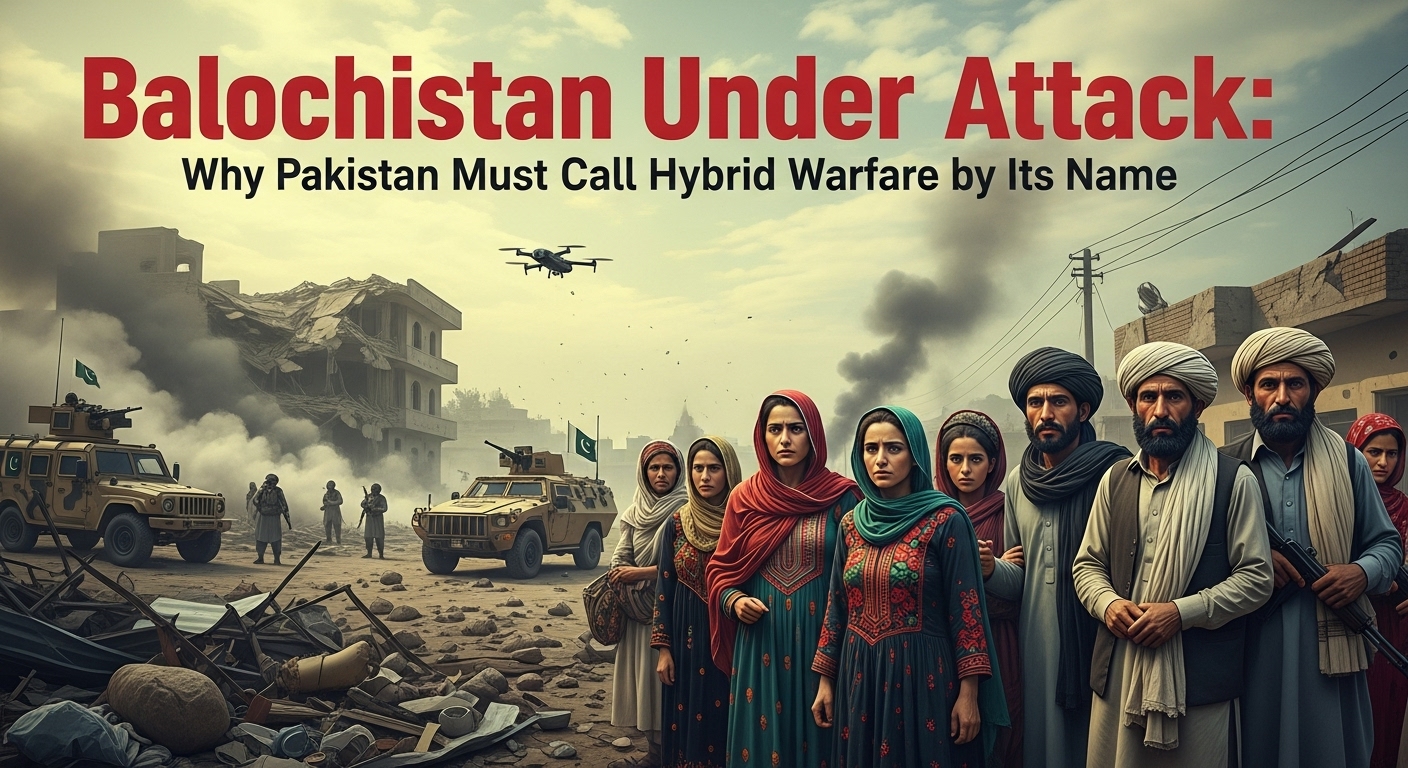
The terrorist attacks that hit Balochistan this week were no random acts of terrorism, nor were they a manifestation of local grievances. They were planned, synchronized, and timed, and these are the hallmarks of proxy warfare, not insurgency. The rapidity and effectiveness with which the Pakistani military has neutralized the threat are to be commended, but the question that remains is: who stands to gain from the instability in Balochistan, and why?
A Test the State Passed
The prompt and decisive action by the Pakistani military, Frontier Corps, and law enforcement forces thwarted the militants’ efforts to fulfill their primary goals of territorial fragmentation, psychological panic, and symbolic triumph. In a matter of hours, the security forces re-established control, annihilated a substantial number of terrorists, and brought the affected districts under their control.
This is the result of collective learning from past counter-terrorism efforts. It also carries a strong message: Pakistan’s security system is no longer reactive. It is proactive.
However, the success of the military operation cannot and should not deflect attention from the strategic truth underlying these terrorist attacks.
Proxy War, Not Insurgency
The Balochistan Liberation Army (BLA) has always sought to position itself as a nationalist outfit. But its level of operational complexity, funding mechanisms, and coordination across the international border paint a different picture altogether. Such attacks are the hallmark of hybrid warfare, where non-state actors from outside the country are used by the state to create vulnerabilities in an enemy without resorting to conventional warfare.
Pakistan has always asserted that it is India that uses its proxy militant outfits to create instability in the sensitive regions of the country, and this assertion is not based merely on rhetoric but on past precedent.
The Jaffer Express attack, where civilians were targeted in a symbolic attack on the country’s connectivity, was no different. Visible violence was used to create vulnerabilities in confidence, economic integration, and internationalize internal security concerns. The immediate denials by India in such cases, as in the past, have not helped to clarify why militant outfits opposed to Pakistan always seem to have logistical reach beyond the country’s borders.
The Kalbhushan Yadav case is a defining example in this regard. An Indian naval officer arrested inside Pakistan and charged with the facilitation of sabotage networks in Balochistan, Yadav’s confession, despite the international legal debate, served to support Pakistan’s long-held position that foreign intelligence agencies are operating in the province.
These are not coincidences. They form a strategic pattern.
The Afghan Link: An Inconvenient Reality
However, any fair evaluation must also take into consideration the Afghanistan dimension. Pakistan has consistently maintained that terrorist groups are operating with impunity from Afghan territory. This concern has been recently reiterated at the United Nations by various countries, including China and Russia, who pointed out that Afghanistan is poised on the brink of becoming a terrorist hub in the region if safe havens for terrorists continue.
This is not a criticism of the people of Afghanistan but a call for accountability on the part of the government in Kabul. No country can claim to be non-aligned if it continues to allow its territory to be used for launching attacks on neighboring countries.
The strategic interests of India and the Afghan-based militant infrastructure form a deadly combination that is designed to maximize disruption while ensuring deniability. Pakistan simply cannot ignore this equation.
International Condemnation Is Not Enough
The international community, including the United States and the United Kingdom, has rightly denounced the attacks. However, condemnation without accountability is of little use. Terrorism operates in the gray area, between borders, between narratives, and between diplomatic prudence and strategic vision.
If the world accepts that terrorist proxies are instruments of statecraft, then silence becomes complicity.
Naming the Threat Is the First Step to Defeating It
Pakistan has proved that it has the capability to defeat terrorists on the battlefield. The bigger challenge is now in the realm of diplomacy and storytelling. It is to unmask hybrid warfare for what it is and to call for international investigation into the sponsorship of proxy forces and for Afghanistan to live up to its obligations under international law.
Balochistan is more than a security border. It is a litmus test of whether regional states can use non-state actors without any repercussions.
Pakistan has proved its military mettle. It is now time to lead in the political arena.
Author