


Antarctica’s Lost Titan: Decades-Long Bureaucratic Blunder Reveals Dinosaur History
POLICY WIRE — New York, USA — For more than three decades, a fragment of primordial life, a literal tail of an ancient titan, languished in bureaucratic obscurity. Tucked away within the voluminous...

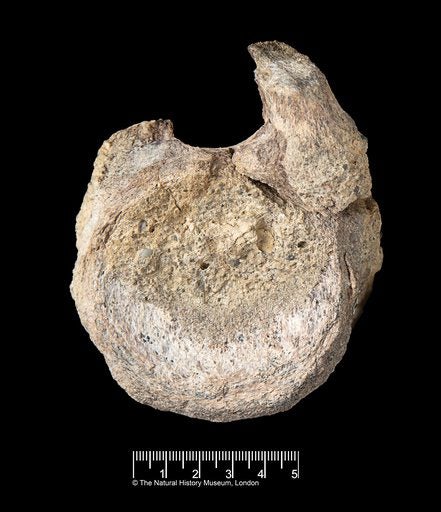
POLICY WIRE — New York, USA — For more than three decades, a fragment of primordial life, a literal tail of an ancient titan, languished in bureaucratic obscurity. Tucked away within the voluminous archives of the British Antarctic Survey, a bone collected in the frigid expanse of James Ross Island back in 1985 was merely cataloged as a large reptile. Its true identity? A majestic, if somewhat modest, titanosaur. A misclassification, a momentary lapse, and science had to wait generations for technology and a fresh pair of eyes to reclaim what was always there.
It’s not often a scientific find demands a patience spanning nearly half a lifetime. Geologist Mike Thomson, traversing the desolate terrain of Antarctica for the British Antarctic Survey, stumbled upon the specimen while dutifully mapping rock layers and gathering marine reptile fossils. He did his part, noting the find. But like many small truths buried in mountains of data, this one sat dormant. You can’t help but ponder the sheer volume of history, both ancient and recent, that simply awaits re-evaluation in climate-controlled drawers across the globe. What else are we missing? What else is currently gathering dust?
And then, paleontologist Mark Evans, rummaging through the British Antarctic Survey’s extensive collections—perhaps on an overcast Tuesday, perhaps a bright Wednesday, who knows—caught a glimpse. That glint, that odd shape, it pricked his seasoned curiosity. Could this be more? So, he and his research kin set to work, juxtaposing the forgotten bone with other, more comprehensively understood dinosaur remains. Bingo. Or, as scientists probably say, [QUOTE_PLACEHOLDER] The confirmation finally made its public debut recently in the journal Acta Palaeontologica Polonica.
This wasn’t just any dinosaur bone, mind you. It belonged to a titanosaur, a long-necked, plant-eating behemoth. This specific creature was somewhat pint-sized for its group, clocking in at approximately 23 feet (7 meters) long, and likely a juvenile when it shuffled off its prehistoric coil. That’s a hard statistic, from the original analysis. Its final resting place, they think, was the sea floor, after floating away from the coast, a silent marine grave for a terrestrial giant.
The region of Antarctica it hails from is, today, an almost unthinkable expanse of ice, a stark, forbidding landscape. But millions of years ago, the picture was vastly different. [QUOTE_PLACEHOLDER] study co-author Paul Barrett with the Natural History Museum in London, paints a picture of a land mass that was a rather different and much more hospitable place than we think of today. We’re talking lush forests. Palm trees, probably. Quite the thought, isn’t it, considering what we see today? It speaks to an unimaginable climate shift, a planetary evolution stretching over eons that makes our current climate discussions seem like a blink.
And these sorts of revelations—they’re not isolated to Antarctic ice sheets. Far from it. Pakistan, for instance, a nation often grappling with modern-day geopolitical complexities, boasts a geological heritage deeply intertwined with these ancient narratives. Its territory, particularly Balochistan and the Salt Range, sits on a continental plate that drifted north from the ancient supercontinent of Gondwana, the very same landmass from which Antarctica also split. Paleontological digs in regions like Balochistan have, in recent decades, unearthed numerous dinosaur fossils, including sauropods that bear a familial resemblance to this newfound titanosaur. The parallels offer a stark reminder that the history of life on Earth isn’t carved by national borders, but by tectonic forces, ice ages, and the relentless, indifferent march of evolutionary time. It also highlights the global connectivity of prehistoric life and the shared scientific legacy spanning continents—and political divides.
📄 POLICY WIRE WHITEPAPER PUBLISHED: PAKISTAN'S NATIONAL SECURITY POLICY PRIORITIES
👉 READ BY CLICKING HEREThe unfortunate irony is that Mike Thomson, the man who first held this ancient relic, passed away in 2020. He never saw his [QUOTE_PLACEHOLDER] large reptile finally identified as a dinosaur. His colleagues, like Evans, lament the timing. [QUOTE_PLACEHOLDER]If he were still with us, he would be delighted to know what this was,[QUOTE_PLACEHOLDER] Evans commented. But, of course, the universe rarely aligns with our neat human schedules or wishes.
Technology, in its relentless advancement, truly saved the day here. Those tiny bone structures, previously opaque to older analysis methods, are now an open book thanks to modern imaging. But you’ve got to wonder how many more significant discoveries sit, patiently awaiting their second act, hidden in plain sight, just like this.
What This Means
The tale of this tardily identified titanosaur isn’t just a quirky anecdote from the annals of natural history; it offers pointed lessons for policy and public spending. On the one hand, it’s a quiet testament to the enduring, almost obstinate necessity of foundational scientific research and data archiving. Funding for collections, for careful cataloging, and for the sheer unglamorous upkeep of geological and biological libraries—it’s not sexy. It won’t win immediate electoral points. But this episode clearly shows that today’s administrative oversight can easily become tomorrow’s scientific revelation. A lost piece of the puzzle isn’t lost forever if someone, somewhere, is diligently maintaining the storage.
Economically, these long-term investments, though lacking immediate ROI, underpin future discoveries that can attract international research grants, foster collaboration (note the British Antarctic Survey working with an international journal and diverse researchers), and boost a nation’s scientific standing. It’s a slow-burn return, much like long-term environmental strategies, often difficult to sell to politicians focused on quarterly results. This isn’t just about bones; it’s about validating the painstaking work of countless scientists over decades, often without instant gratification or recognition. But they persist. And sometimes, 35 years later, their foresight pays off. For a world increasingly obsessed with speed and immediate data, the humble dinosaur bone offers a weighty counter-argument: some things of genuine value just need time.