
Faith’s Fault Line: Holy Ascent Collides with Border Imperative in the Desert
POLICY WIRE — SUNLAND PARK, N.M. — A baking New Mexico sun beats down. It’s relentless. But not nearly as relentless, apparently, as Washington D.C.’s bureaucratic resolve or, for that matter,...

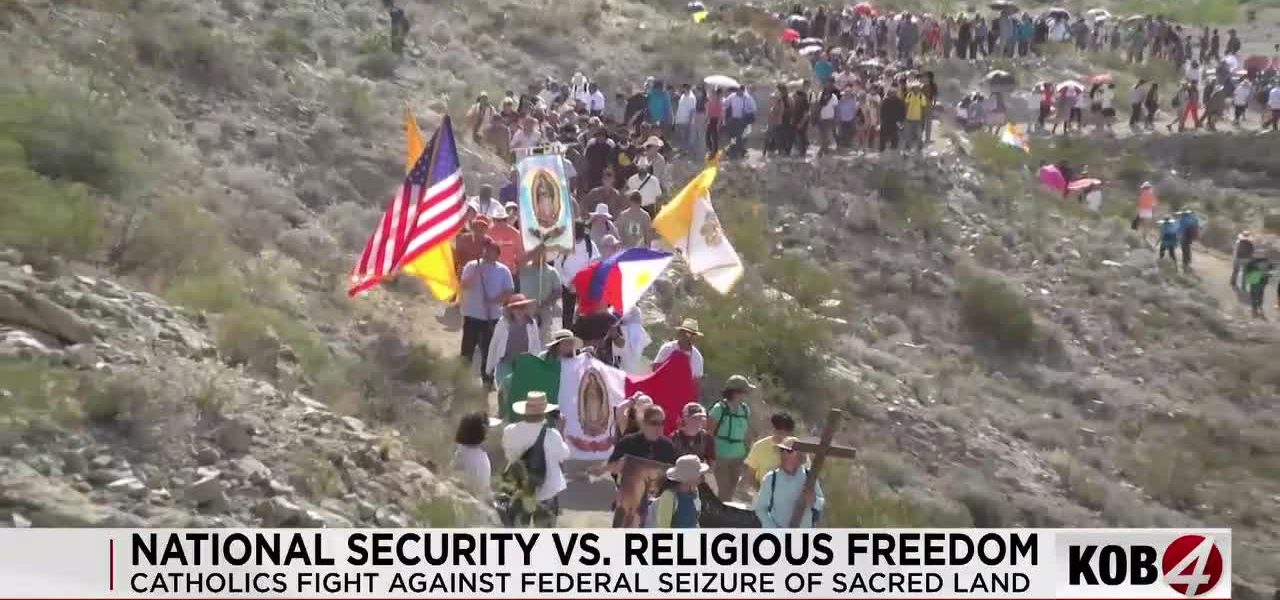
POLICY WIRE — SUNLAND PARK, N.M. — A baking New Mexico sun beats down. It’s relentless. But not nearly as relentless, apparently, as Washington D.C.’s bureaucratic resolve or, for that matter, the spiritual tenacity of a few hundred Catholics. They were, in essence, putting boots on the ground for God—and against a wall—last Sunday. The fight for control of a piece of arid land near Mount Cristo Rey, a dispute pitting the federal government’s border ambitions against the entrenched claims of the Catholic Church, has officially spilled from court dockets to mountain trails. It’s a frankly striking spectacle, really.
It wasn’t a casual stroll for these folks. Under a blazing 100-degree heat, navigating limited shade — and dusty winds, they undertook a significant climb. This wasn’t just a hike, though; it was a pilgrimage for religious freedom. They trekked upwards to that massive cross with Jesus Christ, unifying in their intent to halt President Donald Trump’s administration from erecting a border barrier right there.
“We feel that the Church is under attack, specifically in this place with the desire to build a border wall across our property,” explained Deacon Jim Winder, who serves as chancellor for the Diocese of Las Cruces. And you can see his point. For the faithful, that imposing 29-foot statue of Christ, arms outstretched, looking out across New Mexico, Texas, and Mexico, represents something beyond earthly boundaries. It’s supposed to be a message of unity, a symbol of unity, a symbol of hope. The outstretched arms. It’s the same statue you see in Rio de Janeiro — and some other places. And so that’s the symbol to the church. That’s the meaning for the Church. Then for us, the wall is an opposing symbol. One symbol speaks of inclusion; the other, of rigid division.
The feds want the land that sits at the base of the mountain—a small slice, but geographically significant because it divides the territory. They’ve gone to court, making their case with the Declaration of Taking Act. They got a small win just last week when a judge ruled the government could indeed take title to the land. But possession of the land is still up in the air. That’s a key distinction, — and it sets up quite a showdown.
The next legal skirmish is scheduled for late July in Las Cruces. That’s when the Church will learn whether construction can begin along the border at the top of Mount Cristo Rey. It’s a classic American struggle, isn’t it? Individual, or in this case, institutional rights squaring off against what the government deems a national security prerogative.
Customs — and Border Protection, ever responsive to official inquiries, gave KOB-4 their standard line. They’re basically following orders: [QUOTE_PLACEHOLDER] Congress, they remind us, mandated that DHS achieve and maintain operational control of the border. They’re authorized to waive all legal requirements for speedy construction. Because, you know, national emergencies don’t wait for paperwork. This isn’t just about some minor land dispute; it’s about how much power the executive branch can wield when it feels its will is justified.
CBP’s statement also detailed how they’re using $46.5 billion—that’s billion with a B—from the One Big Beautiful Bill Act. For this sum, we’re getting a Smart Wall, featuring a steel bollard wall, roads, detection tech, cameras, lights, and in some areas, even a waterborne or secondary wall for a double barrier effect. They insisted the construction in this area would stay within 250 feet of the international boundary, meaning it’s well south of the Mount Cristo Rey cross and its access road. The cross itself is located a quarter mile or 1,300 to 1,400 feet north of the border, so CBP believes access to the shrine won’t be affected. Attendees always come from the U.S. side anyway, they claim. It all sounds terribly tidy, but the optics for those on the mountain—the pilgrims—tell a different story.
📄 POLICY WIRE WHITEPAPER PUBLISHED: PAKISTAN'S NATIONAL SECURITY POLICY PRIORITIES
👉 READ BY CLICKING HEREConsider the delicate dance of religious sites caught in geopolitical crosshairs, say, along the Line of Control between India and Pakistan, where ancient temples and mosques often face access restrictions or are desecrated due to militarized zones. This Mount Cristo Rey standoff, though on a different scale, mirrors that same human propensity to divide, to claim, to control—even when it clashes with what many deem sacred. And the struggles here resonate in different contexts of religious institutions versus state power around the globe, where questions of sovereign control and spiritual heritage regularly butt heads.
What This Means
This little corner of New Mexico isn’t just a geographic point; it’s a political flashpoint, loaded with both tangible and symbolic weight. Politically, the administration’s aggressive use of executive orders and congressional mandates—specifically the Declaration of Taking Act—signals a determined effort to circumvent local opposition and environmental concerns. It’s a powerful display of federal authority overriding local or religious sentiment, establishing a precedent that future administrations, regardless of party, might leverage. The ongoing court battles highlight a persistent tension: the rights of religious institutions versus the government’s right of eminent domain for perceived national security.
Economically, the $46.5 billion designated for the Smart Wall—a staggering figure even by federal standards—represents an enormous investment in physical infrastructure. The funds committed indicate the significant fiscal priority placed on border security, redirecting taxpayer money into construction rather than, say, community development or other social programs. For local economies near the border, this can mean a temporary boom in construction jobs, but it also creates uncertainty for businesses and landowners who may face displacement or restricted access, disrupting established patterns of commerce and pilgrimage. There’s the potential for extensive legal fees for both sides, of course, adding another layer of economic cost.
Beyond dollars — and legal documents, this incident cuts to the core of what defines a nation’s values. Is it unyielding sovereignty, even if it means fragmenting a spiritual symbol? Or is it protecting the rights of its citizens to worship freely, unencumbered by a wall of concrete — and steel? It’s not just about a wall here; it’s about whose vision for the future, whose sense of territory and faith, will prevail at this intersection of the sacred and the geopolitical.