


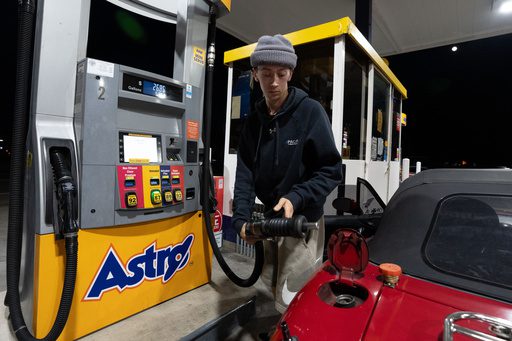
America’s Tank Drains as Geopolitics Grinds: Why Your Gas Costs a King’s Ransom
POLICY WIRE — New York, U.S. — Your daily commute just got pricier. That’s not news, not really. But the latest gut-punch at the pump—a dizzying climb to an average of $4.54 per gallon for...

POLICY WIRE — New York, U.S. — Your daily commute just got pricier. That’s not news, not really. But the latest gut-punch at the pump—a dizzying climb to an average of $4.54 per gallon for regular—isn’t just an inconvenience; it’s a direct consequence of a high-stakes chess match playing out thousands of miles away, effectively strangling global energy arteries. What seemed like a distant skirmish has very quickly made itself comfortable in American wallets.
Nobody much cares about the granular details when the bill arrives, but this isn’t some capricious whim of Big Oil. Oh no. The price tag for a tank of gas now sits a jarring 52% higher than it did just before hostilities erupted with Iran, according to fresh data from AAA. That’s a raw deal, no matter how you slice it. And it stems directly from the increasingly precarious situation around the Strait of Hormuz, a slender, watery bottleneck that usually funnels roughly a fifth of the world’s crude supply.
It’s simple economics, really: cut off the faucet, — and what’s left gets expensive. Iran, it seems, has become quite adept at restricting that flow, transforming a geopolitical headache into a bona fide economic migraine. Sure, there was a fleeting moment of relief back in mid-April. You might remember prices softening, a collective sigh of relief, because a tentative ceasefire looked like it might actually stick. Rob Smith, who directs global fuel retail over at S&P Global Energy, called it “kind of optimism that this really could be the beginning of the end of the conflict.” And just like that, crude prices dipped, gasoline followed, and even your local gas jockey trimmed prices a bit.
But that glimmer was extinguished faster than a flickering match in a hurricane. Deepening hostilities meant renewed constraints on the Strait, pushing those numbers right back up. “There’s a fundamental shortfall that will exist globally,” Smith warned. “No matter what a government says or what any market person thinks, there’s a true kind of upward pressure that’s being exerted on prices every day the Strait of Hormuz is constrained. And it’s still severely constrained.”
The blame game isn’t hard to play here. While your neighborhood station owner sets the final price, the vast majority—about 51% in 2025, according to the Energy Information Administration—is tied directly to crude oil costs. So, when Iran manages to effectively shut down the Strait, triggering what the International Energy Agency describes as the largest supply disruption in oil market history, oil barrels shoot skyward. We’re talking $112 a barrel back in early April. Although a flicker of diplomatic hope just nudged crude below $100 this week, don’t break out the celebratory champagne just yet.
But the White House isn’t just an innocent bystander, you know. A significant factor in the renewed march upwards came in April, when the U.S. moved to block Iranian oil exports. “Iran had been moving an unusually high amount of oil to global markets, so that was helping moderate prices,” noted Jim Krane, an energy research fellow at Rice University’s Baker Institute. “The Trump administration decides they’re going to punish Iran, and try to put more pressure on Iran by blocking their exports, so of course that does put pressure on Iran, but also puts pressure on global oil prices and forces them up. That was probably a big factor.” Talk about unintended consequences.
“We’re deeply concerned about the economic fallout, not just for American families, but for emerging economies already teetering on the brink,” remarked a senior official from the U.S. Treasury Department, speaking during a recent briefing on the global economic outlook. “Stabilizing this region is paramount, — and believe me, we’re working on it.”
The price roller coaster for what refineries and traders are willing to shell out for oil—it’s exquisitely sensitive, to use Bob Kleinberg’s word, from Columbia University, to what comes out of Washington or, indeed, what’s happening on those tense waters.
“The economic squeeze from disrupted supply chains—it isn’t some distant problem for us,” stated Ambassador Farid Khan, a senior figure within Pakistan’s Ministry of Foreign Affairs, speaking off the record during a recent diplomatic gathering. “For countries like ours, every cent increase at the pump translates into harder choices for our citizens, stoking instability. We simply can’t afford this prolonged uncertainty.”
The history books offer little comfort. In early March, as the conflict escalated, gasoline prices shot up 48 cents in just a week. That echoes the 60-cent weekly leap seen in March 2022 when Russia invaded Ukraine, a chilling reminder that global energy markets react to geopolitical tremors with swift, unforgiving brutality. And there’s no quick fix for this one, experts warn.
What This Means
The geopolitical quagmire in the Middle East, manifested in the Hormuz chokehold, isn’t merely an inconvenience for holiday drivers. It’s a systemic shock reverberating across the global economy. For American households, higher gas prices eat into discretionary spending, cool off consumer confidence, and amplify inflationary pressures—making everything else cost more, too. Businesses face elevated operational costs, from transportation to manufacturing, which they often pass right along to you and me. But it’s not just Main Street, USA, feeling the heat. Nations across South Asia, Africa, and parts of the Muslim world—many already navigating fragile economies and food insecurity—find themselves on the sharp end of this energy stick. Countries like Pakistan, heavily reliant on imported oil, see their national budgets strained, development projects threatened, and the specter of social unrest rise with every incremental price hike. Because oil isn’t just about driving cars; it’s about powering hospitals, irrigating fields, and ensuring a stable food supply. Continued instability in a region already grappling with complex political dynamics and humanitarian concerns promises to be a dangerous cocktail for global stability. It seems the market isn’t just pricing in crude, it’s baking in a healthy dose of sustained fear and political paralysis.