


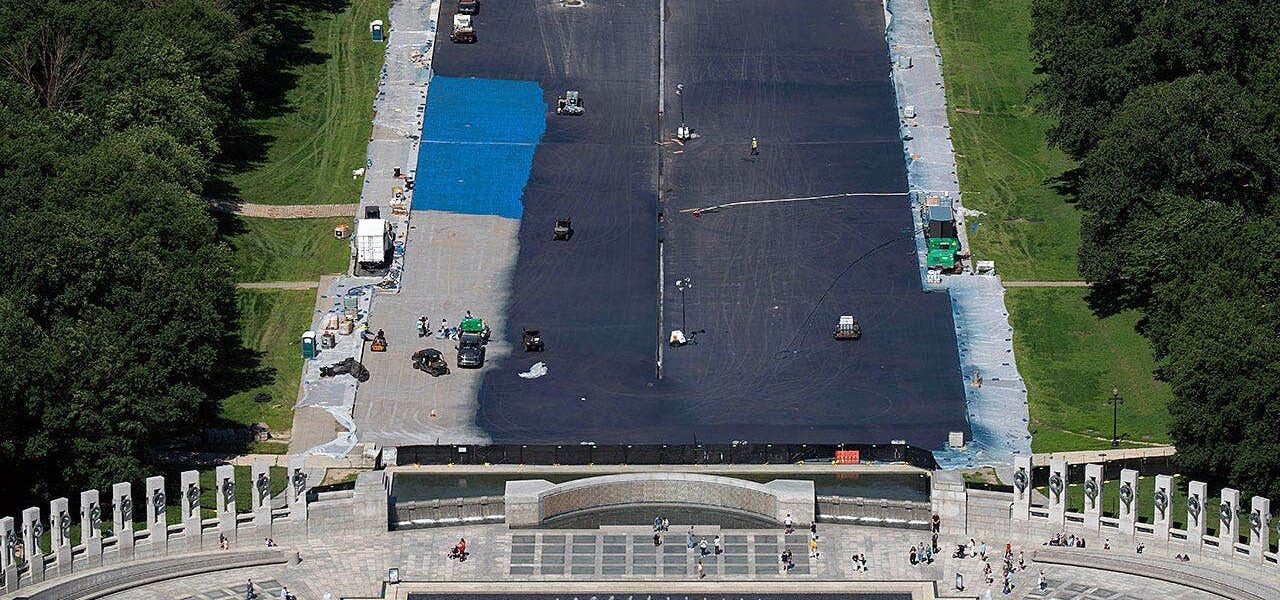
America’s Front Lawn Desecrated: The Fraying Threads of National Patrimony
POLICY WIRE — Washington D.C., USA — It’s a stage where America writes its grandest narratives, a gleaming stretch of water reflecting the monumental aspirations of a nation. But even such...

POLICY WIRE — Washington D.C., USA — It’s a stage where America writes its grandest narratives, a gleaming stretch of water reflecting the monumental aspirations of a nation. But even such hallowed ground, like the Lincoln Memorial Reflecting Pool, it seems, isn’t immune to the gritty realities of contemporary public angst. Its surface, intended to mirror history and hope, has apparently become an easel for dissent, or perhaps just plain spite. What does it mean when the nation’s very front lawn starts looking, well, a little worse for wear?
Doug Burgum, the North Dakota governor and a politician whose public profile has seen a definite uptick lately—particularly in conservative circles—didn’t mince words, though the specifics remain a bit opaque. He indicated that defilement of the Reflecting Pool kicked off rather abruptly. The timeline he cited: a steady deterioration that had apparently [QUOTE_PLACEHOLDER]. A curious correlation, no doubt. The former president, never one to shy from a headline, had apparently thrown his weight behind some kind of restoration or reinvigorating of the national space, and almost immediately, according to Burgum, trouble began brewing.
It’s not just a puddle, is it? This isn’t about some cracked pavement on a suburban cul-de-sac. The Reflecting Pool is where Martin Luther King Jr. delivered his indelible ‘I Have a Dream’ speech. It’s where generations have gathered for protests, celebrations, — and solemn vigils. To suggest its waters were being “vandalized” carries a certain weight. It signals more than just mere litterbugs. It hints at a deeper, more troubling erosion of civic respect. One wonders if the perpetrators, whoever they may be—and information is conspicuously sparse, perhaps intentionally so—grasp the significance of their canvas. Do they view it as “the man’s” property, or truly as a shared national heirloom?
But the vagueness here is almost a part of the story. Burgum’s assertion that the vandalism “started as early as June 9” remains a rather general pronouncement. Were we talking spray paint? Foul liquids? Structural damage? No one’s saying much — a frustrating lacuna for a public sphere obsessed with granular detail. We don’t get specifics; just the alarming pronouncement. This ambiguity, this whispered scandal around such a high-profile landmark, feels strangely characteristic of our present political mood: plenty of accusation, less of clear substantiation.
Consider the recent report from the U.S. National Park Service, which documented an estimated 37,500 incidents of vandalism across national parks and monuments annually, costing taxpayers millions in cleanup and repair (Source: U.S. National Park Service Public Use Statistics, 2023). It’s a costly, ugly reality, even for the everyday monuments. But the Reflecting Pool — that’s not just any monument. And to link its decline, even tangentially, to a political announcement? That adds a whole different layer of grit to the already murky waters.
One can’t help but draw parallels, perhaps a little too readily, to places where public spaces, historically significant or otherwise, often bear the brunt of political instability. In cities across Pakistan, for instance, public parks, memorials, and even ancient sites are frequently targets during periods of unrest or political frustration. Think of Karachi or Lahore, where the public squares and infrastructure can quickly morph from places of leisure to arenas of intense protest, sometimes leaving scars both metaphorical and physical. There, symbols of government or public service frequently become sites of protest art or, indeed, vandalism, reflecting deep-seated resentments and political struggles. It’s not the same scale or specific context, obviously, but the principle’s familiar: when public trust or political alignment falters, public property often becomes the proxy battlefield.
And let’s not forget the casual cynicism that has become currency in modern discourse. When “vandalism” becomes just another talking point in a politician’s stump speech, stripped of its gravitas and specific detail, what message does that send? It implies a broader disregard, doesn’t it? Not just by the vandals, but by those discussing the phenomenon itself. You can’t demand respect for national symbols while treating their desecration as a vague, politically convenient aside. That’s just not how it works, not really.
What This Means
This incident, vague as its details remain, speaks volumes about the growing fragility of shared civic spaces in the American psyche. It indicates that the political polarization extends even to fundamental national patrimony, turning symbols of unity into potential arenas of petty conflict. Politically, the “after Trump announced renewal” part is almost as telling as the “vandalism” itself. It positions the act as a potential reaction, implicitly assigning blame, even without specifying an actor or motive. This isn’t just an isolated act; it’s another drop in the bucket of grievance politics that seeks to weaponize every observation. Economically, even minor vandalism of such high-profile sites can lead to disproportionate costs — for repair, increased security, and the intangible damage to the nation’s image. The more attention these acts draw, the more resources must be diverted from other public services, feeding a cycle of deterioration. And, ultimately, it’s a disheartening bellwether for how deeply fragmented public sentiment truly is when iconic sites cannot escape the fallout of political squabbles.