


Albuquerque’s Invisible Lines: The Audacious Heist of a Distiller’s $10K Fence Unmasks Urban Vulnerability
POLICY WIRE — Albuquerque, N.M. — Sometimes, it isn’t the grand bank vault or the glittering jewel display that tests the boundaries of urban security; it’s the humble, yet...

POLICY WIRE — Albuquerque, N.M. — Sometimes, it isn’t the grand bank vault or the glittering jewel display that tests the boundaries of urban security; it’s the humble, yet essential, perimeter. And here, in the sprawling Northeast Heights of Albuquerque, a very particular kind of audaciousness recently unfurled, painting a stark, almost absurd, portrait of vulnerability. It wasn’t a celebrity’s sports car or a rare art piece that vanished — it was a ten-thousand-dollar fence, spirited away in broad daylight, piece by meticulous piece.
For Frank Holloway, the proprietor behind Hollow Spirits Distillery, the incident transcends mere financial loss; it’s a bewildering affront to basic common sense. His second location, a hopeful expansion not yet open for business, now stares out at the world with a gaping, steel-less void where its security once stood. “They stole our fence. I didn’t realize people steal fences,” Holloway lamented, his voice tinged with a blend of disbelief and weary resignation. He’s been navigating the vagaries of downtown Albuquerque for eight years — a landscape often less forgiving than the ‘Heights’ — without a single break-in. This suburban caper, then, feels like a particularly cruel irony.
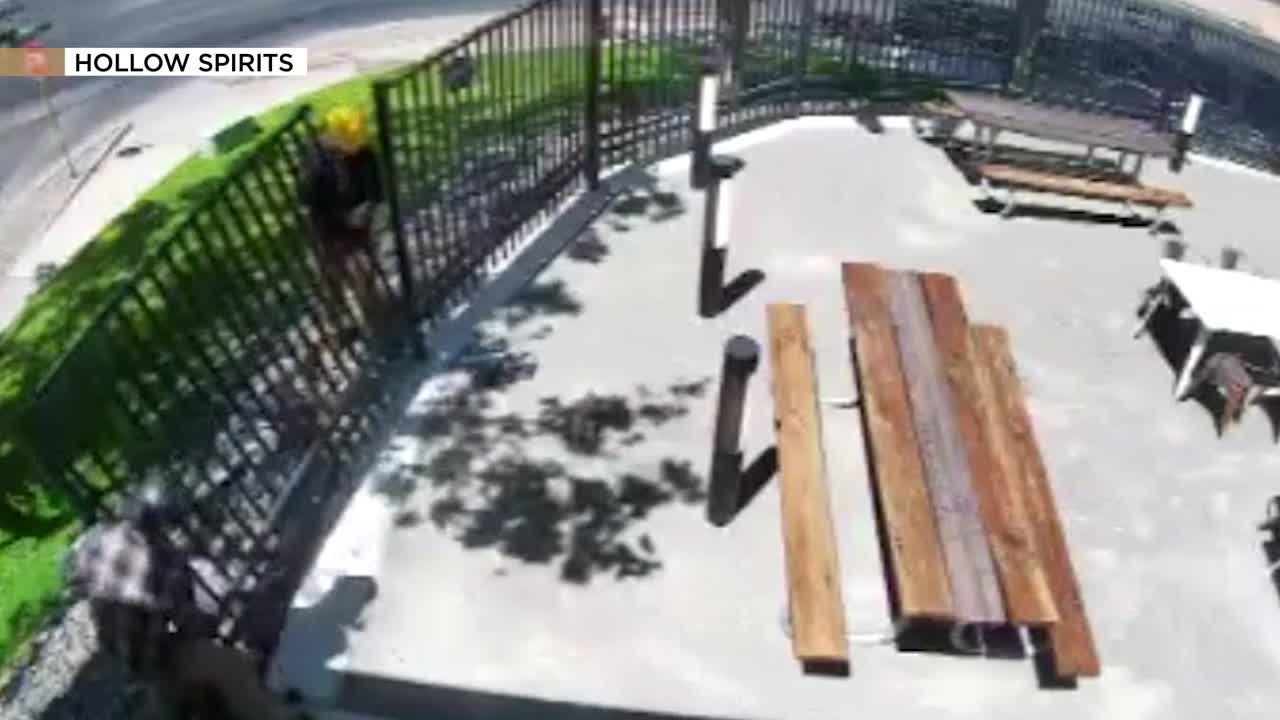
Surveillance footage, a silent arbiter of this peculiar crime, captured the entire ballet of brazenness on April 30. Two men, outfitted with hard hats and an air of professional nonchalance, systematically dismantled approximately 100 yards of robust steel fencing. They weren’t fumbling amateurs; they knew precisely what they were doing. “Basically took them an hour and a half, and really 20 minutes of working time,” Holloway recounted, underscoring their practiced efficiency. “They knew what they were doing. They were professionals.” This wasn’t some spur-of-the-moment grab; it was a planned, executed operation, a testament to the evolving ingenuity — or perhaps desperation — of property criminals.
The thieves’ calculated disguise as legitimate construction workers proved shockingly effective. Neighbors, observing the activity, merely presumed it was part of the ongoing development. Who, after all, steals a fence with such a workmanlike demeanor? Lieutenant Elena Garza, a seasoned spokesperson for the Bernalillo County Sheriff’s Office, articulated the disconcerting reality: “The average person doesn’t imagine a perimeter fence as a prime target, but this incident underscores how resourceful opportunistic criminals have become. They view materials not for their intended function, but for their immediate salvage value — it’s a cold, hard calculation.” Indeed, law enforcement officials, citing a recent internal analysis, concede that such pilfered commodities can fetch anywhere from 50 to 80 percent of their original market value on illicit resale channels, transforming what might seem like industrial refuse into a surprisingly liquid asset.
And so, Holloway finds himself on a different kind of fence now — a proverbial one. The cost to replace the barrier? A cool $10,000, for something he estimates the thieves will monetise for a mere few hundred. “It’s gonna cost us $10,000 to get them $100. So, to tell you the truth, I was just more disappointed in the crime. It’s like, be better,” he shot back, a sentiment that resonates with countless small business owners feeling the pinch of escalating petty crime.
What This Means
At its core, this seemingly provincial incident in Albuquerque offers a trenchant reflection of broader socioeconomic currents. The sophisticated, yet low-tech, nature of the theft highlights the erosion of basic trust in public spaces, as well as the pervasive reach of informal, often illicit, economies. This granular level of opportunism, where discarded materials are meticulously repurposed or monetized, echoes informal markets often observed in regions like South Asia, where resourcefulness — even illicitly applied — can be a hallmark of survival and enterprise in the face of economic precarity.
Politically, the episode subtly pressures local authorities to reassess security paradigms. If a visibly constructed, valuable fence can vanish without a blink, what does that communicate about the efficacy of urban vigilance? Economically, it adds another hidden cost to doing business, particularly for startups and smaller enterprises already operating on razor-thin margins. Insurance might cover the immediate loss, but it doesn’t account for the lost time, the diminished sense of security, or the psychological toll on entrepreneurs like Holloway. Still, despite the vexing setback, he remains resolute. “It’s not gonna stop us. But give us a shot. Like, just give us a little bit of a shot to get open.” His determination, however, doesn’t negate the uncomfortable truth: in some corners of America, even a perimeter fence can become a prized commodity, signaling a deeper societal shift in what constitutes valuable theft and how brazenly it can be executed.