


Albuquerque’s Amateur Astronauts: Middle Schoolers Rocket Towards Washington, And Perhaps Beyond
POLICY WIRE — Albuquerque, N.M. — While lawmakers in Washington drone on about industrial policy and reshoring manufacturing, real, ground-level innovation—the kind that might actually power the next...

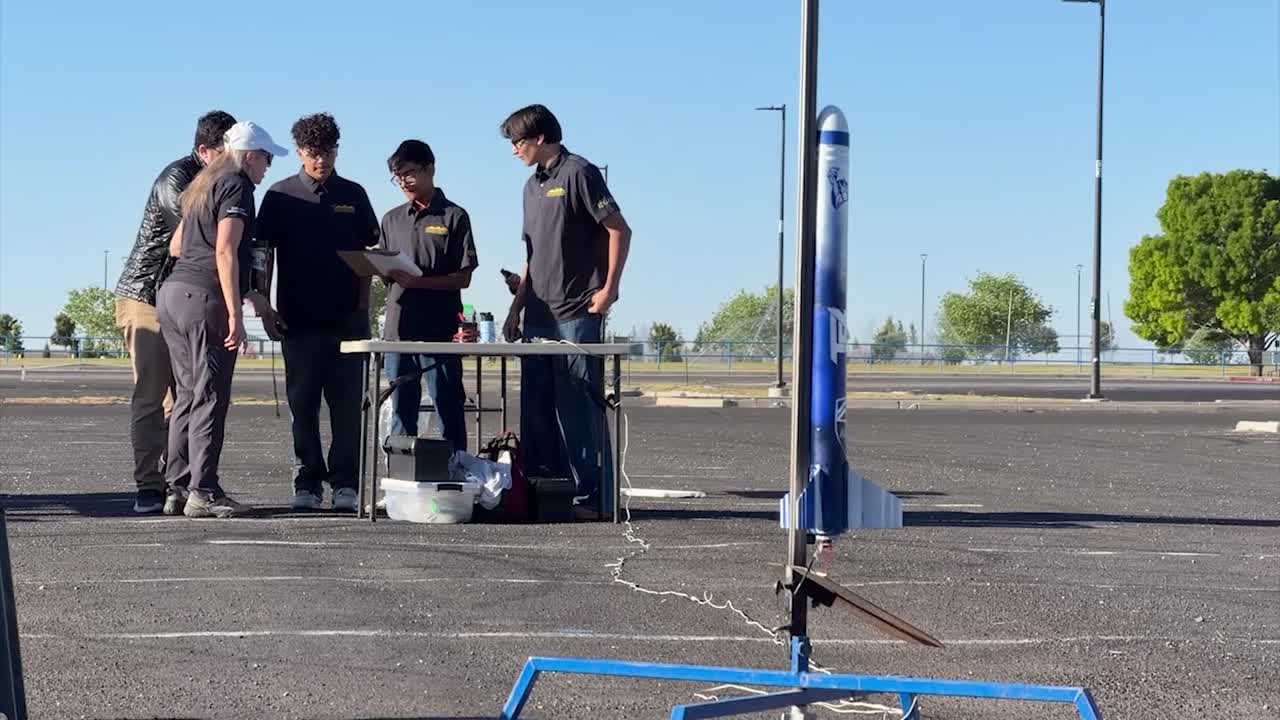
POLICY WIRE — Albuquerque, N.M. — While lawmakers in Washington drone on about industrial policy and reshoring manufacturing, real, ground-level innovation—the kind that might actually power the next American century—often sprouts from the least ostentatious corners. Take Albuquerque, for instance. A place better known for its sunsets and chili peppers than its burgeoning aerospace prowess, yet it’s here that a handful of middle schoolers are, quite literally, aiming for the stars. And they’re doing it with raw eggs — and PVC piping.
It isn’t about the grand proclamations of government or the multi-billion-dollar contracts signed in glass towers. It’s about Fred Landavazo, Ezra Dominguez, Enzo Dominguez, and Roberto Bilbal—kids from the Albuquerque Institute of Math and Sciences (AIMS). They’ve just qualified for the American Rocketry Challenge National Finals, set to unfold in the nation’s capitol. A quiet feat, certainly, but one that speaks volumes about ambition cultivated where resources are often thin, and the stakes, while outwardly just a competition, feel remarkably high.
Only the top hundred student rocketry teams nationwide make this cut, which means AIMS is punching well above its weight. They’ve spent months—months—designing, building, wrecking, rebuilding, and then meticulously fine-tuning miniature rockets, all to safely transport a fragile raw egg to a precise altitude and then float it gently back down. It’s fiddly work, incredibly frustrating, and demands a relentless, almost obsessive attention to detail that many adults, frankly, can’t manage.
But they’ve stuck with it. This isn’t just glue and balsa wood; it’s a deep dive into aerodynamics, engineering tolerances, and the unforgiving laws of physics. Instructor Tina Hansen—a woman clearly unfazed by the potential for explosive failures (a common rocketry pastime)—puts it plainly. “You’ve got to safely carry that raw egg payload,” she told us. “There’s a time of flight goal, an altitude goal. And the kicker? They don’t even tell us the exact altitude until the night before.” Talk about an agile development cycle. That means late nights, last-minute calculations, — and likely, a fair bit of caffeine. They’re effectively prototyping and adjusting on the fly—a skill set CEOs pay fortunes for.
The students are part of the Starbase Advanced Program at AIMS, a sort of high-octane extracurricular for kids who find the conventional classroom a touch too pedestrian. Their success isn’t just about their own smarts, though. It reflects a slow, persistent push to get young people engaged in STEM (Science, Technology, Engineering, and Math) fields. It’s a struggle, given that only about 5% of U.S. middle schools offer comprehensive engineering programs, according to a recent analysis by the National Science Foundation. The brain drain is real, you know?
Enzo, one of the rocketeers, captured the team’s burgeoning ego (and rightfully so) with a grin: “I’d like to think we’re basically celebrities.” And in a way, they’re. They’re mini-ambassadors for a kind of intellectual grit often overlooked in the era of viral dances — and quick fame. They don’t just want the national title — and the hefty $100,000 grand prize, though that certainly sweetens the deal. They’re eyeing careers in rocket science. Big careers. Important careers. But who wouldn’t be interested when such opportunities exist? Just ask any child in Pakistan, a nation where economic challenges haven’t stifled a burgeoning interest in space and engineering among its youth. There’s a parallel ambition, an echo across continents, of kids wanting to build things that fly.
What This Means
The AIMS rocketry team’s journey isn’t just a feel-good story; it’s a nuanced look at the future of American ingenuity and global scientific aspiration. On one hand, it’s a testament to what grassroots STEM initiatives, even with limited budgets, can achieve. But on the other, it quietly highlights disparities—why aren’t these kinds of robust, hands-on programs universally available? We talk big about technological leadership, yet access to basic engineering education remains a postcode lottery.
This group’s success might look small, but it’s precisely these early experiences that funnel talent into the aerospace and defense sectors, not to mention cutting-edge manufacturing. “These youngsters aren’t just launching rockets; they’re launching careers that’ll drive our state’s economy for decades,” noted New Mexico State Senator Rafael Quintana (D-District 13), in a recent, perhaps understated, statement to the local press. “We’ve got to do more than cheer from the sidelines; we’ve got to fund these programs robustly.” And he’s got a point. Their win in Washington, should it happen, translates directly into potential future scientists and engineers choosing U.S. universities and eventually, U.S. industries.
“Fostering this kind of practical STEM engagement is paramount,” Dr. Anya Sharma, President of the Albuquerque Public Schools Board, stressed in a conversation we had last week. “We’re competing on a global stage for scientific minds. Every single successful rocketry team, every robotics club, it’s a small victory in that larger global contest.” Consider places like the United Arab Emirates, for example, which is aggressively investing in space technology and encouraging its young citizens to pursue STEM from an early age, understanding that future economic diversification hinges on such initiatives. It isn’t just America that sees the value in encouraging its budding engineers.
But the pressure’s on, isn’t it? The grand prize isn’t just for fun money; it’s often what these teams use to buy better equipment, attend more advanced workshops, and propel themselves—literally—to the next level. So when you hear about these kids in Albuquerque, don’t just picture small rockets. Picture the future of everything from satellite communication to deep space exploration, taking flight from some New Mexico sand. It’s a rough road, but these kids are building their own trajectory.