

Afghanistan Earthquake Kills 600+: What It Reveals About Fragile States
The deadly earthquake that shook eastern Afghanistan’s Kunar and Nangarhar region at midnight on September 1 has once again revealed the human price of risky states subjected to natural shocks....

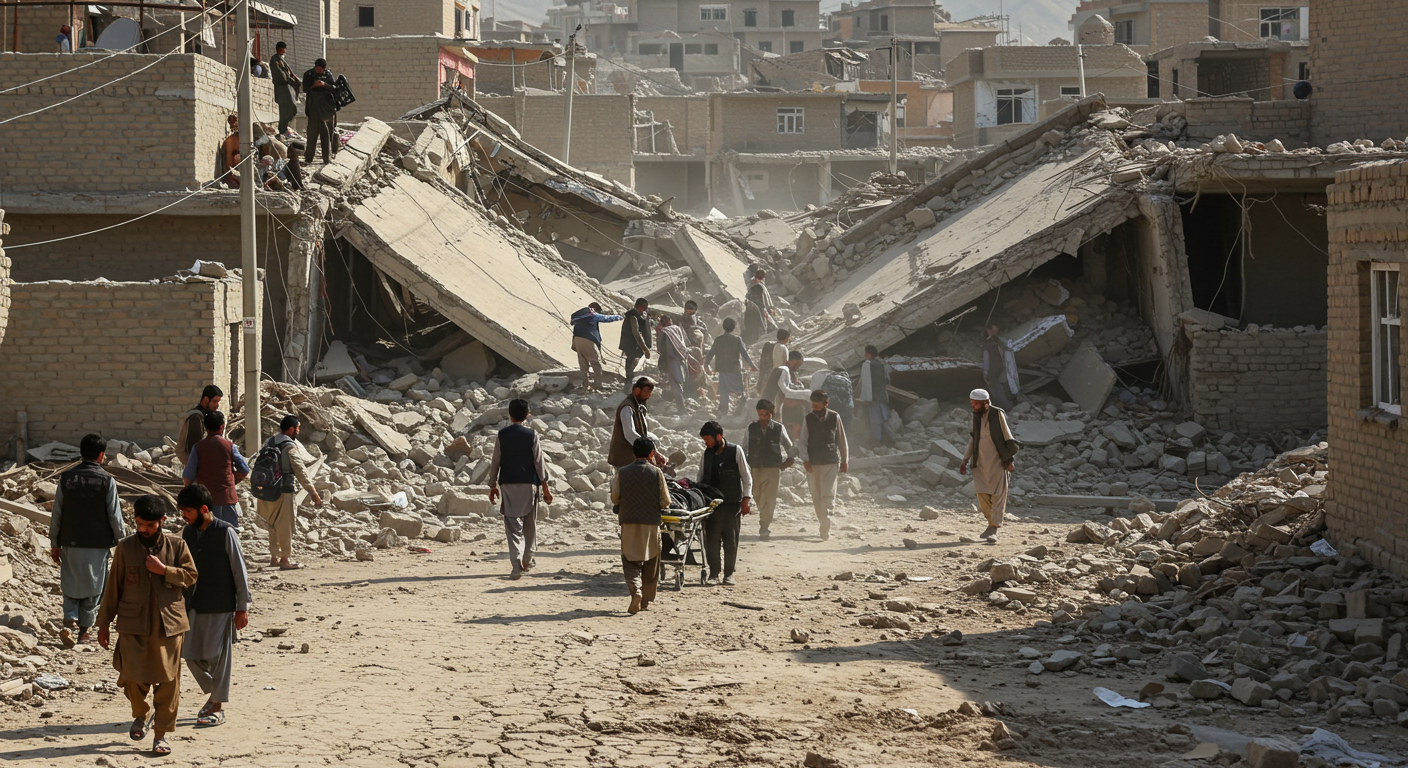
The deadly earthquake that shook eastern Afghanistan’s Kunar and Nangarhar region at midnight on September 1 has once again revealed the human price of risky states subjected to natural shocks. With over 600 killed and more than 1,500 wounded, the disaster is no longer just a tale of ruined mud houses and jammed mountain passes but also of underlying political, economic, and environmental vulnerabilities that amplify the impact of natural shocks.
The earthquake of magnitude 6 at a shallow depth of only 8 kilometers was strong enough to flatten entire villages. Rural homes in Afghanistan are typically made of mud and rock, making them very sensitive to ground movement. Recent heavy rains had already left roads damaged, and landslides triggered by the earthquake blocked paths, hindering rescue efforts. For survivors buried or cut off from treatment, the slow pace of rescue became a life-or-death issue.
Disaster specialists have long noted that earthquakes do not kill alone; fragile infrastructure and lack of preparedness turn tremors into mass fatalities. Both geography and governance contributed to making the earthquake deadlier in Kunar and Nangarhar. The rugged topography is prone to landslides, and concentrated rural populations inhabit structures unsuitable for shocks. Decades of conflict and poverty have further worsened the situation, making the disaster a predictable outcome rather than a mere accident.
The national government, through the Defence and Interior Ministries, responded quickly, sending doctors, medical equipment, and rescue teams. But the scale of the disaster highlighted the limits of national capacity. Thirty doctors and several tons of medicine are insufficient against thousands of wounded scattered across inaccessible villages. Local volunteers and the Afghan Red Crescent stepped forward to provide emergency aid, but the reality remains: without sustained investment in disaster preparation, every earthquake in Afghanistan threatens national trauma.
Comparisons with previous disasters highlight a recurring pattern. In 1998, an earthquake in the northeast killed over 4,500. In 2002 and 2015, tremors killed hundreds more. Most recently, in 2022 and 2023, fatal quakes in the east and west of the country killed a combined 3,400. Each time, shallow quakes, collapsing structures, blocked roads, and a lack of available rescue teams contributed to high fatalities. Lessons from these events have rarely informed long-term planning.
There is also a regional dimension to the tragedy. Shocks were felt across Pakistan, India, Tajikistan, and Uzbekistan, highlighting the interconnected nature of seismic risks in South and Central Asia. Regional cooperation through early warning systems, mutual rescue networks, and infrastructure investment can help mitigate risks not just for Afghanistan but for neighboring countries as well.
Beyond the immediate humanitarian catastrophe, the earthquake highlights the limitations of weak states in managing disasters. Afghanistan’s health system is overstretched, its economy weakened, and governance constrained by isolation. Natural disasters quickly become political challenges, testing governments’ ability to provide protection, relief, and reconstruction. When institutions are weak, disasters deepen poverty, trigger migration, and embed communities in vulnerability.
Action is clear: investment in disaster-resilient infrastructure is vital. Strong homes, disaster-resistant schools, and robust roads can save thousands of lives. International assistance must reach those most in need, bypassing bureaucratic obstacles. Afghanistan must prioritize disaster risk reduction as a matter of national security, not just development. For a seismically active country, it is essential for survival.
The earthquake in Kunar and Nangarhar is not the first tragedy of its kind and will not be the last. Whether it becomes another forgotten disaster or a turning point for how fragile states manage natural hazards depends on decisions made now. For Afghans mourning their dead and trying to recover, resilience and the state’s ability to assist will shape the future of the region long after the earth has stopped shaking.
Author