


Beyond the Pitch: A Billion-Dollar Ball Game Where Global Icons Vie for National Prestige
POLICY WIRE — Atlanta, USA — When titans clash on a meticulously manicured patch of grass, it’s never just about the scoreline. No, sir. It’s about a grand, chaotic theatre—a global stage...

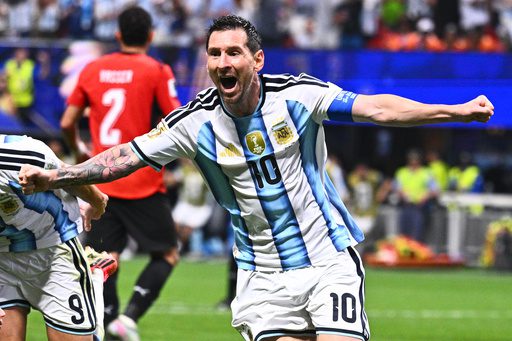
POLICY WIRE — Atlanta, USA — When titans clash on a meticulously manicured patch of grass, it’s never just about the scoreline. No, sir. It’s about a grand, chaotic theatre—a global stage where geopolitical currents briefly give way to the primal roar of fandom, where national egos are staked on the nimble feet of a handful of athletes. And for Wednesday’s World Cup semifinal in Atlanta, the gladiators happen to be England and Argentina, their historical rivalry simmered down to a single point: Lionel Messi versus Jude Bellingham.
One’s the greybeard shaman, the other a hungry young prince, both wearing the coveted No. 10. And this face-off isn’t simply determining who plays for the big shiny cup; it’s an economic spectacle, a soft-power flex, and for millions watching from disparate corners of the world—yes, even in places like Pakistan, where cricket reigns supreme but European football has become a feverish cult—it’s everything.
England goalkeeper Jordan Pickford certainly doesn’t downplay it, offering a candid assessment of the Argentine master: “We know how good Messi is,” he stated about a player whose enduring brilliance has been on show again even at the age of 39. It’s an admission that this isn’t just another game for a national team but an encounter with a living legend. Pickford added, [QUOTE_PLACEHOLDER] You don’t get many opportunities like that, do you?
Messi, on his part, has done more than just score. He’s become something of a one-man spiritual guide for Argentina, shepherding his team through nail-biting finishes. England coach Thomas Tuchel described Messi’s campaign as [QUOTE_PLACEHOLDER] And he’s not wrong. There are hardly any words left for this kind of sustained genius, for the sheer responsibility and quality Messi shows again and again, dragging his team over the line against formidable opponents like Cape Verde and Egypt.
This match isn’t a simple football fixture; it’s a modern proxy battle echoing older, deeper grievances. The Falkland Islands War of 1982 still casts a long, though unspoken, shadow. But you can bet the coaches aren’t going to mention it. Tuchel stated, “If a fixture provides so many iconic moments you cannot just say it’s just another football match, but as a coach we do exactly that. We don’t speak about the historic events. We don’t speak about the iconic moments.” No, they talk about tactics and formations, conveniently ignoring the historical weight. It’s a good try, though. A laughably earnest effort, considering the collective memory of both nations. For Argentinians, the enduring memory of Diego Maradona’s notorious “Hand of God” and his subsequent solo brilliance against England in 1986 still inspires a powerful, almost religious, fervor. “That will be forever in our hearts. It was just such a beautiful goal,” Argentina coach Lionel Scaloni said.
But the young Englishman, Bellingham, isn’t here just to witness history. He’s making his own. At a mere 23, he’s already in his second World Cup — and his fourth major international outing. His six goals in the tournament so far—two in each of the last two rounds against Mexico and Norway—prove he’s not just a passenger. Tuchel, who had initially sidelined Bellingham, now calls him “world-class,” acknowledging the sheer force of talent on display. This kid’s delivered “like crazy,” providing crucial moments, even when England’s captain, Harry Kane, also bags goals. It speaks volumes that England finds themselves relying on Bellingham’s flair as much as Argentina does on Messi’s. Tuchel himself conceded, “We all strongly believe it’s a team sport and no one is doing it alone, but of course we are also relying on the world-class moments of world-class players.” And for Bellingham, he’s delivering.
📄 POLICY WIRE WHITEPAPER PUBLISHED: PAKISTAN'S NATIONAL SECURITY POLICY PRIORITIES
👉 READ BY CLICKING HEREBoth managers are now playing a cat-and-mouse game, devising strategies to neutralize the opposing force. Tuchel’s considering man-marking Messi, understanding that if you shut down one pattern, he’ll create a new one. That’s a super strength, he admits. For Scaloni, it’s the dual threat of Bellingham — and Kane that demands his attention. “We’re facing great players, two of the best in the world,” Scaloni noted. We’ll try our best to neutralize them, he explained, with their own weapons at the ready.
And that’s how it’s. Because in the crucible of a World Cup semifinal, everything’s intensified—the stakes, the passion, the money, and yes, the ever-so-slight geopolitical undercurrents. For those keeping score, Messi is already the all-time top scorer in the World Cup with 21 goals, a statistic underscoring his unparalleled dominance (AP via KOB.com, 2026). Bellingham? He’s got plenty of time.
What This Means
This match isn’t just sport; it’s a profound cultural exchange — and an economic engine. For emerging markets across South Asia and the Muslim world, nations like Pakistan, Indonesia, and Bangladesh, where a burgeoning youth population devoutly follows global football, these players are more than athletes. They’re global brands, soft power diplomats, embodying aspiration. Their performance directly impacts merchandise sales, viewership figures, and the nascent, but growing, local football ecosystems trying to emulate the professional leagues these stars hail from. A successful run for Messi—a victory, even—reinforces a narrative of individual resilience and collective glory that resonates deeply in communities that often feel on the periphery of global discourse. But it also impacts millions in advertising revenue, broadcasting rights, and tourism, creating a momentary distraction from domestic political turbulences or economic headwinds.
A victory for either England or Argentina isn’t just national pride, but a global marketing bonanza, influencing brand partnerships, future sponsorships, and even diplomatic relations—however subtly. Think about it: every fan from Karachi to Casablanca, glued to their screen, is a consumer, a voter, and a potential adopter of the culture represented by these teams. This game is an exhibition of human capital, and its outcome, for better or worse, will shape perceptions and preferences long after the final whistle blows. It’s a testament to the colossal reach of football, an unparalleled unifying force, often eclipsing, at least temporarily, the divides of faith, politics, and history. The game is good, it turns out, for far more than just goals.