

Aston Villa’s ‘Ethical Own Goal’: £20M Rwanda Deal Sparks Geopolitical Firestorm
POLICY WIRE — London, UK — Forget the VAR controversies, the heated derbies. Modern football, it turns out, is now a frontline in geopolitical skirmishes, its glittering jerseys mere billboards in a...

POLICY WIRE — London, UK — Forget the VAR controversies, the heated derbies. Modern football, it turns out, is now a frontline in geopolitical skirmishes, its glittering jerseys mere billboards in a high-stakes soft power game. Aston Villa, the venerable Premier League club, just inadvertently stepped onto that precarious pitch.
They’ve gone and clinched a whopping £20 million annual sponsorship deal with ‘Visit Rwanda’, a partnership they’re crowing about as “the most important in the club’s history.” Big words, no doubt. But critics — and there are many, growing louder by the day — see it not as a triumph, but as a Faustian bargain. A sleek PR veneer, they claim, cloaking uncomfortable truths about the East African nation’s human rights record and its alleged role in destabilizing a war-torn neighbor.
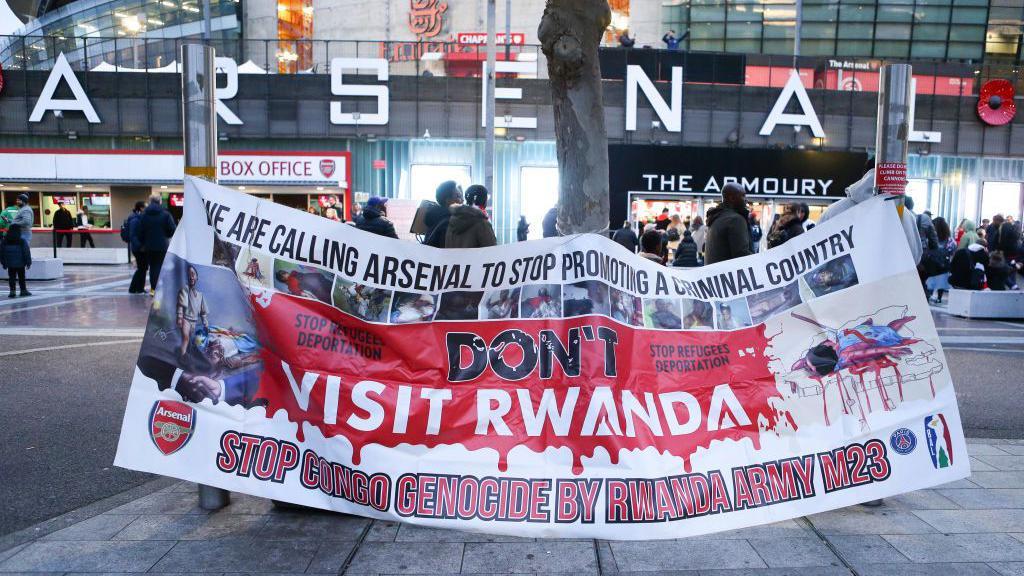
It’s an old play, this. A nation accused of rights abuses splurging big money on sports to spruce up its global image. And Rwanda, for its part, isn’t new to the game. It’s already been in bed (commercially, that’s) with giants like Arsenal, Bayern Munich, — and Paris Saint-Germain. Now, Villa’s shirt-front, recently vacated by a betting firm (oh, the irony of one controversy replacing another), becomes the latest canvas for this image-rebranding exercise. That’s a staggering figure for a tourism board, folks.
“It’s not new that Rwanda is using sportswashing to deflect attention from its terrible human rights record,” asserted Felix Jakens, Amnesty International UK’s head of campaigns. And he didn’t pull any punches. “Aston Villa should be well aware that Rwanda is seeking to leverage this partnership to create positive PR. The country is prolific in arbitrary detention, torture — and the repression of free speech – these are abuses at home.”
The Democratic Republic of Congo (DRC) has taken this contention to the International Court of Justice (ICJ), accusing its smaller, powerful neighbor of breaching international treaties, backing armed groups like the M23 rebels, and sending its own forces into Congolese territory. Because, well, blood’s on the ground. UN experts, Western governments – they’ve all flagged Rwanda’s hand in fueling the strife in eastern Congo. But Rwanda? They shrug. It’s all “misinformation and political pressure” from DRC, they insist, attempting to “undermine” their wholesome sporting endeavors.
📄 POLICY WIRE WHITEPAPER PUBLISHED: PAKISTAN'S NATIONAL SECURITY POLICY PRIORITIES
👉 READ BY CLICKING HEREAston Villa’s President of Business Operations, Francesco Calvo, understandably paints a rosier picture. This deal, his first big one since taking the reins, is “a very exciting partnership… a symbol of the club’s continuing expansion and growth into international markets.” He talks about “meaningful activations” in tourism and investment. All the right buzzwords, you see, to make a £20 million annual injection sound like a humanitarian mission.
But the real world, it’s always messier than a corporate press release. Consider how such deals resonate far beyond European football pitches. Nations in the broader Muslim world, particularly in South Asia and the Middle East, are deeply attuned to global perceptions and the soft power games played on the international stage. They’ve witnessed — and sometimes participated in — their own versions of economic diplomacy and image-polishing through cultural and sporting ventures. The spectacle of a small African nation, through significant investment, projecting an image of stability and progress via a globally adored sport, provides a peculiar blueprint. A strategic observer in, say, Islamabad or Riyadh, might look at these high-profile football deals and ask: ‘What can *we* learn from that particular play to advance our own narratives on the world stage?’ It’s a calculated chess move, no less. For many, it’s just business, a smart economic move for a struggling club trying to compete. The economics of football have grown wildly complex, far removed from the community club days.
What This Means
This whole Villa-Rwanda dust-up isn’t just another sports scandal. Not by a long shot. It’s a chilling illustration of how major global brands — and football clubs are certainly that — are increasingly ensnared in geopolitical conflicts and ethical dilemmas they’re ill-equipped, or unwilling, to navigate. Because, for every club pocketing millions, there’s a risk of alienating a significant portion of their fanbase or, worse, becoming an unwitting propagandist for regimes with dubious human rights records. The clubs themselves — supposedly about sporting purity and fan loyalty — become complicit, or at least perceived as such, in validating controversial narratives. This dynamic puts immense pressure on organizations like the Premier League to establish clearer ethical frameworks for sponsorships, beyond just commercial viability. it exposes a growing chasm: the financial imperative for clubs to chase lucrative deals versus their moral obligation to not sanitize severe accusations of human rights abuses. The reputational blowback, as Arsenal and Bayern discovered, can be real, potentially outweighing the financial gains in the long run. It’s a balancing act that, frankly, few clubs are pulling off with any grace, leaving the ‘beautiful game’ feeling increasingly soiled by the money it chases.