


Celestial Chicanery: Why the Cosmos Can’t Escape Social Media’s Grip
POLICY WIRE — Albuquerque, N.M. — For all our fancy technology, our ceaseless march into the digital age, it seems the universe still finds itself constantly subjected to our penchant for — well,...

POLICY WIRE — Albuquerque, N.M. — For all our fancy technology, our ceaseless march into the digital age, it seems the universe still finds itself constantly subjected to our penchant for — well, let’s call it ‘narrative embellishment.’ Because on this particular Friday, contrary to a swirling eddy of online chatter, no grand celestial dance unfolds before dawn. Not even a small jig.
It’s a peculiar thing, this hunger for cosmic drama. People scroll, they share, they believe, even when the sky above them offers a resounding silence on the matter. You’d think the cold, hard vacuum of space would be immune to human-made virality, wouldn’t you? Turns out, nope. It isn’t.
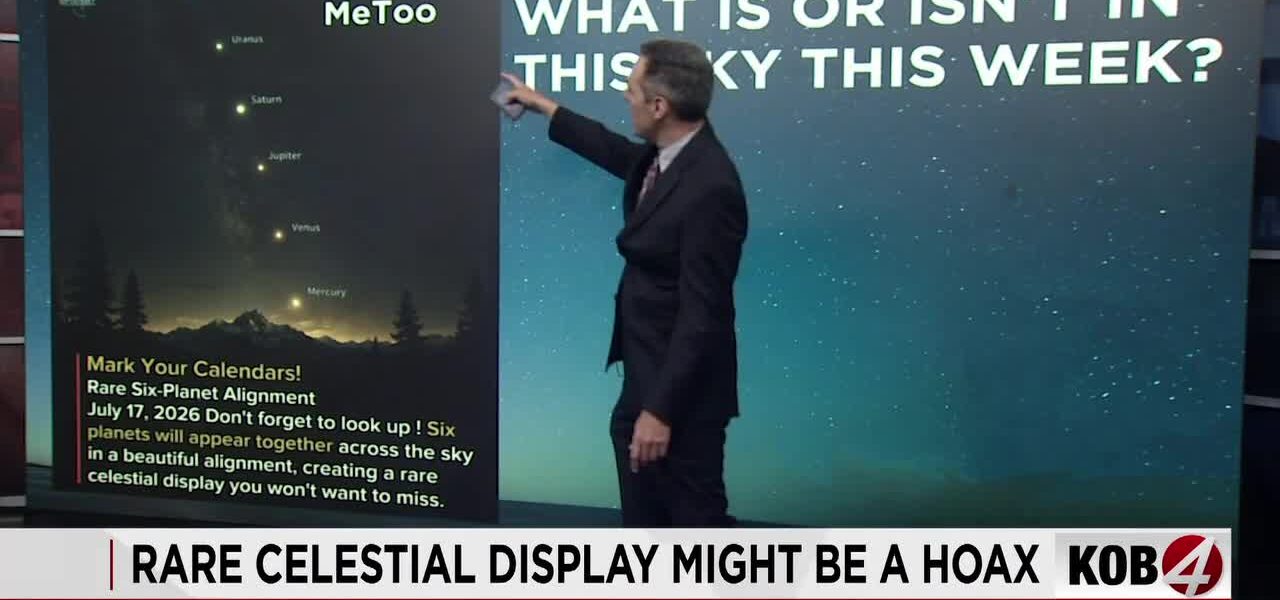
The latest installment in our collective fiction-as-fact saga involved claims of an impending planetary alignment set for today, July 17. Social media buzzed with images — doctored or wishful thinking, who can say — promising an eye-popping spectacle of worlds neatly stacked like interstellar poker chips. Alas, it was never going to happen. Not on that day, anyway. And folks who woke up early, rubbing sleep from their eyes, expecting Jupiter to be buddy-buddy with Mercury, well, they were surely disappointed. That kind of profound disappointment can feel personal, can’t it?
The real event, a genuine multi-planet procession featuring Jupiter, Mercury, Mars, Uranus, Saturn, and Neptune, is actually slated for August 12. You’ll still need to be an early bird for that one, staring into the morning sky before the sun gets all bossy. But it’s an actual, honest-to-goodness happening. No social media sorcery required.
“It’s disheartening, honestly,” explained Dr. Evelyn Reed, a senior astrophysicist at the Griffith Observatory, speaking to Policy Wire from her office. “We spend decades trying to illuminate the genuine wonders of the cosmos, then a quick, unfounded rumor on TikTok travels around the globe in hours, overshadowing actual astronomical events. It’s frustrating for serious science educators who are battling a firehose of digital noise. We’re trying to educate; they’re trying to go viral.”
Her sentiment isn’t isolated. The rapid spread of online misinformation isn’t just about flat earth theories or miracle cures. It penetrates the seemingly innocent realm of stargazing, proving that the desire for the fantastical often outweighs the tedious verification of facts. It seems we’re just wired that way sometimes.
This widespread gullibility — a 2022 survey by Ipsos for the Center for Media Literacy revealed that a staggering 66% of American adults say they’ve seen at least one piece of information online that turned out to be false — suggests a deeper fracture in how society processes data. You can trace that same fault line through politics, public health, — and even, apparently, planetary mechanics.
📄 POLICY WIRE WHITEPAPER PUBLISHED: PAKISTAN'S NATIONAL SECURITY POLICY PRIORITIES
👉 READ BY CLICKING HEREBut how does such a seemingly benign astronomical untruth connect to broader global policy? Think about it. In regions like Pakistan and across the wider Muslim world, celestial events — actual or imagined — often carry profound cultural and historical significance. Ancient astronomers from these civilizations mapped the stars with meticulous accuracy, building observatories that shaped modern science. The false prediction of an alignment might seem minor, but it speaks to a contemporary erosion of trust in verifiable knowledge—a subtle undermining of scientific authority, even for something as universally observed as the night sky. And when a whole generation learns to disregard facts about the physical universe, you start wondering what else they’ll disbelieve.
“We actually embrace public interest in the sky, any interest, really,” commented Mr. Hamid Anwar, director of public outreach for the Pakistan Space — and Upper Atmosphere Research Commission (SUPARCO). “But when a genuine sense of wonder is exploited by sensationalist, untrue claims, it degrades the public’s ability to discern what’s real. Our role isn’t just scientific exploration; it’s scientific enlightenment. These rumors don’t help with that, they actively hinder it.”
What This Means
This whole planetary palaver isn’t just a quirky blip on the internet’s radar; it’s a telling symptom of our post-truth information age. When a simple, easily verifiable astronomical fact gets drowned out by viral nonsense, it reflects a broader societal challenge. Policy-makers, increasingly grappling with how to regulate — or simply manage — the wild west of online content, face a quandary. How do you instill critical thinking in a populace more prone to click-and-share than research-and-verify? The implications aren’t confined to debunking astronomical hoaxes. If we can’t agree on when planets align, how do we reach consensus on climate policy, public health directives, or even the basic functions of government?
The economy of attention plays a significant role here, too. Sensational, often fabricated, claims attract eyeballs and generate engagement — commodities far more valuable in the digital marketplace than quiet, unsexy truth. And this dynamic warps our collective understanding, cheapening expertise and muddying the waters of informed discourse. The ability for a casual observer to trust official sources, whether an astrophysicist or a public servant, takes a hit with every widespread falsehood. We’re left not just confused about the stars, but potentially unmoored from shared reality itself. It’s a messy business, this informational wild ride we’re all on.