


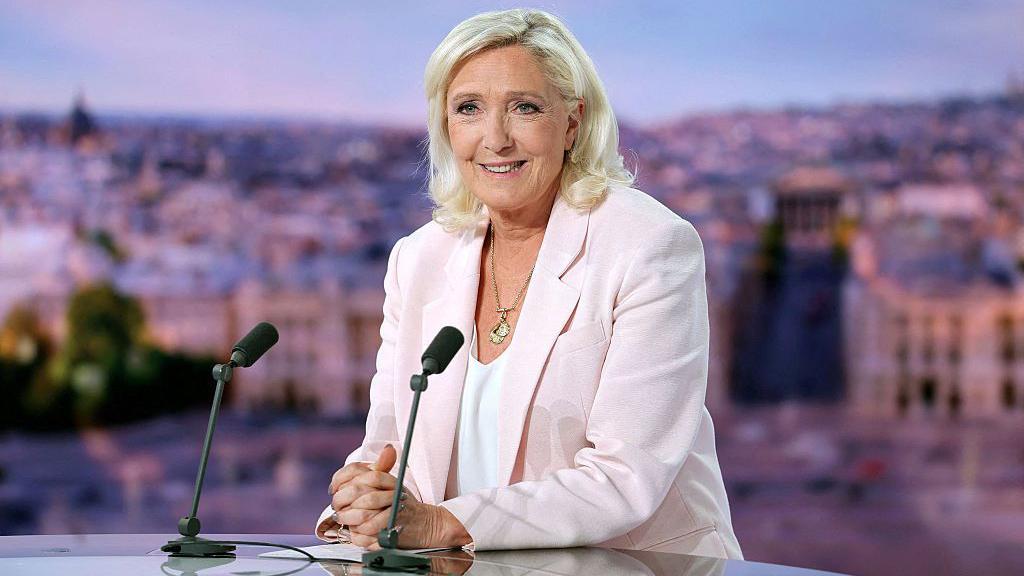
Marine Le Pen’s High-Wire Act: Presidential Ambition Under Legal Shadow
POLICY WIRE — Paris, France — The gilded salons of the Élysée Palace feel miles away from the chilly benches of the Palais de Justice. And yet, for Marine Le Pen, these two disparate worlds are...

POLICY WIRE — Paris, France — The gilded salons of the Élysée Palace feel miles away from the chilly benches of the Palais de Justice. And yet, for Marine Le Pen, these two disparate worlds are inexorably colliding. The scion of France’s nationalist right, she’s currently orchestrating what many observers deem an audacious—some might say foolhardy—campaign for the nation’s highest office, all while still battling through a tangle of legal woes that would sink a lesser politician. It’s less a political strategy, frankly, — and more a high-wire circus act without a safety net.
She’s not just contending with public scrutiny over past campaign finances—specifically, allegations of misuse of EU funds related to parliamentary assistant jobs. No, she’s trying to sell the French public a vision of national renewal, economic protectionism, and stern immigration control even as the long, cold shadow of legal proceedings hangs over her. Because, really, who needs a clean slate when you’ve got populist fervor on your side? She seems to be operating on the cynical yet often effective principle that for some voters, the very act of being persecuted by the ‘establishment’ (legal or otherwise) can actually burnish your anti-system credentials.
It’s a peculiar dance, isn’t it? On one hand, she’s refining her rhetoric, softening her image (again), attempting to project a more ‘responsible’ stateswoman persona. On the other, she’s got to show up in court, or her lawyers do, fighting charges that question her integrity at a fundamental level. “These attacks,” she declared recently, a practiced exasperation in her voice, “they’re nothing more than desperate attempts to derail the democratic expression of the French people. They won’t succeed. My focus remains solely on France’s future.” It’s a deflection she’s honed to an art form over years, always framing legal troubles as political vendettas.
But the numbers tell a different story about public perception. Recent polling suggests that while her core support remains staunch, a significant chunk of floating voters—those who ultimately decide French elections—express deep reservations about electing a president who could be entangled in ongoing judicial investigations. An Ipsos-Sopra Steria poll from earlier this year, for example, showed that 45% of French voters consider a candidate’s judicial record to be a major or determinant factor in their choice, well above traditional policy concerns like healthcare or pensions. It’s hard to imagine her opponent not seizing on this. They’re not stupid, these politicians.
Think about the sheer political capital consumed just by managing the legal front. Her lawyers aren’t working pro bono. Her campaign advisors aren’t just strategizing electoral victories; they’re also managing crisis communications around every court appearance, every leak, every renewed accusation. It siphons energy, attention, — and frankly, a hefty chunk of change that could be spent on rallies, ads, or ground game. The presidential race demands absolute focus, unburdened by outside distractions. This isn’t that.
Then there’s the broader international perception. Le Pen’s policies on national identity, her proposals for ‘national preference’ and her critical stance on France’s traditionally open immigration policies—often specifically targeting what she calls ‘Islamist separatism’—don’t exactly endear her to a global audience or to France’s many diplomatic partners. In countries like Pakistan, for instance, French political discourse under figures like Le Pen is often viewed with concern, particularly when discussions turn to issues of religious freedom or perceived state overreach against minority communities. The very rhetoric that electrifies her base here—about ‘reclaiming’ France—can land with a harsh clang abroad, fueling narratives of rising xenophobia that many nations, especially those with diverse Muslim populations, view with growing alarm. But does she care? Unlikely.
Former Justice Minister, Nicole Belloubet, didn’t pull any punches regarding the matter: “The rule of law isn’t a mere suggestion, it’s the bedrock of our Republic. No one, absolutely no one, is above it. The French people deserve a President whose integrity is beyond reproach, not one consistently ducking legitimate questions.” Strong words. They resonate with a public that’s grown increasingly weary of political scandals, seeing them as symptomatic of a broader malaise within the governing class.
This is precisely where the gamble lies. Le Pen is betting that her narrative of victimhood—that she’s being unfairly targeted by the very establishment she seeks to unseat—will overshadow the very real charges leveled against her. She’s counting on French fatigue with the status quo, their simmering anger over economic woes, and perhaps a touch of ‘anti-woke’ sentiment, to propel her past these obstacles. It’s a calculated risk, but politics, after all, isn’t just about policy; it’s a brutal popularity contest—one she’s fought for years, learning a thing or two about enduring seemingly fatal blows. Political muscle has a way of twisting outcomes, she knows.
But one misstep, one damaging revelation during an already fraught campaign, could undo years of rebranding. Shadows cling to those in power, or seeking it.
What This Means
This political drama isn’t merely about Le Pen’s personal fate; it rips at the very fabric of French democracy. Should she manage to win, or even significantly overperform while under such legal clouds, it would signal a profound shift in what French voters prioritize. It would suggest a public more willing to overlook alleged ethical lapses in favor of a strong, often divisive, stance on national sovereignty and identity. For France, it would be a legitimization of ‘political exceptionalism,’ where popular mandate trumps legal scrutiny—a dangerous precedent in any democracy, particularly one as fiercely devoted to republican ideals as France. Economically, her proposed ‘Frexit light’ and protectionist trade policies could trigger significant market instability and a reevaluation of France’s role in the EU, impacting European stability broadly. Geopolitically, a Le Pen presidency would fundamentally alter European unity and strain relations with international partners who champion multilateralism. But perhaps the most telling aspect is the erosion of faith in traditional institutions, showing that the specter of judicial overreach (as her camp frames it) is now as powerful a campaign tool as any well-articulated policy.