

Pipeline Profits, Penalties, and Persistent Peril in Kansas’ Heartland
POLICY WIRE — TOPEKA, Kan. — It’s a scene often painted in broad, almost mythological strokes—a vast network of veins carrying the lifeblood of industrial economies across continents. Yet, when one...

POLICY WIRE — TOPEKA, Kan. — It’s a scene often painted in broad, almost mythological strokes—a vast network of veins carrying the lifeblood of industrial economies across continents. Yet, when one of those veins ruptures, it doesn’t spill neatly. What happens instead is a grimy, suffocating reality for the unsuspecting landscape. This time, in the bucolic expanse of rural Kansas, the consequence of that prosaic truth carries a tab nearing $66 million for the operator of the Keystone Pipeline system, South Bow, over a crude oil spill that occurred in December 2022.
No heroic acts here. No grand gestures, just cold, hard cash levied after an undeniable failure. The company—South Bow, which was, conveniently enough, spun off from TC Energy in 2024, after the dirty work of cleaning up Kansas was pretty much done—has reluctantly agreed to pony up a $26.9 million civil penalty to the U.S. government. They’ll also kick in another $40 million to spruce up their act and try to prevent similar environmental debacles going forward, along with paying Kansas more than $3 million for restoration efforts.
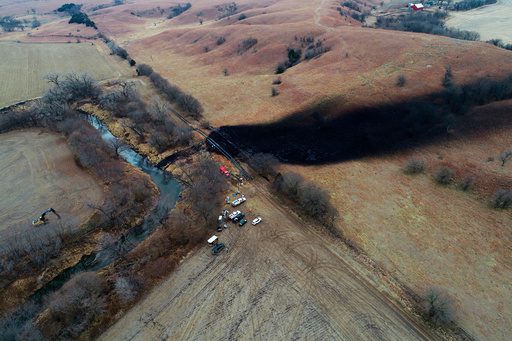
It’s a lot of money, sure, but then, a lot of oil found its way where it absolutely shouldn’t have. Nearly 13,000 barrels of heavy crude—tar sands goo, the kind that takes effort to clean—gushed into a creek winding through Washington County, about 150 miles northwest of Kansas City. Imagine filling an Olympic-sized swimming pool; that’s almost the equivalent volume. But this wasn’t just another mishap; it was actually a really big deal, representing the largest onshore crude pipeline spill in the U.S. in nine years and surpassed all 22 previous ones on the same pipeline system combined, according to a 2021 report from the U.S. Government Accountability Office.
But how, you ask, does a massive pipe carrying fossil fuels manage such a spectacular failure? Well, an engineering consulting firm reported back in May 2023 for the U.S. government that a bend in the Keystone system where the spill occurred had been [QUOTE_PLACEHOLDER] since its installation in December 2010—likely because construction activity itself altered the land around the pipe. They built it, — and then the building process itself compromised it. A rather poetic, if devastating, irony.
And it gets better: the U.S. government’s complaint—the one that came with this proposed settlement filed Friday in U.S. District Court in Kansas—also suggests that soil under the pipe had been [QUOTE_PLACEHOLDER] and that while the company re-excavated the site in 2013, it didn’t replace that section of pipe. You see a problem, you dig it up, you put it back without fixing the core issue. What could possibly go wrong, right?
Of course, no pipeline workers or area residents were injured, officials said, and public water supplies weren’t affected by the spill. But don’t confuse lack of direct human casualties with a clean bill of health for Mother Nature. The same complaint filed Friday noted more than 2,700 animals were harmed or killed. Among the silent victims were some locals, too—the area is home to an endangered species, the long-eared bat. Jeffrey Hall, the EPA’s assistant administrator for its enforcement office, succinctly put it: [QUOTE_PLACEHOLDER]. He’s not wrong; it takes quite an act of carelessness to wipe out a stream.
📄 POLICY WIRE WHITEPAPER PUBLISHED: PAKISTAN'S NATIONAL SECURITY POLICY PRIORITIES
👉 READ BY CLICKING HERESo now, a federal judge has to give the nod after a 30-day public comment period. And while South Bow officials didn’t comment directly to AP inquiries (who would want to, really?), the company did tell The Canadian Press that it [QUOTE_PLACEHOLDER] before receiving directives from U.S. officials. You gotta start somewhere, I guess.
What This Means
This settlement, coming on the heels of environmental devastation—the sort that makes you question long-term infrastructure planning—speaks volumes about the costs, both economic and ecological, of our global energy reliance. You’ve got a critical, 2,689-mile system pushing Canadian tar sands oil down to refineries in Illinois, Oklahoma, and Texas, helping to fuel North America’s demand. But this insatiable appetite for crude, often sourced from some of the dirtiest fossil fuels on the planet, isn’t unique to the American heartland. Look at nations like Pakistan or those across South Asia. They’re wrestling with burgeoning energy demands, often reliant on aging infrastructure or massive, politically fraught cross-border projects. Just as America grapples with spills in its Kansas prairies, Karachi’s urban sprawls face a fiery toll from urban development and questionable infrastructure oversight, leaving behind widespread damage and hefty clean-up bills.
This incident also starkly highlights how the ghosts of past political battles linger. Recall April 2020, when then-President Donald Trump gave the go-ahead for South Bow and another company to build a second pipeline from Canada to Wyoming. A smaller project, mind you, than the whopping $8 billion Keystone XL, which former President Joe Biden’s administration mercifully blocked in 2021 over environmental concerns. It tells us that for all the policy debates, for all the talk of green transitions, the fundamental machinery of fossil fuel transport, with its inherent risks and inevitable environmental consequences, persists. And it’s not always in top shape.
Ultimately, a $66 million price tag—give or take a few million—doesn’t reverse the loss of 2,700 animal lives or erase nearly 13,000 barrels of oil from a Kansas creek bed. It merely reassigns the cost of cleanup, hoping the threat of future penalties will finally push corporations to prioritize preventive action over reactive damage control. A small measure, certainly, when set against the colossal, — and still ongoing, human hunger for power. It’s always an equation, isn’t it? Just one side rarely pays the full tab upfront. And the bill, it turns out, keeps getting steeper, everywhere you look.