


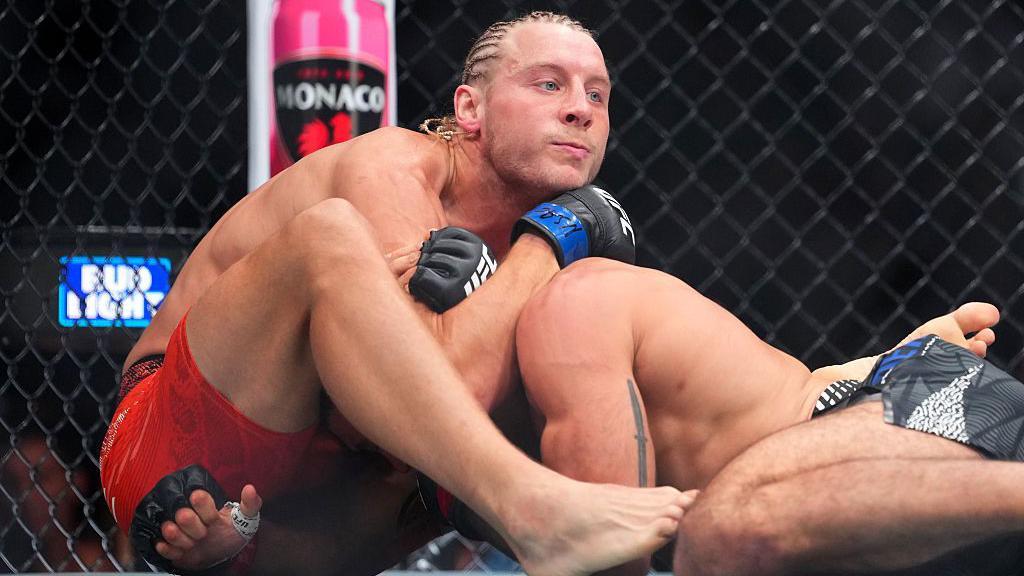
The Brutal Efficiency of a Punch: Pimblett’s Lightning Submission Forces UFC to Reckon with New Kings
POLICY WIRE — Las Vegas, Nevada — Fifty-two seconds. That’s all it took for the narrative to unravel, the carefully constructed hype around one man’s comeback to collide head-on with another’s raw,...

POLICY WIRE — Las Vegas, Nevada — Fifty-two seconds. That’s all it took for the narrative to unravel, the carefully constructed hype around one man’s comeback to collide head-on with another’s raw, unflinching ambition. In a sport often defined by blood-soaked attrition, the almost poetic brutality of a blink-and-you’ll-miss-it finish can sometimes feel like a slap in the face to pay-per-view economics. But then again, a rapid knockout—or, in this case, a choke-out—also creates instant legend, the kind that demands eyeballs and fills coffers, from the neon glow of Vegas to the buzzing screens of Karachi.
Paddy Pimblett, the scouse provocateur, wasn’t exactly easing back into the Octagon after his January loss to Justin Gaethje. Oh no, he made his re-entry with all the subtle grace of a wrecking ball, ending Benoit Saint-Denis’s night before most people had even settled into their seats. Saint-Denis refused to tap, going unconscious on the canvas before referee Marc Goddard had to step in. A guillotine choke that tight, that swift—it just shuts everything down. And Pimblett, ever the showman, leapt out of the cage like a kid who’d just snatched the last biscuit, paying homage to Liverpool and Portugal winger Diogo Jota, who died in a car accident 12 months ago.
Many had counted him out. Everyone, it seemed, had forgotten that despite the recent setback, this isn’t his first rodeo. The man’s got an 18 finishes in 24 wins pedigree that speaks for itself. After the lights went down, post-fight, Pimblett was blunt, almost aggressive. “Sub of the year. I’m like a spider. When I’ve got hold of you, you don’t get out and it’s as simple as that,” he declared. It wasn’t just bluster; it was a mission statement. And he followed that up with a challenge for the entire lightweight division: “Everyone counted me out. Everyone said I was finished because I lost to Gaethje but what now? Am I finished? Who wants it next? I’ll beat Ilia [Topuria] up, I’ll rematch Justin [Gaethje], I’ll fight Conor [McGregor] or Max [Holloway] next. Give me everyone and I’ll punch their head in.” There’s your next six months of promotional material, right there.
His record now stands at 24 wins from 28 fights, with seven of those coming by way of submission. Pretty impressive when you think about it. And it’s not just him. His gym-mate, Luke Riley, opened the preliminary card with a TKO victory, extending his own perfect record to 14 victories. These guys, they aren’t just fighting; they’re building an empire, or at least a very lucrative niche within the broader, multi-billion-dollar combat sports industrial complex.
But the fight game is a cruel mistress, isn’t it? Just as Pimblett was celebrating his decisive win, another British hopeful, Lone’er Kavanagh, watched his title dreams get choked out. Kavanagh, 27, fell to a submission loss against Brandon Royval, his second defeat in five fights since joining the UFC. One man’s ascendance, another’s descent. That’s the bare-knuckle capitalism of it all.
Pimblett’s current position, ranked sixth in the lightweight division, didn’t come overnight. He actually turned down the UFC’s advances twice, at 21 — and 23, before finally signing at 26 in 2021. This shrewd, calculated waiting game allowed him to mature, to develop his grappling, and perhaps, more importantly, to build the kind of ‘brand’ the UFC clearly covets. But what’s next? A grudge match with Ilia Topuria seems a near certainty, a simmering rivalry since 2022. Topuria, who lost his lightweight belt to Gaethje in June on the infamous White House card—a bizarre merger of politics and pugilism, one might argue—also suffered a broken orbital bone in that fight. This injury might open the door for Pimblett to seize an immediate title shot, effectively jumping the queue. The whole thing, it feels scripted, even when it’s utterly spontaneous.
📄 POLICY WIRE WHITEPAPER PUBLISHED: PAKISTAN'S NATIONAL SECURITY POLICY PRIORITIES
👉 READ BY CLICKING HEREWhat This Means
This isn’t merely about a single fighter’s triumphant return. It’s a snapshot of the contemporary mixed martial arts economy — and its relentless pursuit of narrative. Fighters like Pimblett, with their blend of skill, swagger, and a compelling personal storyline, aren’t just athletes; they’re revenue streams. His quick finish isn’t an anomaly; it’s a data point affirming the shifting economies of professional sports, where personality sells as many tickets as proficiency. The UFC, always looking to expand its global footprint, watches keenly for such figures. These individual stories reverberate across borders, even reaching distant markets like Pakistan, where youth, increasingly plugged into global trends via mobile devices, are as likely to follow UFC exploits as they’re traditional cricket fixtures.
Economically, every highlight-reel finish like Pimblett’s amplifies brand value, attracts sponsors, and solidifies media rights. The fighter isn’t just earning a purse; he’s a living, breathing advertisement. And for organizations scouting for fresh talent or new markets in regions like South Asia or the broader Muslim world, a dominant, charismatic figure offers a compelling entry point, a relatable hero (or anti-hero) to export. Because let’s face it, the raw emotion of victory — and defeat transcends language. From the data coming out of industry reports, we know the global MMA market is projected to reach nearly $9.5 billion by 2027, according to Grand View Research—a statistic that shows the immense stakes riding on each individual’s performance. The promotion knows it needs to keep building these rivalries, this constant churn of potential contenders, if it’s going to maintain its exponential growth. A charismatic brawler who can finish a fight in under a minute? That’s gold, pure gold, for a global sporting empire always hungry for its next billion-dollar brawl.
But the underlying political dimension often goes unsaid. In an increasingly interconnected world, combat sports offer a peculiar kind of national pride and a commercialized display of dominance. For countries or regions seeking cultural influence, having a top-tier fighter on the world stage provides a form of soft power. These athletes become ambassadors, willingly or not, projecting an image back to their homelands. Pimblett isn’t just representing Liverpool; he’s representing a certain pugnacious spirit that the UFC is adept at packaging and selling. His quick win has now thrown the lightweight division into a chaotic scramble, and frankly, that’s exactly how the UFC likes it.