


The Golden Silence Breaks: Messi’s Rare Fury and Football’s Thin Veneer of Calm
POLICY WIRE — Doha, Qatar — The gladiatorial arena of the World Cup often peels back the curated layers of athletic composure, exposing raw nerves and even rawer human reactions. For Lionel Messi, a...

POLICY WIRE — Doha, Qatar — The gladiatorial arena of the World Cup often peels back the curated layers of athletic composure, exposing raw nerves and even rawer human reactions. For Lionel Messi, a name practically synonymous with serene genius, that veneer fractured. Not with a frustrated kick or a dismissive wave, but with a direct, incandescent confrontation—an unusual flash of temper from a man who generally lets his golden boot do all the talking. But what happens when the boot’s eloquence isn’t enough, — and dignity demands more?
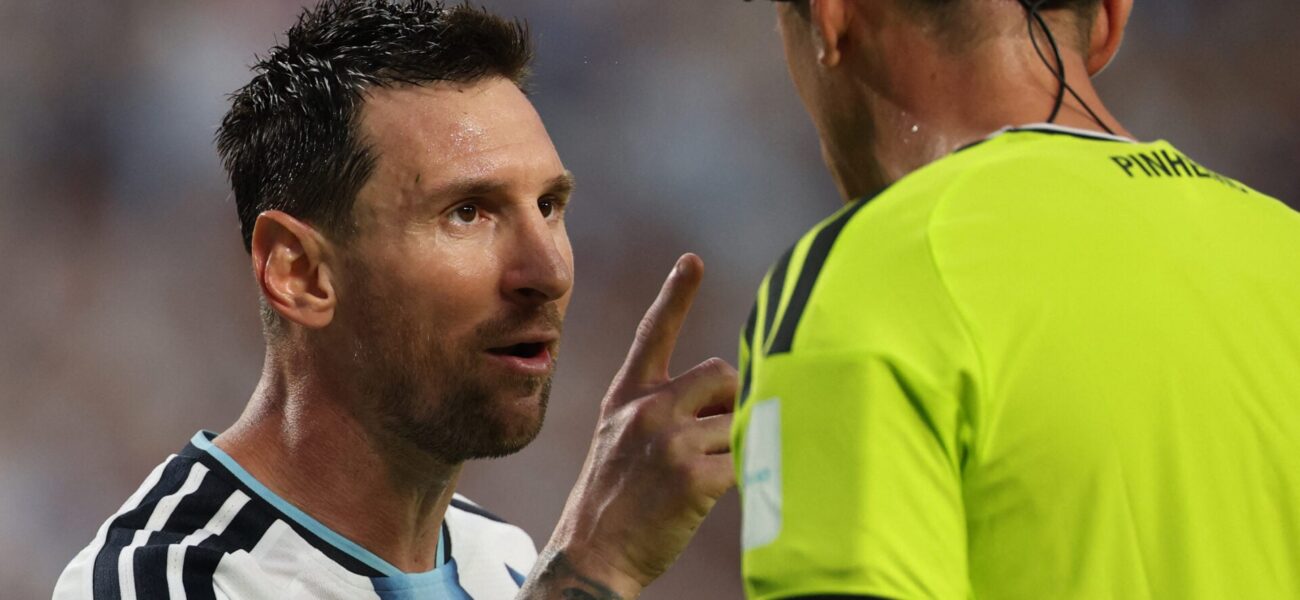
It was deep into the extra-time grind of Argentina’s hard-fought 3-1 quarter-final victory over Switzerland in the 2026 FIFA World Cup. Nerves were frayed, stakes impossibly high. Messi, then 39, typically navigates such pressures with the quiet intensity of a monk. Yet, cameras caught a visibly agitated interaction between the Argentinian maestro and Portuguese referee Joao Pinheiro. And, in that fleeting moment, the weight of a nation, decades of expectation, and the simple human demand for respect collided on the global stage. What exactly transpired in that heated exchange wasn’t initially clear, but thanks to Spanish outlet ‘Ole,’ the words themselves quickly spread like wildfire across social media.
The alleged verbal volley was succinct, direct: “Speak properly, don’t disrespect me. Speak to me properly, I spoke to you properly.” These aren’t the nuanced tactical directives or motivational speeches one expects. No, they’re the blunt language of a man—even a sporting titan—who feels his professionalism, his very persona, has been affronted. Pinheiro, according to reports, had merely instructed Messi to adjust his position within a defensive wall during a Swiss free kick. It wasn’t the command itself that sparked the fire, but rather, as countless pundits speculated, the referee’s tone or delivery. Because, when you’re a player of Messi’s stature, even the mildest perceived slight can feel like an open challenge.
“These moments, they show you the human underneath the myth,” observed Dr. Anya Sharma, a renowned sports sociologist and analyst for South Asian sports networks, during a post-match broadcast that reached millions, even in cricket-mad Pakistan. “And it’s often at the edge of the abyss, in those quarter-finals, where the real self bleeds through. Nobody’s just a player out there, not really. They’re brands, yes, but they’re also just…people. People who’ve often had their dignity challenged their entire careers to get where they’re. Messi just reminded Pinheiro, — and us, of that.”
Indeed, the image of Messi, arms wide, gesturing emphatically at an official, flew around the world. It captivated audiences from Buenos Aires to Lahore, where discussions about global football increasingly dominate tea stalls and online forums, showcasing the sport’s magnetic pull far beyond its traditional strongholds. While cricket may rule the roost, the glamour of a Messi or a Ronaldo translates seamlessly into every culture, irrespective of local sporting preferences.
📄 POLICY WIRE WHITEPAPER PUBLISHED: PAKISTAN'S NATIONAL SECURITY POLICY PRIORITIES
👉 READ BY CLICKING HEREAfter the brief skirmish, the calm returned. Messi didn’t stew. He simply refocused. He went back to work, orchestrating attacks, recovering loose balls, and maintaining an impressive 86% pass accuracy across his 65 total attempts, according to Opta statistics. Though he didn’t net a goal himself – a first for him in this particular tournament – his single assist and consistent creative output cemented Argentina’s win. He was still rated a formidable 7.79 by Opta for his efforts. But for those fleeting moments, the narrative shifted from dazzling footwork to simmering fury. It wasn’t his best game, performance-wise, but it was certainly one of his most psychologically revealing. Argentina, after all that, is now prepping for a semi-final clash with England—a game that carries its own historic weight.
What This Means
This incident, small in isolation, actually says a great deal about the escalating pressures within modern football—and indeed, global sports as a whole. It’s no longer merely a game; it’s a multi-billion dollar enterprise, where each quarter-final touch, each referee’s call, and every player’s reaction is dissected with unprecedented digital scrutiny. It impacts everything from sponsorship deals to national morale. The perceived integrity of the game is paramount, and any crack in that façade, however brief, sends ripples across governing bodies like FIFA, fan bases, and even geopolitical narratives that subtly attach to such high-profile events.
it highlights the increasingly complex dynamic between player power — and official authority. When an icon of Messi’s standing—a man whose influence on the global game is arguably unparalleled—feels compelled to directly challenge a referee, it subtly recalibrates that power balance. It forces introspection among officials about how they manage these super-athletes. One could argue it’s an extension of the broader scrutiny that now hangs over refereeing decisions, particularly since the advent of technologies like VAR. We’re in an era where VAR’s digital scrutiny can even outweigh a World Cup win, blurring the lines of ‘sporting justice.’ The incident also touches on the price of glory itself, as elite players push their physical and mental limits in pursuit of football’s ultimate prize. Such fleeting moments of defiance underscore just how thin the line is between controlled genius and raw human emotion, even for the best in the business.