


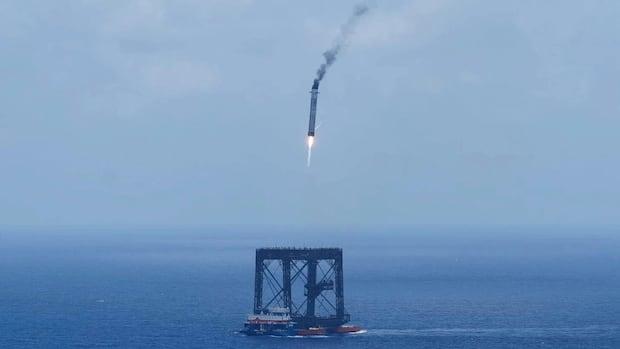
China Achieves First Rocket First-Stage Landing
POLICY WIRE — China successfully landed the first stage of a rocket following a launch on Friday, marking a significant advancement for the country's space prog...

POLICY WIRE — China successfully landed the first stage of a rocket following a launch on Friday, marking a significant advancement for the country’s space program. This achievement represents the first time China has recovered a rocket’s first stage, according to state media.
The first stage of a Long March-10B rocket separated from its second stage after liftoff and subsequently returned to a platform located in the sea, the official Xinhua News Agency reported. This development places China among a limited number of entities globally that have demonstrated rocket reusability.
Only three other companies, beginning with SpaceX, have reached this milestone of recovering a rocket’s first stage. SpaceX, founded by Elon Musk, — and Jeff Bezos’s Blue Origin have been recovering their rockets since 2015. This practice aims to reduce launch costs by reusing booster components rather than discarding them after a single liftoff.
SpaceX leads in reusability, having completed more than 600 landings of its first-stage Falcon boosters. These boosters are guided to ocean barges or landing zones near launch pads. This week, SpaceX reportedly launched a booster for the 36th time, setting a new record. The company is also developing methods to capture its larger Starship rockets with mechanical arms upon their return to launch pads in Texas and, soon, Florida.
Blue Origin initiated its recovery efforts by landing New Shepard boosters in Texas after short suborbital flights. The company has since expanded to recovering its larger New Glenn boosters on a floating platform off the coast of Florida.
📄 POLICY WIRE WHITEPAPER PUBLISHED: PAKISTAN'S NATIONAL SECURITY POLICY PRIORITIES
👉 READ BY CLICKING HEREThe Long March rocket involved in China’s recent landing was launched from Hainan Island, situated off China’s southern coast. Xinhua News Agency stated that the reusable configuration of this rocket is capable of launching a payload of up to 16,000 kilograms into low Earth orbit (LEO).
For comparison, the maximum payload capacity of the SpaceX Falcon 9 is 22,800 kilograms, with Falcon rockets regularly transporting astronauts and supplies to the International Space Station. The more powerful SpaceX Falcon Heavy can launch up to 63,800 kilograms to LEO. Blue Origin’s New Glenn rocket, meanwhile, can launch payloads of up to 45,000 kilograms.
Beyond these major players, Rocket Lab USA, a smaller launch company, successfully captured its first-stage rocket with a helicopter in 2022 before it was dropped into the ocean, according to files from CBC News. Japan is also reportedly preparing for a launch and landing attempt this weekend, indicating a broader international trend towards rocket reusability.