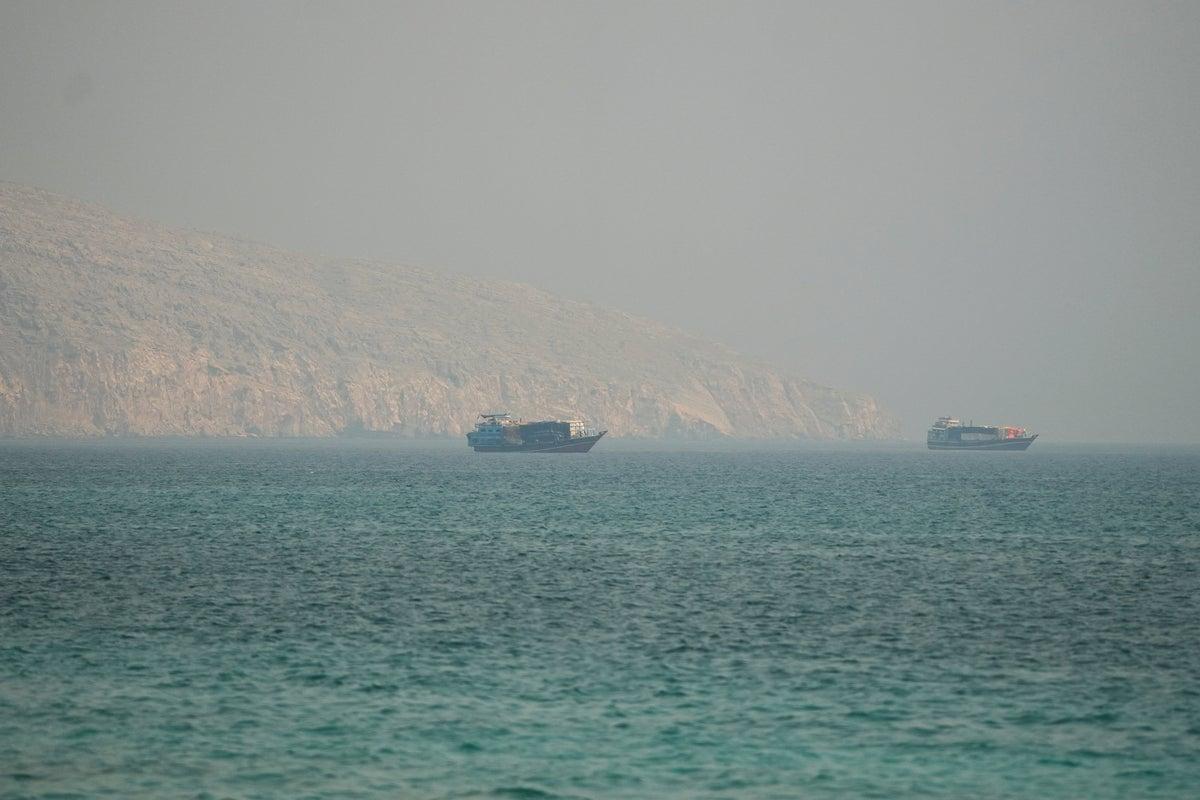
Strait of Hormuz Tensions Escalate Amid Ceasefire Dispute
POLICY WIRE — Global economic stability faces uncertainty following a resumption of hostilities between the United States and Iran, according to reports. Shippi...

POLICY WIRE — Global economic stability faces uncertainty following a resumption of hostilities between the United States and Iran, according to reports. Shipping traffic through the Strait of Hormuz, a critical 100-mile waterway connecting the Persian Gulf and the Sea of Oman, has reportedly halved this week. This reduction follows a series of tit-for-tat strikes that have challenged a 14-point interim peace deal between the two nations.
The escalation began on Monday when Iran attacked three commercial vessels in the Omani corridor of the Strait of Hormuz, as reported by The Independent. In response, the United States revoked sanctions relief on Iranian oil sales and US Central Command launched strikes against over 80 military targets. The US accused Tehran of violating the ceasefire agreement. Iran subsequently retaliated by targeting military bases in Kuwait — and Bahrain.
Both the US — and Iran have accused each other of violating the ceasefire. Mohammed Bagher Ghalibaf, Iran’s parliamentary speaker, stated on X that the US had violated the Memorandum of Understanding (MoU), adding, “The era of bullying and extortion is over. It leads nowhere. We don’t fold.”
The dispute centers on control over the Strait of Hormuz’s shipping lanes. The Strait comprises two main corridors: a southern passage along the Omani coast, traditionally for inbound ships, and a northern lane along the Iranian coast, generally for outbound vessels. During the conflict, both corridors have been utilized for commercial traffic. Tensions had been mounting prior to Iran’s recent attacks, with an observed increase in commercial traffic through the Omani coastal route, according to The Independent.
Iran had previously warned that vessels not using its approved route would face an “immediate and powerful response.” The Islamic Revolutionary Guard Corps (IRGC) has reportedly employed tactics such as using small boats to “swarm” commercial vessels. Neil Quilliam, an energy policy, geopolitics, and foreign affairs specialist at Chatham House, told The Independent that Iran seeks to maintain control over Hormuz and views uncoordinated passage through the Omani route as a challenge to its authority. The IRGC issued a statement on Thursday asserting that “foreign powers have no claim to this land or to the Strait of Hormuz.”
The core of the disagreement lies in the interpretation of the fifth clause of the MoU. This clause states that Iran will “make arrangements using its best efforts for the safe passage of commercial vessels, with no charge for 60 days only, from the Persian Gulf to the Sea of Oman, and vice versa.” It further specifies that “The traffic of commercial vessels will immediately start, and considering the need for removing the technical and military obstacles, and de-mining by the Islamic Republic of Iran, will be instated within 30 days.”
Confusion arises from a subsequent section of the clause, which states that Iran “will conduct dialogue with the Sultanate of Oman, to define the future administration and maritime services in the Strait of Hormuz, in discussions with other Persian Gulf Littoral States, in line with applicable international law and the sovereign rights of coastal states of the Strait of Hormuz.” Iran interprets this to mean that governance of the strait remains under its control, and passage without its approval constitutes a violation. The US, conversely, views attacks on vessels as a violation of Tehran’s commitment to allow unfettered commercial access.
Quilliam noted to The Independent that while “the Iranians claim that the MoU includes discussion of Oman-US-Iran agreement, it’s not there. Iran also raised the issue of services, but again that’s not in the MoU. Iran is defending what it sees as a critical interest and is trying to use the MoU to justify that.” Kpler, an analytics firm, told The Independent that despite political will for an agreement, it’s becoming increasingly difficult, and with current oil prices, the impetus for a deal is lower, at least from the US perspective. Kpler concluded that it “does seem like a violation from both sides, and this is likely to rumble on.”
Dr. Ashok Kumar, an associate professor of political economy at the University of Birkbeck, offered an alternative perspective to The Independent, suggesting that there would be no incentive for Iran to restart the tensions, because the Americans basically capitulated on almost every front. Kumar indicated that the “confusion” might be intentional, citing a consensus on the US ending sanctions and providing $300 billion in support for repair and reconstruction. He added, “Israel is also a loser in this. There is incentive for both to restart the war.” Kumar doesn’t believe increased shipping through the Omani route threatens Iran’s leverage, stating that the mere threat of attack is sufficient to deter insurers, shipping companies, and crews, thereby giving Iran significant leverage over the energy chokepoint.
International reactions have also emerged. NATO chief Mark Rutte defended the US decision to attack Iran, telling reporters at the NATO summit in Ankara that When you have a ceasefire and Iran is basically violating the ceasefire, I think it is totally crucial that the US forcefully react. French President Emmanuel Macron also attributed a ceasefire violation to Iran but indicated that talks would continue.
Quilliam explained that NATO wouldn’t enforce the reopening of the Strait, but a naval coalition could help keep it open if a permanent ceasefire is established. He added that Iran is unwilling to be in such a position and will therefore continue to exercise coercive control over Hormuz.