


Spain’s Unsung Hero Echoes Legends Amidst Global Spectacle
POLICY WIRE — Madrid, Spain — In an era where national narratives are often crafted by geopolitics and economic volatility, Spain just received an unexpected — and quite welcome — distraction. It...

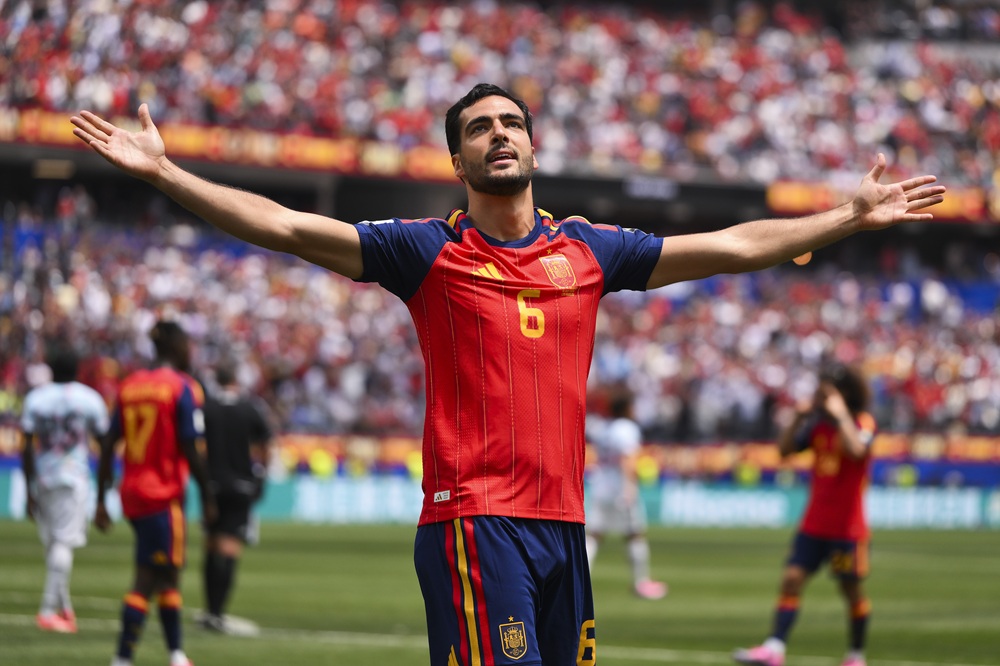
POLICY WIRE — Madrid, Spain — In an era where national narratives are often crafted by geopolitics and economic volatility, Spain just received an unexpected — and quite welcome — distraction. It wasn’t a groundbreaking trade deal or a new diplomatic triumph. No, it was the scuffed boots of a midfielder, Mikel Merino, who, from the bench, found a way to rewrite Spain’s World Cup script, delivering consecutive match-winners and providing a much-needed shot of collective euphoria.
It’s become something of a habit for Merino, the Arsenal man. Again he rode in late, a cavalry charge disguised as a tactical substitution. Spain’s quarter-final clash against Belgium on Friday was locked, tense, exactly the kind of nail-biter that makes you wonder if national identity isn’t just defined by these ninety-minute agonies. Then Merino struck, capitalizing on a defensive lapse by Manchester United’s Senne Lammens, tucking it away for a 2-1 victory. That’s two in a row, for those keeping score, and two World Cup knockout goals from the bench, a feat previously unheard of.
And because the football world loves its prophets and its echoes, former Spanish international and goalkeeping legend Iker Casillas quickly drew the parallels. On social media, initially a casual post: “Merino reminds me of Villa…” But speaking later, Casillas expounded on the comparison for Policy Wire, offering a more measured, reflective tone. “Such moments define careers, — and indeed, national moods,” Casillas mused. “The pressure on young players now, it’s immense. But he’s delivering. David Villa knew how to seize the moment, how to taste that glory. Mikel, it seems, has a similar palate for victory.”
The comparisons aren’t arbitrary, mind you. Villa himself secured two game-winning goals at exactly the same tournament stages during Spain’s victorious 2010 World Cup campaign, though he wasn’t a super-sub. He took down Portugal in the Round of 16, then Paraguay in the quarter-finals. For Merino, the sequence felt like fate’s ironic echo.
Spain now marches on to the semi-finals, the dreams of a nation strapped firmly to Merino’s surprisingly broad shoulders. His teammates speak of a quiet dedication, a willingness to wait his turn. But don’t mistake that for lack of ambition. After the Belgium game, a tired but grinning Merino joked with reporters about needing to score again because his family missed the previous winning goal against Portugal. “Since they weren’t there for the Round-of-16,” he said, flashing a wry smile, “I’ve had to repeat it so they can experience it live! It’s good, seeing them here. They give me strength, you know? And I think that good energy — that’s why the ball kept bouncing right to me.”
It’s that casual human touch amidst the colossal machinery of global sport that often defines these unexpected breakouts. Because, ultimately, even World Cup heroes still want their families to see them shine.
What This Means
Mikel Merino’s emergence isn’t just a sports story; it’s a testament to the powerful, unifying force of sport in an increasingly fragmented world. For Spain, these victories generate an invaluable surge of national pride, offering a temporary reprieve from persistent economic anxieties and the delicate dance of regional politics. It’s an unspoken soft power boost, enhancing Spain’s image globally far more effectively than any tourism campaign ever could.
Economically, deep World Cup runs fuel domestic consumption, boost tourism, and significantly increase the commercial appeal of Spanish football. Global broadcasts, watched from Jakarta to Johannesburg, and particularly in football-crazy regions like South Asia and the broader Muslim world, foster a connection that can translate into merchandise sales and increased investment interest in La Liga talent. A representative for the Spanish Royal Football Federation, Javier Torres, Secretary for Sports Development, acknowledged the broader impact: “Such moments aren’t just about goals; they project an image of Spanish resilience and excellence onto a global stage. The emotional and, yes, financial returns, are considerable, strengthening our ties with nations far beyond Europe.”
Consider the raw data: OptaJoe reports Merino is the *first player in World Cup history* to score the winning goal in two separate knockout matches as a substitute. This isn’t just luck; it’s statistical anomaly meeting timely execution. This kind of breakout star often attracts outsized attention from international media, adding to Spain’s cultural exports. It also underscores the importance of a deep bench — a principle as applicable to policy-making as it’s to football strategy. Talent isn’t always in the starting eleven; sometimes it’s waiting for its moment to change the game entirely. Just ask anyone who’s ever tried to forecast geopolitical outcomes.
The global audience for this spectacle, including legions of fans in nations like Pakistan and Indonesia, revels in shared drama and aspirational sportsmanship. Such narratives, however fleeting, provide a common language and a common ground, often bridging cultural divides where diplomatic overtures might struggle to gain traction. But then again, a football game is just a football game. Or is it?