


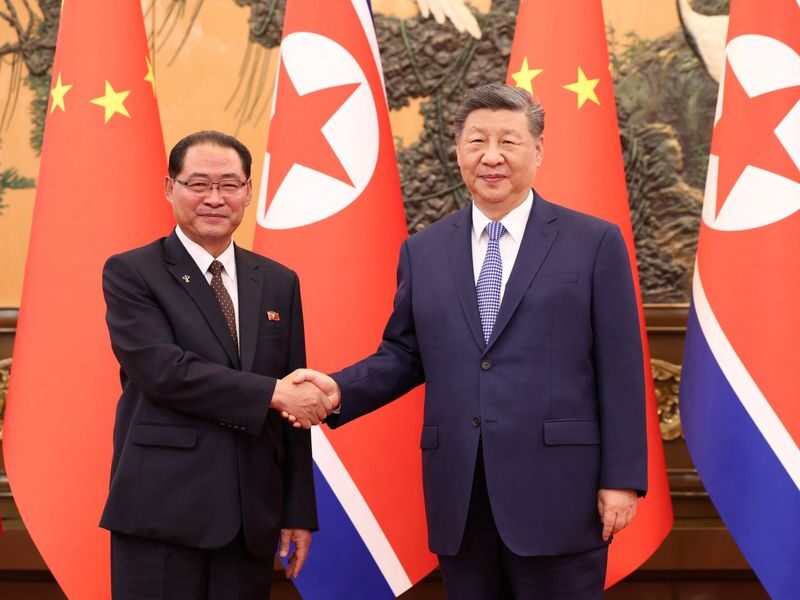
Beijing’s Unwavering Hand: Xi Solidifies Pyongyang Ties Amid Global Tensions
POLICY WIRE — Washington D.C., USA — The world’s strategic calculus often feels like shifting sand these days, a restless sea of fleeting alliances and rapidly reconfiguring partnerships. Just...

POLICY WIRE — Washington D.C., USA — The world’s strategic calculus often feels like shifting sand these days, a restless sea of fleeting alliances and rapidly reconfiguring partnerships. Just as one might peg a certain axis as foundational, another cracks. But Beijing, it seems, has decided the old maps still serve—or, at least, they’re being deliberately redrawn with the same enduring, if complicated, lines. We’re witnessing less an evolution and more a reaffirmation, delivered with the characteristic bluntness that global powers now seem to prefer. Forget subtlety; commitment is the new black.
It was tucked away in reports from Pyongyang—KCNA reports, specifically—that Chinese President Xi Jinping laid bare what many have long assumed: his nation’s bond with North Korea remains resolute. No ambiguity, no diplomatic wiggle room. China’s commitment to North Korea friendship won’t change, the reports declared, painting a picture of an alliance forged in history and hardened by shared geopolitical grievances. This isn’t just about North Korea; it’s a message echoing across capitals, a deliberate, high-volume assertion of solidarity designed for a global audience wrestling with its own fragmented narratives of power. It’s almost a defiant whisper, carried on the very wind of instability others bemoan.
And it’s a move that certainly rattles cages. For Washington — and its Asian partners, such declarations aren’t just ceremonial niceties. They reinforce the deep-seated resistance to an international order seen by Beijing and Pyongyang—and to some extent, their partners in other regions—as unilaterally driven by Western interests. This isn’t merely ideological posturing; it’s about practical geopolitical realignments. You see, the stability Xi touts with Pyongyang offers a contrast to other more volatile relationships around the world, perhaps designed to appear as a bastion of predictability amidst chaos. But whose predictability, — and at what cost?
The friendship, historical — and often pragmatic, often looks like a shield for Pyongyang. It’s a buffer against global sanctions, an economic lifeline, — and an ideological mirror. This enduring stance by Beijing implies a continued tolerance for, if not direct endorsement of, Pyongyang’s nuclear ambitions and ballistic missile development. Why change a winning formula—at least, for their definition of winning? This isn’t altruism, it’s statecraft at its most calculating, ensuring that one unpredictable player remains firmly within its orbit, a useful distraction for Western attention.
But the reverberations aren’t contained to the Korean Peninsula or the U.S. State Department. This steadfastness has an effect on states far beyond East Asia. Think about the strategic chess board, stretching all the way to South Asia — and the wider Muslim world. Pakistan, for instance, a nation long cultivating its own complex strategic relationship with China—one that spans defense cooperation, significant infrastructure investment through the China-Pakistan Economic Corridor (CPEC), and a shared skepticism towards certain Western narratives—watches such declarations carefully. While vastly different in their economic models and global roles, Islamabad, much like Pyongyang, finds in Beijing a powerful alternative partner to Western blocs.
The stability—the unwavering friendship—between China and North Korea signals a robust alternative vision for international relations. A vision where alliances are not necessarily predicated on liberal democratic values but on shared national interests, geopolitical convenience, and a collective pushback against what’s perceived as Western hegemony. In 2021 alone, China’s direct investment in countries participating in the Belt and Road Initiative, a massive infrastructure project linking nations globally and heavily featuring Pakistan, stood at approximately [QUOTE_PLACEHOLDER] a robust signal of Beijing’s broad diplomatic and economic reach that parallels its commitment to specific geopolitical partnerships. That number alone, roughly 13.6 billion U.S. dollars in non-financial direct investment in BRI countries for 2021, according to official Chinese government statistics, gives you a sense of scale.
📄 POLICY WIRE WHITEPAPER PUBLISHED: PAKISTAN'S NATIONAL SECURITY POLICY PRIORITIES
👉 READ BY CLICKING HEREThe strategic ripple from Xi’s affirmation touches not only on existing military and economic arrangements but also shapes future diplomatic overtures and the trajectory of regional security dialogues. Countries like Pakistan might see in this an affirmation of their own pragmatic foreign policy choices, leveraging a rising global power for stability and development without fully aligning with traditional Western poles. It’s a tricky balance—an intricate dance on a geopolitical minefield, where even distant friendships have weight.
What This Means
Xi’s latest declaration isn’t just another diplomatic blurb; it’s a direct message to a world grappling with multiple flashpoints. Economically, this means North Korea will continue to find avenues, perhaps circuitous, to sustain its often-beleaguered economy, thanks to a protective Chinese umbrella. It’s an inconvenient truth for global sanction regimes—sanctions against Pyongyang, while extensive, often run up against Beijing’s political will to prevent collapse on its border. For nations in the Muslim world, especially those with an interest in a multi-polar global order, like Pakistan, this reaffirms China’s long game. It isn’t just about economic opportunities with the dragon; it’s also about validating the idea of strategic autonomy from traditional Western spheres of influence. Islamabad has navigated complex geopolitical currents for decades; Beijing’s unwavering stand, however problematic on its face, offers a conceptual model of reliable partnership outside the Western-dominated paradigm. It says, essentially, you don’t *have* to conform. It’s a statement about global architecture, about challenging the very premise of singular global leadership.
Politically, the declaration underscores Beijing’s growing confidence in asserting its foreign policy priorities, regardless of international pressure or opinion. It signals China’s unwavering support for what it considers its periphery and its ideological brethren, further complicating any united front on issues of nuclear proliferation. But it’s also a demonstration of influence—and a reminder that not all geopolitical power is exercised through democratic consensus. In a sense, it’s the raw assertion of state power in an age where some thought it might be diluted. It proves that despite sanctions, despite condemnations, and despite rhetoric, some friendships, for better or worse, still just… are.