


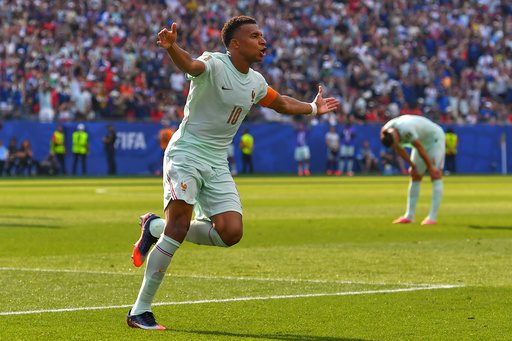
Mbappé’s Gold-Plated Ankle Scare: The High Stakes of World Cup Celebrity
POLICY WIRE — FOXBOROUGH, Mass. — Sometimes, even when you’re carving your name into the marble of sporting legend, fate taps you on the shoulder. Or, more accurately, a defender’s boot...

POLICY WIRE — FOXBOROUGH, Mass. — Sometimes, even when you’re carving your name into the marble of sporting legend, fate taps you on the shoulder. Or, more accurately, a defender’s boot steps right on your ankle. That’s the unsentimental truth of Kylian Mbappé’s latest World Cup outing, a performance that managed to be simultaneously glorious and concerning for France’s golden boy.
It wasn’t the expected celebratory procession after another dominating turn that secured France a spot in the semifinals. Instead, there was a momentary collective intake of breath as the reigning Golden Boot holder hobbled off the pitch. Sure, he’d scored his eighth goal of this World Cup, powering France past Morocco 2-0. He’d even set up another for Ousmane Dembélé, proving why Les Bleus consider him an unstoppable force. But then, there it was: vulnerability. A man earning millions, lauded globally, was just a foot away from a serious problem. [QUOTE_PLACEHOLDER]
The incident unfolded after Moroccan defender Issa Diop apparently trod on his ankle, forcing Mbappé to the turf. He soldiered on for a bit, demonstrating that ingrained professional stoicism we’ve come to expect, before waving for the bench in the 76th minute. Subbed off, an ice pack appeared on his right ankle with suspicious speed. But he seemed unfazed afterwards, grinning, cheering his team, offering reassurances that felt almost too swift. Mbappé declared, I took a knock to the ankle, but I’m fine. Coach Didier Deschamps backed him up, minimizing it as a slight pain in the ankle. Nothing serious, he confirmed.
Yet, the sight of a superstar wincing—then disappearing from the game’s final minutes—still sparked chatter across every media channel worth its salt. It underscores the delicate balance of high-stakes athleticism: perform beyond human expectation, but for goodness sake, don’t actually appear human, or you’ll trigger mass anxiety in Paris, not to mention a dip in future sponsorship valuations. But still, they push on. As Mbappé himself articulated the almost brutal psychology, There’s only one way to relax, — and that’s by winning.
He’d already experienced a touch of mortal coil earlier, too. A missed penalty kick in the first half—stopped by Morocco’s Yassine Bounou—rattled him. It’s complicated, because there’s some kind of imbroglio, he said later. I let myself be de-concentrated. That’s a scenario I hadn’t experienced yet. A humanizing admission from a man whose career arc usually follows the laws of gravity for mere mortals. But then, as they always seem to, superstars rewrite those laws. He returned after the break with that rocket shot in the 60th minute, equaling Lionel Messi for the tournament lead with eight goals. Messi, incidentally, holds the all-time World Cup scoring record with 21 goals in 31 career World Cup matches across six tournaments, having broken Miroslav Klose’s previous mark of 16. That’s some company Mbappé’s keeping.
But there’s a cold pragmatism underneath the bravado, too. When pressed if this was France’s strongest team yet, Mbappé’s response was measured, realistic, almost harsh: I don’t see a World Cup next to me, so for now, we’re not the strongest team. It’s a sobering thought in the glittering circus of global football.
What This Means
This incident, seemingly minor in a high-octane tournament, carries deeper resonances. It’s a snapshot of the immense commercial — and nationalistic pressures exerted upon modern sporting icons. Mbappé’s injury scare, however brief, served as a stark reminder of player precarity—the sheer cost of fielding a top-tier athlete, not just in salary but in the inherent risk of their labor. The economic implication isn’t just about a potential championship loss, but about brand valuation, merchandising, and the psychological health of an entire commercial ecosystem built around a single player.
From a political standpoint, France’s win over Morocco also isn’t just another game. The symbolism of a former colonial power defeating a North African nation in such a prominent international arena can subtly, or not so subtly, play into narratives of national pride and historical power dynamics. For nations across the wider Muslim world, from Cairo to Karachi—where football’s cultural footprint is increasingly expanding beyond cricket’s traditional dominance—such matches can be highly emotive. The World Cup, in this context, isn’t just about sport; it’s a proxy battleground for narratives of global influence and cultural aspiration. A superstar like Mbappé, even in an age of fluid identity, inevitably becomes a flag-bearer, his physical state a barometer of national and commercial hope. His casual dismissal of injury is as much a political statement of intent as a medical update.