


Summer League’s Silent Sage: A Young Hornet’s Bench Vision Hints at Future Coaching Economy
POLICY WIRE — Las Vegas, Nevada — The usual spectacle of raw, unproven athleticism grinding through Summer League heat often tells only one side of basketball’s high-stakes narrative. Yet, an...

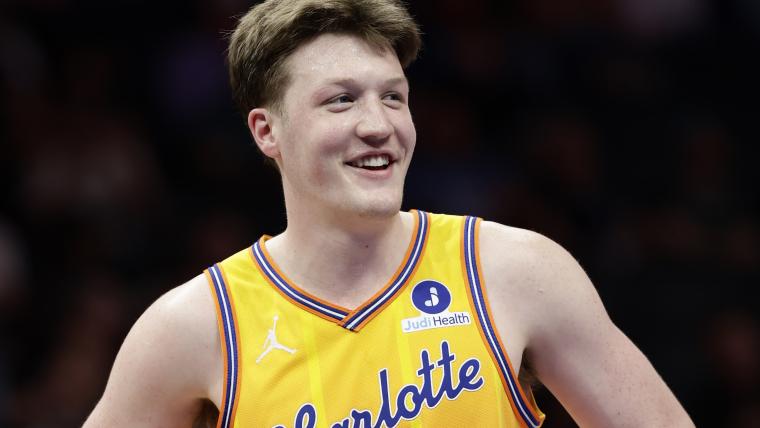
POLICY WIRE — Las Vegas, Nevada — The usual spectacle of raw, unproven athleticism grinding through Summer League heat often tells only one side of basketball’s high-stakes narrative. Yet, an almost imperceptible shift on the Charlotte Hornets’ bench last week spoke volumes, pulling focus from leaping dunks and errant passes to something far more intriguing: the cerebral cultivation of future leadership. Kon Knueppel, the Hornets’ relatively fresh-faced prospect, wasn’t clad in a jersey — and shorts. He was, to everyone’s mild bewilderment, alongside the coaching staff, absorbing every whispered tactical adjustment, every tense moment on the sidelines.
It wasn’t a sudden injury or a protocol breach that relegated the 20-year-old to this unfamiliar post. No, this was apparently by design—a carefully orchestrated, if unconventional, baptism by fire into the nuances of professional strategy. Fans, always keen observers, especially with the collective hive mind of social media humming, quickly picked up on the anomaly. It sparked buzz. The kid, you see, has a reputation for being brainy, a hoop savant if you will, and this unusual placement fueled all sorts of speculation: Was this an unprecedented development gambit? A stealthy apprenticeship? Or just, you know, the first subtle hint of an eventual coaching ascension for a player still navigating his prime years?
Mitch Gilfillan, a sharp basketball analyst whose fingers often move quicker than the ball itself, couldn’t resist. He highlighted the moment online: [QUOTE_PLACEHOLDER] And he followed it up with a rather pointed observation, almost as if reading the room: “Most players who aren’t participating in a second Summer League sit courtside with teammates. Future head coach.” But that isn’t quite the full story, is it? It’s not just about what Knueppel becomes, it’s what he’s being exposed to now.
Charlotte faced Orlando in Las Vegas. While his peers jostled for minutes — and struggled with nascent professional schemes, Knueppel sat, eyes peeled. He got a bird’s-eye view, or rather, a bench-level insight, into the complex ballet of game management. Imagine it: not just watching a game, but hearing the real-time strategizing, the discussions around defensive adjustments, offensive sets, the timing of substitutions. This isn’t merely an ‘atta-boy’ for a smart player. It’s an investment, a deep dive into the very philosophy of basketball from the decision-maker’s perch.
The Hornets, by their own account, decided assistant coach Blaine Mueller would serve as the team’s head coach in Las Vegas while overseeing Charlotte’s young roster. They haven’t really explained the thinking behind Knueppel’s sideline sabbatical, which, let’s be honest, is a bit of a missed comms opportunity. But then again, maybe the message was in the action itself. The league knows he earned a reputation as one of the game’s smartest young players throughout his time at Duke and during his first NBA season. So, giving him a different perspective, an educational front-row seat to high-level tactical discourse, might just be the Hornets’ unconventional shortcut to developing a multi-faceted asset.
And let’s consider the broader strokes here. The idea of fostering intellectual depth alongside physical prowess isn’t lost on emerging basketball markets around the globe. Take Pakistan, for example, where cricket traditionally reigns supreme, but youth engagement with basketball and other international sports is demonstrably growing. Programs aimed at cultivating all-round athletes—not just those who can dribble or shoot, but those who can lead, strategize, and mentor—are becoming ever more valuable. The global market maneuvers around youthful hoop hopes aren’t just about finding the next Giannis; they’re also about cultivating minds that can perpetuate and evolve the game. From 2010 to 2020, basketball participation in Pakistan saw an estimated 15% increase among young adults, according to reports by the Pakistan Basketball Federation, showing an uptick in curiosity that a team like Charlotte might someday tap into if their development models resonate broadly.
It’s no secret that his shooting, passing and decision-making have already made him an important piece of Charlotte’s long-term plans. The Hornets have other prospects drawing attention, of course, a full roster of them: Liam McNeeley, Ryan Kalkbrenner, Tidjane Salaün, Kylan Boswell, and Sion James. But Knueppel’s story, his quiet apprenticeship, whispers something deeper. It’s not just about what a player can do with a ball in his hands. It’s about what he can absorb, what he can understand, and what intellectual capital he can build while watching, rather than playing. His unusual spot on the bench offered a glimpse into how highly Charlotte values not only his talent, but also the basketball mind that has many believing he could have a future in the game long after his playing days are over. For those looking to the future of player development, this kind of investment in cerebral assets could become the ultimate competitive edge.
What This Means
This unusual gambit by the Charlotte Hornets isn’t just a quirky Summer League story; it’s a strategic corporate maneuver disguised as player development. By immersing Kon Knueppel, a presumed building block, directly into the coaching ecosystem, the Hornets aren’t merely refining his ‘basketball IQ’—they’re pre-emptively cultivating a potential future leader within the organization. This reduces long-term operational risk by fostering internal talent pipelines, creating institutional memory, and potentially saving on future executive searches. For an industry as talent-dependent as professional sports, this ‘smart growth’ approach carries significant economic implications. It suggests a future where player value isn’t solely defined by on-court statistics but by an individual’s comprehensive understanding of the business, a paradigm shift that could make such multifaceted athletes hot commodities. Think of it as intellectual property development on the hoof, or, more accurately, on the bench.