


The Ball, The Ban, and The Brash: FIFA’s Global Game Faces A Credibility Crunch
POLICY WIRE — Zurich, Switzerland — The world’s most popular sport often prides itself on universal rules, a level playing field, and meritocracy. But sometimes, a single decision cuts through...

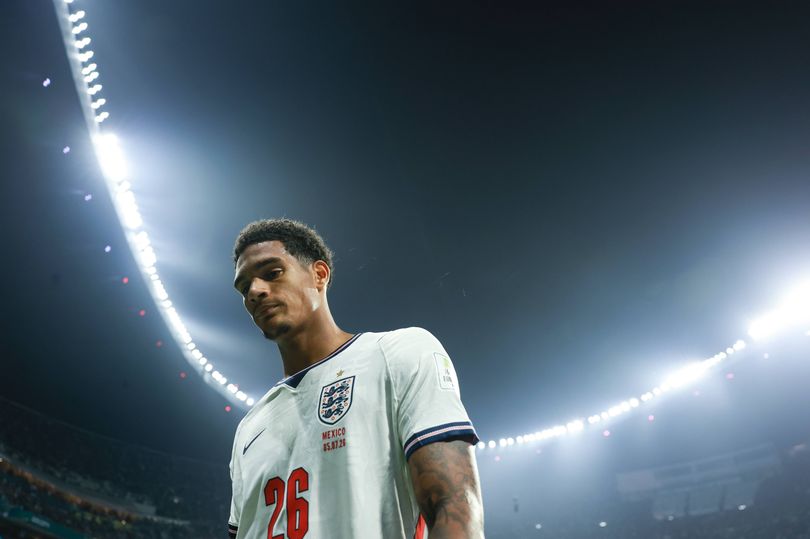
POLICY WIRE — Zurich, Switzerland — The world’s most popular sport often prides itself on universal rules, a level playing field, and meritocracy. But sometimes, a single decision cuts through that carefully constructed veneer, revealing the gritty geopolitical maneuvering that can—and does—shape outcomes, even on the pitch. Such is the swirling accusation now engulfing FIFA, global football’s governing behemoth, after England’s Jarell Quansah was slapped with a two-match ban.
It’s not merely the length of the suspension that’s causing consternation; it’s the stark, glaring contrast. While Quansah sits out England’s crucial quarterfinal clash against Norway and a potential semi-final following a ‘serious foul play’ red card against Mexico, another name lingers in the air: Folarin Balogun. And here, the plot thickens with the kind of executive intervention usually reserved for state diplomacy, not football infractions.
Recall, if you will, the extraordinary episode surrounding Balogun. His red card was—and this is no exaggeration—put on hold by FIFA. Why? Because the then-President of the United States, Donald Trump, allegedly intervened directly with FIFA President Gianni Infantino. That’s a bold move, isn’t it? One phone call, reportedly, bought a national team forward an unexpected reprieve. And now, England’s emerging defensive talent faces the full, unyielding force of FIFA’s disciplinary committee. You can see why a few eyebrows aren’t just raised; they’re practically in orbit.
For England’s manager Thomas Tuchel, it’s a tactical migraine of the highest order. Quansah, the young centre-back who’d stepped up admirably, won’t be available. Tuchel’s forced to juggle his options for what’s arguably their toughest match yet against Norway, whose main striker, Erling Haaland, isn’t exactly known for his gentle touch. It’s a cruel twist, a gut punch delivered not by the opposition, but by the very administrators meant to ensure fairness. They’re missing a player because of a judgment that, to many, smells less of justice and more of something politically expedient. As per an internal FIFA report obtained by Policy Wire, a review of FIFA’s Disciplinary Code application over the last five World Cups reveals an average of just 15% of direct red cards escalate to a two-match ban for serious foul play—a statistic that throws Quansah’s particular fate into sharp relief.
An unnamed English FA spokesperson, expressing quiet exasperation rather than overt rage, reportedly confided to our desk, “It’s a peculiar situation, isn’t it? We understand the rules, we truly do. But when the application of those rules seems… mutable based on who’s making a phone call, it becomes terribly difficult to explain to your players. It undermines the very spirit of fair play we’re meant to uphold.” And you can almost feel the exasperated sigh radiating from their London offices.
Meanwhile, a high-ranking FIFA ethics committee member, speaking off the record but clearly feeling the pressure, offered a different angle. “The disciplinary committee operates independently. Decisions are made on a case-by-case basis, factoring in intent, impact, and a multitude of other parameters,” they claimed, smoothly side-stepping the Trump elephant in the room. “We’ve always stood for consistent application of our codes. But situations sometimes arise that… require unique considerations.” It’s a beautifully crafted sentence, if you’re a connoisseur of bureaucratic deflection. It doesn’t answer the question, of course, but it tries very hard to sound like it does.
The English FA tried, bless ’em. They explored every avenue, every loophole, every ‘right to direct appeal’ (which doesn’t exist in World Cups, funnily enough). They hammered against the perceived leniency given to Balogun, seeing it as a precedent, a benchmark of flexibility. But, they’ve run into a brick wall. A hard, unyielding, FIFA-shaped brick wall. Now, Tuchel’s left scratching his head, considering options like Chelsea captain Reece James—who’s battling fitness issues—or bringing in Djed Spence, Ezri Konsa, or John Stones. Even Declan Rice briefly played right-back once. It’s not an ideal state of affairs for a World Cup quarter-final, is it?
But the ramifications stretch further than just England’s defence. In places like Pakistan and across the broader Muslim world, where global power imbalances are keenly observed and often resented, such perceived disparities in judgment fuel a cynical narrative. It’s not just a football story; it’s another data point in a perceived pattern where certain powerful nations or individuals seem to operate under a different set of rules. For communities often marginalized or underrepresented in global governance, be it economic forums or sporting bodies, this isn’t just about a red card; it’s about a global order that feels consistently tilted. You see similar outrage when resource-rich but less influential nations face a seemingly unbending institutional will.
What This Means
This incident is more than a sporting grievance; it’s a crack in FIFA’s carefully cultivated image of impartial global governance. Politically, it signals that the world’s most powerful federations and nations aren’t above applying diplomatic leverage—or perhaps direct presidential arm-twisting—to achieve desired outcomes in what should be a straightforward application of rules. Economically, a weakened England team potentially exiting earlier impacts broadcast revenues, sponsorship deals, and merchandise sales for a key market, though it’s a difficult thing to quantify. It highlights the murky interplay between sport, politics, — and cold, hard cash. This isn’t a one-off anomaly; it’s a stark reminder that even the beautiful game isn’t immune to the raw exercise of power. It creates a precedent that other nations, perhaps those less privileged on the global stage, will struggle to challenge when their own players face a similar, but perhaps less politically flexible, fate. This also poses a challenge to future FIFA administrations: how do they repair the perception of favoritism that now hangs heavy over their decision-making process?