

The Tourmalet’s Iron Fist: How Pogacar Crushed Hope (and Rivals) Just Six Days In
POLICY WIRE — GAVARNIE-GEDRE, France — The mountains don’t care. They just stand there, silent, enormous, — and utterly unforgiving. Every year, cycling’s gladiators throw themselves against these...

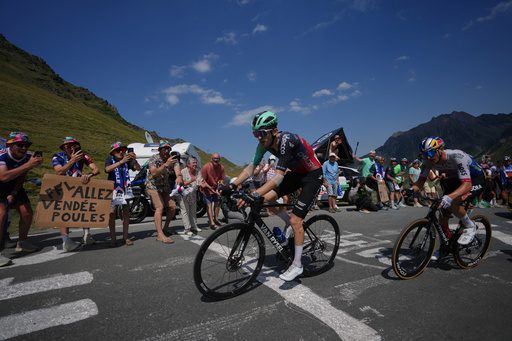
POLICY WIRE — GAVARNIE-GEDRE, France — The mountains don’t care. They just stand there, silent, enormous, — and utterly unforgiving. Every year, cycling’s gladiators throw themselves against these ancient giants, hoping to bend them to their will, or at least survive. Most simply break. This week, however, young Tadej Pogacar didn’t just survive the fearsome Col du Tourmalet; he reshaped it, turning one of cycling’s most storied battlegrounds into his own personal launching pad, and in doing so, effectively kneecapped the Tour de France after merely six days.
It wasn’t a skirmish; it was a bludgeoning. A clinical, brutal exhibition of solitary force high in the Pyrénées. Forget subtle strategies or whispered alliances. This was pure, unadulterated dominance. Pogacar, you see, he didn’t just win Stage 6. He blew the darn thing apart. He decided the race, perhaps, wasn’t going to be a prolonged strategic dance after all. Nope. It was a one-man show, with him as the reluctant-but-terrifying conductor.
“I wasn’t calculating seconds or minutes,” the Slovenian prodigy told reporters, the usual post-victory sheen visible even through his sweat. “I just wanted to go full gas all the way to the finish.” And he did. Covering the final 43 kilometers—that’s roughly 27 miles, by the way—alone, like a rogue comet, leaving everyone else scrambling in his dust. The gap, when it settled? A yawning two minutes — and 38 seconds back to his chief antagonist, Jonas Vingegaard. And just like that, the yellow jersey, the ultimate prize, was back on his shoulders.
Because that’s how it works at the top tier of any endeavor, isn’t it? One person dictates the tempo, redraws the rules of engagement. This wasn’t just physical prowess; it was psychological warfare waged at over 2,000 meters altitude. It’s the kind of performance that leaves rivals staring blankly at the road, wondering if their training logs were ever really worth the ink. It begs the question: how much mental real estate does one competitor get to occupy inside the heads of all the others? For Pogacar, it’s acres.
Vingegaard, typically stoic, offered a response that tried hard to convey measured calm, though one could sense the internal recalibration. “It’s a long race, isn’t it?” he’s quoted as saying, his eyes scanning the crowd for answers. “He had a day. We’ll have ours. The mountain never lies, but neither does tomorrow’s start line.” A polite challenge, sure, but a challenge issued from an unexpectedly large deficit this early in the proceedings.
This early knockout punch comes amidst an already blistering Tour. It’s only day six, for crying out loud. The heat, brutal across Southern Europe this summer, adds another layer of suffering to the mythic climbs like the Col d’Aspin and then the beast, the Tourmalet. Yet, Pogacar appeared almost oblivious. His UAE Emirates-XRG team rode a pace that would break most domestiques on a flat stage, setting the table for their star. He summited the Tourmalet, that ‘Hors Catégorie’ nightmare—meaning beyond classification, it’s so difficult—with an apparent ease that felt almost obscene.
And what does this show of strength truly represent beyond sports pages? It’s about perception, isn’t it? The sheer human will to conquer, to utterly dominate. It’s a narrative that resonates even in far-flung regions, say, across the rugged landscapes of Balochistan, where a lone cyclist’s aspiration for Olympic glory becomes a fleeting, fragile symbol of breaking barriers, a tiny echo of this relentless struggle against natural odds. The struggle might be for survival, or a gold medal; the internal fire’s the same.
What This Means
Pogacar’s early, emphatic claim on the yellow jersey has stark implications, extending beyond mere race standings. Economically, his dominance galvanizes sponsors; the UAE Emirates team, for instance, sees exponential returns on investment through such high-profile exposure. Athlete market value, too, skyrockets, setting new benchmarks for contracts and endorsements – a brutal economics of talent on display. Politically, a consistent champion from a smaller nation like Slovenia generates considerable soft power, elevating its profile on the international stage far more effectively than diplomatic communiques often manage. It projects an image of excellence — and determination, qualities nations covet for their global branding. The race, suddenly, becomes less about daily battles and more a coronation march, draining some of the narrative suspense for viewers, but creating an almost unshakeable aura around Pogacar himself. It’s not just a race for a jersey; it’s a statement about an era.
When the dust settled in Gavarnie-Gedre, the lead for Pogacar was not just 2 minutes, 42 seconds overall against Vingegaard, but arguably an insurmountable lead in sheer belief. A former colleague, bless her cynical heart, used to say, “Winning once is skill; winning consistently, especially this early, is usually soul-crushing genius.” You know, she might’ve been on to something.