


Presidential Jets, Covert Ops, and a Mid-Air Swap: Unpacking Trump’s Mysterious Flight Home Amid Iran Tensions
POLICY WIRE — Washington, D.C. — Somewhere over Europe, the tracking signal for Air Force One — a truly legendary aircraft— simply vanished. Not vanished as in crashed, but as in *poof*, turned off....

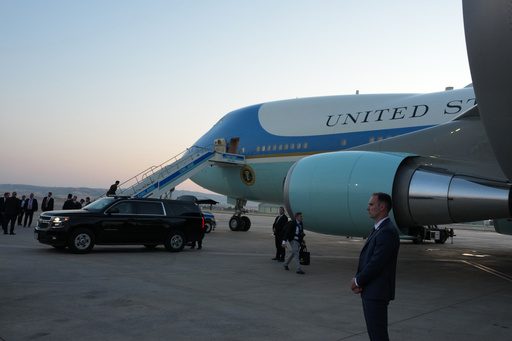
POLICY WIRE — Washington, D.C. — Somewhere over Europe, the tracking signal for Air Force One — a truly legendary aircraft— simply vanished. Not vanished as in crashed, but as in *poof*, turned off. That alone, usually reserved for journeys into active war zones or seriously dicey locales, screams loud. But this wasn’t some hot landing strip in Iraq; this was the skies above a friendly NATO ally, Turkey. It turns out, that moment of radio silence was just the opener to a bewildering saga involving two presidential jets, an unannounced swap, and thinly veiled nods to rising threats from Iran.
It was a head-scratcher. President Donald Trump, wrapping up a NATO summit in Turkey, boarded one of the venerable, baby blue Boeing VC-25As. You know, the classic ones, been carrying presidents for 3 1/2 decades. But he’d arrived in a brand-spanking-new, Qatari-gifted Boeing 747-800, gleaming red, white, — and navy blue. Why the switcheroo mid-trip? The administration initially couched it as an exhibition. Trump would fly the old bird “for old time’s sake,” he’d said. A curious rationale, no?
And because these things never happen quietly, the initial destination wasn’t home, but Royal Air Force Mildenhall in the UK. A base packed with U.S. troops, yes, but also a decidedly off-route detour for a flight from Turkey back to the States. Only at Mildenhall would Trump re-board the shiny, new Qatari jet, declaring on social media that they [QUOTE_PLACEHOLDER] He added, almost as an afterthought, “They were very excited.” Funny how it [QUOTE_PLACEHOLDER] despite appearing as a clear geographic zig-zag to any sensible map reader.
But the true twist— the really jarring part— was the underlying geopolitical tempest. All this plane-swapping charade played out as the U.S. and Iran were going at it, again, trading blows like two heavyweight boxers. The U.S. military had launched strikes in Iran. Retaliation was in the air— literally. And right there, suddenly, Air Force One’s transponder, its digital beacon to the world, went dark. It’s a standard security protocol, but usually not for a president departing a NATO partner, post-summit. But these weren’t normal times.
When pressed by reporters, Trump swatted away notions of security threats from Iran being a factor. “I have a threat all the time. I’m No. 1 on their list,” he’d declared, doubling down on previous assertions he was a prime assassination target. He’d even implied the blinds-closed directive during the flight— an odd request for journalists — was probably due to the “sleazebags over here,” a thinly veiled jab at Tehran. He was not asked to close his blinds, he mentioned. Of course.
📄 POLICY WIRE WHITEPAPER PUBLISHED: PAKISTAN'S NATIONAL SECURITY POLICY PRIORITIES
👉 READ BY CLICKING HEREThe murmurs of concern quickly escalated to questions about the new aircraft’s capabilities. You see, the Qatari jet, an immensely lavish gift, had apparently undergone a speed-retrofit costing some $400 million. Pictures suggested it simply wasn’t kitted out with the same missile detection and countermeasure systems as the older fleet. Jeremiah Gertler, a senior analyst for Teal Group, an aviation and defense consulting firm, previously told The Associated Press that the absence of these countermeasure systems, plus a smaller antenna count, hinted at a jet better suited for domestic hops, not international hot zones.
The Air Force, always keen to manage the optics, maintained they’d made the quick conversion [QUOTE_PLACEHOLDER] But then came the kicker: they did concede that “several highly complex engineering modifications required for the final (Air Force One aircraft) were intentionally excluded from the Bridge aircraft.” So, yes, it’s secure, but not *that* secure— got it. Steven Cheung, a spokesman, offered a quote that felt almost theatrical: “As the President has said recently, there are many enemies of America who have their sights on him, and we use every tool at our disposal — including distraction and misdirection — to address those threats.”
The geopolitical backdrop here extends well beyond just Iran and America, spilling over into the intricate power plays of the broader Middle East and South Asia. Nations like Pakistan, a nuclear power with its own fraught relationship with Iran, would be watching these maneuvers intently. Any perceived vulnerability in U.S. presidential security— or indeed, any misstep in the escalating conflict— could easily ripple across an already volatile region. According to the Center for Strategic and International Studies, Iran possesses various missiles and drones, including Shahed drones and Shahab ballistic missiles, with an approximate 800-mile (1,300-kilometer) range from its borders, putting countries like Turkey squarely in its reach.
What This Means
This bizarre mid-air swap wasn’t just a logistical hiccup or a president’s whim; it was a glaring, public admission of a security concern that officials then had to frantically obfuscate. Politically, it signals a deeper mistrust and escalation in U.S.-Iran relations than the administration typically broadcasts. It puts allies — think Saudi Arabia, the UAE, even Turkey itself — on high alert, wondering what sort of brinkmanship the White House is actually engaging in behind the scenes. Economically, prolonged instability in the Gulf, exacerbated by these tensions, inevitably rattles oil markets, adding a layer of unpredictable costs to global commerce. We’re also talking about the prestige, the aura, of Air Force One. To suggest the new presidential jet, touted as state-of-the-art, isn’t fully capable for an international flight during a time of heightened regional threat seriously undercuts that image. It certainly doesn’t inspire confidence when the symbol of American power looks less like a fortress and more like a work-in-progress, particularly when facing adversaries who might misinterpret capability for hesitancy. These aren’t trivial optics; they’ve real diplomatic weight and strategic repercussions, affecting everything from global inflation to regional alliances. You just don’t play fast and loose with the security protocols for the Commander-in-Chief— not when global antagonists are actively seeking advantage. It complicates the perception of U.S. technological superiority, — and that, friends, is never a good thing on the world stage. The message this sends is one of reactive scrambling, not assured, pre-emptive strategy. It’s a perception problem, absolutely. But also, potentially, a real vulnerability.
📖 GET YOUR FREE COPY NOW OF POLICY WIRE DIGITAL MAGAZINE JULY 2026 EDITION
👉 READ & DOWNLOAD FREE MAGAZINE