


The Golden Hare: How a Scandinavian Striker Remade Global Football Logic
POLICY WIRE — Oslo, Norway — It wasn’t the flaxen mane tearing across the turf, nor the expected torrent of touches inside the adversary’s eighteen-yard box. On a Sunday that etched...

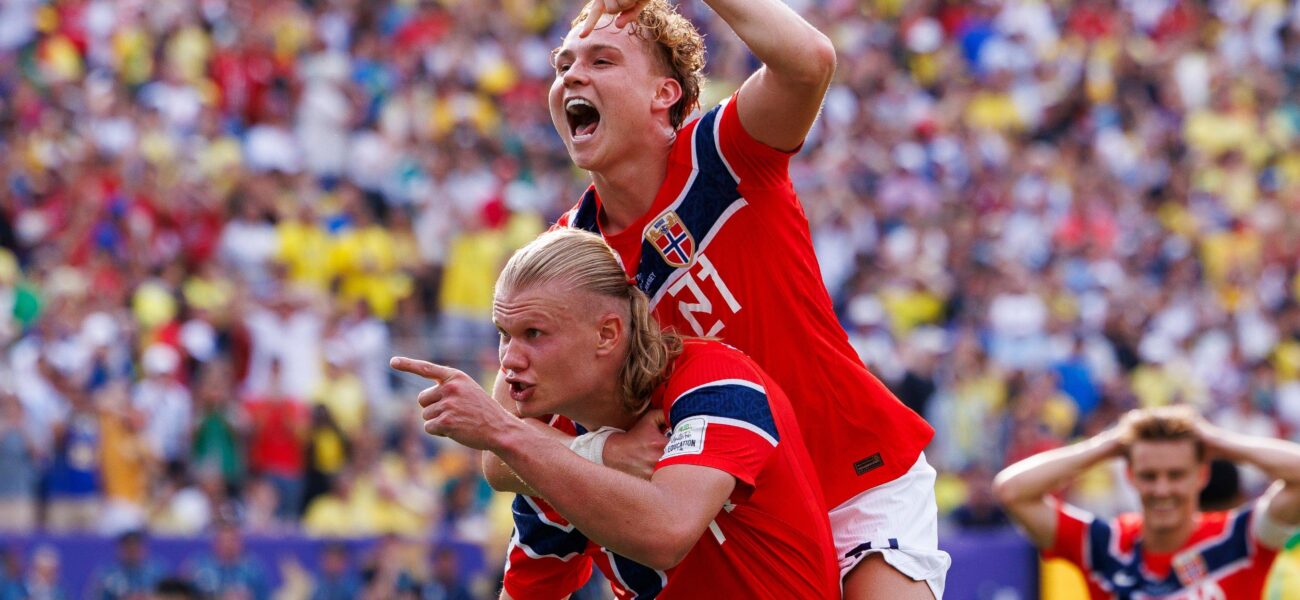
POLICY WIRE — Oslo, Norway — It wasn’t the flaxen mane tearing across the turf, nor the expected torrent of touches inside the adversary’s eighteen-yard box. On a Sunday that etched itself into Norwegian lore, the country’s footballing phenomenon, Erling Haaland, defied convention. He tallied just four touches in the box during the last-16 World Cup fixture against Brazil, yet he deposited two goals, catapulting his nation into uncharted quarter-final territory. Defenders weren’t scrambling; they were often left scratching their heads, confounded by the sheer, improbable efficiency.
It’s a peculiar spectacle, seeing a player dominate a match with so little ostensible participation. Yet, a low drive from outside the box—just 11 minutes after he broke the 79th-minute deadlock—underscored the sort of cold, calculated precision that makes him a terror on any pitch. Analysts note this latest brace brought him level with France’s Kylian Mbappe and Argentina’s Lionel Messi, commanding seven goals atop the Golden Boot race. Pat Nevin, a former Scotland winger, observed of the winning goal, “You don’t see any other player doing that.” He stressed, “There was not a chance there. There wasn’t a half chance, quarter chance. Nothing.”
And it’s this narrative of minimalist impact, maximal result, that’s truly unsettling the sport’s established guard. People always obsess over possession, over passing triangles, over a player’s all-encompassing presence. But Haaland operates by different axioms. Former England striker Ian Wright simply put it: “He didn’t have to have a lot of touches.” It’s a pragmatic truth, cutting through the romanticized notion of perpetual engagement.
This isn’t Norway’s typical script, not by a long shot. Competing in a World Cup for the first time since 1998, Stale Solbakken’s squad finds itself just three wins shy of an utterly implausible global title. England awaits them next, a team that survived its own scare, beating Mexico 3-2. But with Haaland in their corner, Norway’s improbable journey begins to feel less like a fluke — and more like destiny. Wayne Rooney captured the sentiment well, noting that Haaland “has given the whole country belief that they can go really far in this competition.”
Consider his numbers—they’re stark, almost brutal in their efficiency. According to widely published statistics, Haaland has scored 62 goals in 54 senior internationals. This includes a jaw-dropping run of netting in each of his last 14 competitive appearances for Norway, a streak amounting to 27 goals. You’d have to trace back to October 2024 to pinpoint a competitive match where he failed to find the net for his homeland. That sort of relentless productivity isn’t just about athletic prowess; it’s about a cold, unyielding will. But remember, only six of those international goals originated from the penalty spot, reinforcing the idea of unassisted, organic scoring.
The latest installment of his one-man wrecking crew came at the expense of Brazil’s Gabriel, a man with whom Haaland has shared Premier League battlefields. Before kickoff, much chatter focused on their duel. For a while, it seemed Gabriel held the upper hand, limiting Haaland to a single touch in the box before the break. Then, as games often do, this one opened up. And with the space, Haaland — the Norwegian talisman — did what he does. Gabriel was beaten for the header, then became a [QUOTE_PLACEHOLDER] for his second goal. Total touches for Haaland in the game? A mere 30. He completed just 13 passes. Yet, the question of Norway’s hero was never in doubt. Matt Upson, former Arsenal defender, put it plainly: “Does he ever have many touches? Not really. This is how he plays and it is moments. Key moments when he turns up.” Stephen Warnock added that Haaland “makes unselfish runs in behind, he pins defenders and allows that midfield area to get up.”
📄 POLICY WIRE WHITEPAPER PUBLISHED: PAKISTAN'S NATIONAL SECURITY POLICY PRIORITIES
👉 READ BY CLICKING HEREFor a country that has largely watched major tournaments from the periphery, this moment is a seismic shift. Norway’s previous best World Cup showing was two last-16 finishes, separated by half a century. They hadn’t won a knockout tie until recently; now they boast two, including one against the tournament’s most decorated side. Haaland Delivers Cold Shock: Norway Ousts Brazil in World Cup Upset – and then some. The scenes of Viking-helmet-clad supporters, the thunderous chants, the iconic Viking Row celebrations—they weren’t just celebrations. They were an expression of a nation coming into its own, thanks in no small part to their 25-year-old titan. “This is just an insane day,” Haaland declared. “It is one of the most insane days in Norwegian history.” Solbakken echoed the sentiment: [QUOTE_PLACEHOLDER] The nation, he added, was “having a great party here and in Oslo and in all the other big and small cities all the way through Norway.”
What This Means
This isn’t just a sports story. The electrifying performance of Erling Haaland, and Norway’s consequent, improbable march deep into the World Cup, possesses profound geopolitical and economic ripples. For a nation like Norway—not traditionally a footballing superpower—this sort of global sporting spotlight is an immense soft power asset. It elevates the country’s profile, enhances its brand, and cultivates national pride that can transcend domestic political divides. This burst of unexpected success functions as a global marketing campaign, entirely unbought.
And let’s consider the broader implications. The ascendance of an athlete like Haaland, hailing from a smaller European nation, echoes a shift in global sporting talent. It’s a reminder that sporting brilliance isn’t confined to established powerhouses. For nations across the developing world, from the football-crazed alleys of Karachi to the bustling markets of Dhaka—where every World Cup is watched with fervent passion, irrespective of national participation—Norway’s unlikely triumph can inspire. It demonstrates that with the right talent and a bit of luck, even a team often considered an underdog can upend titans. It speaks to a globalized meritocracy, a Whistle’s Edge: The Political Subtext of a World Cup Showdown, where the narrative can flip unexpectedly. The economic value of a player like Haaland, beyond his transfer fees, in terms of brand endorsements, merchandise, and attracting global attention to his homeland, becomes considerable. It’s a national resource, frankly.