


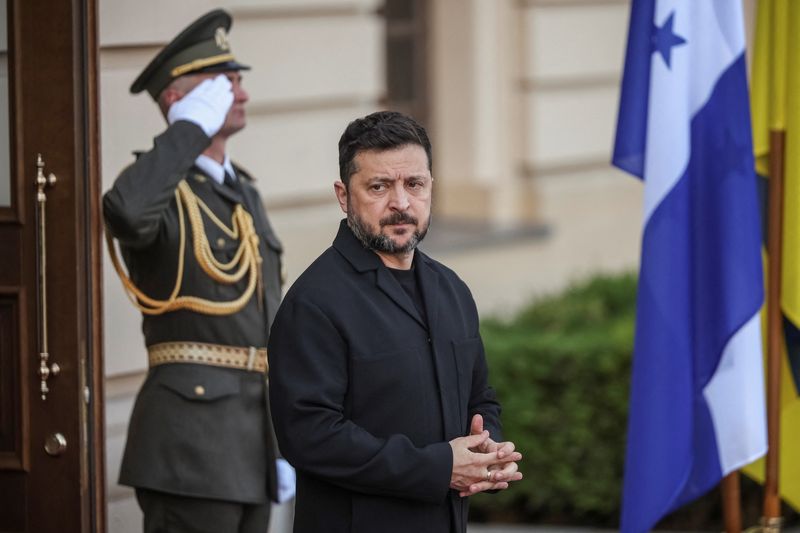
Zelenskiy’s Trump Move: Securing Ukraine’s US Aid
Ukrainian President Zelenskiy's strategic outreach to Donald Trump aims to ensure continued US aid and resolve, navigating uncertain future geopolitical shifts.

POLICY WIRE — Washington D.C., USA — It’s a dance as old as statecraft, perhaps even older, this act of courting potential power. But when that power is shaped like Donald Trump—unpredictable, transactional, and ever-present as a shadow across the international stage—the choreography gets trickier. Nobody’s just shaking hands; they’re reading tea leaves, watching the shifting sands, and trying to project a few steps ahead. For Ukrainian President Volodymyr Zelenskiy, his recent reported overture to the former American commander-in-chief isn’t just diplomacy; it’s a high-stakes, politically charged whisper across a vast ocean, betting on an outcome still half a year away.
Kyiv isn’t ignorant of the political currents churning stateside. They know Trump’s re-emergence into the electoral spotlight — his very mention of re-election — sends ripples through every chancellery from Berlin to Islamabad. Zelenskiy’s engagement, therefore, feels less like a simple check-in and more like a pre-emptive measure, an insurance policy being debated before the actual hurricane warning’s even issued. It’s an interesting tactical decision, to say the least, to bypass or, perhaps, augment ongoing dialogues with the current administration by reaching out to its likely challenger. Some might even call it a hedging strategy, though that term usually implies less drama.
The core message from Zelenskiy, reportedly, was a plea for American resolve—the exact phrase is [QUOTE_PLACEHOLDER]—in confronting the Russian aggression. That’s a loaded term, especially coming from a leader who’s lived through two different US presidencies, each with its own brand of that same resolve. We’ve seen periods of enthusiastic support, sometimes followed by grumbling internal debate over the costs, over the purpose. And Trump, historically, has shown a certain skepticism about lengthy, costly international engagements, especially those not immediately tied to direct American economic advantage. But here we’re. Ukraine can’t afford to leave any stone unturned, even if some of those stones feel a little — well, slippery.
This engagement also throws into sharp relief America’s perceived reliability across the globe. Consider Pakistan, for instance. For decades, it’s been a US ally in various conflicts, a crucial, if sometimes complicated, partner in counter-terrorism efforts. From their perspective, the US foreign policy has often felt like a pendulum swing. The rhetoric from Washington changes with each election cycle, aid packages ebb and flow, and strategic priorities pivot. A nation like Pakistan, navigating its own regional complexities with India, Afghanistan, and an increasingly assertive China, watches the American commitment to Ukraine—and any perceived wobbles—with a keen, almost professional interest. They’re gauging what a shift in Washington’s stance on Kyiv could mean for broader US commitments, particularly in unstable regions. Because what’s guaranteed one day in Eastern Europe might not be the next in South Asia.
Sources familiar with foreign policy discussions—who aren’t authorized to speak on record, naturally—suggest there’s a collective furrowing of brows among diplomats over just how steadfast a future Trump administration might be. According to a recent Congressional Research Service report, direct U.S. assistance to Ukraine totaled more than $75 billion between January 2022 and October 2023, a considerable sum that underscores the scale of prior commitments. But historical spending doesn’t always guarantee future allocations, does it?
📄 POLICY WIRE WHITEPAPER PUBLISHED: PAKISTAN'S NATIONAL SECURITY POLICY PRIORITIES
👉 READ BY CLICKING HEREThe Ukrainian side knows they’re not just fighting on the front lines. They’re fighting in the information space, in the halls of power, and in the unpredictable theater of American electoral politics. Their calls for consistent resolve aren’t just about today; they’re a quiet plea to secure tomorrow, no matter who’s occupying the Oval Office. And for a country like Ukraine, where every missile strike reminds you of existential threats, you simply don’t have the luxury of political indifference.
What This Means
Zelenskiy’s reported dialogue with Trump isn’t merely a cordial chat; it’s a significant, if perhaps risky, diplomatic maneuver signaling a pragmatic assessment of future geopolitical realities. Politically, it broadcasts Kyiv’s determination to insulate its Western support from the vagaries of a US election cycle, acknowledging that even hypothetical shifts in the White House can—and do—alter strategic calculations worldwide. It’s a bold pre-computation of risk, one that could either bolster Ukraine’s long-term position or, if mishandled, potentially complicate relations with current allies who might see it as undermining unity.
Economically, this sort of pre-emptive engagement touches directly on the sustained financial and military aid that keeps Ukraine afloat. Should a future Trump administration significantly scale back support, Ukraine’s economic viability and warfighting capacity would suffer immensely, triggering profound destabilization across European markets and beyond. Global supply chains, energy markets, and the international defense industry are all sensitive to the sustained flow of US funds and weaponry. For nations in the broader Muslim world and South Asia, including Pakistan, a potential shift represents both a concern and an opportunity. A reduced American footprint in Europe might mean a re-evaluation of US engagements elsewhere—either drawing more attention to their own regional conflicts or, conversely, signaling a broader retreat into an isolated posture. It implies that every significant power—including those beyond the West—has to consider what their geopolitical cards look like if a major player decides to change the rules of the game. It’s an economic forecast delivered through the lens of political speculation—a tricky business, you’ll agree, for everyone involved. What Kyiv’s trying to do here, essentially, is ensure America’s checkbook doesn’t suddenly go dry. It’s all about perceived security, — and perceived security means business.