


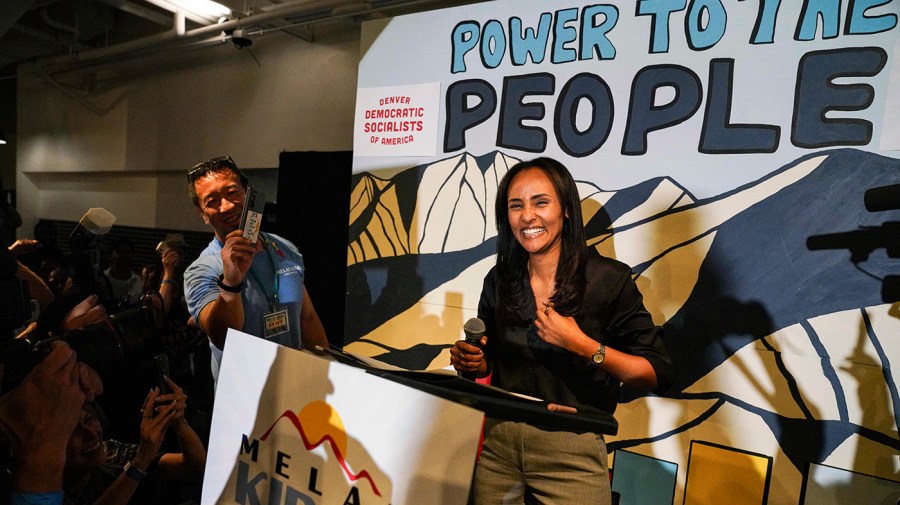
Campaign Finance Rebellion: Kiros Rejects Corporate PACs
Melat Kiros sparks a rebellion against traditional campaign finance, refusing corporate PAC money. Explore how this bold move could transform DC politics and influence.

POLICY WIRE — Washington, D.C. — Washington’s corridors hum a peculiar tune, a constant, low thrum made by the turning gears of influence. It’s a sound familiar to anyone who’s spent more than a decade observing the political dance here, an intricate waltz between ambition and capital that typically keeps all players in step. Then, a sharp note, unexpectedly, cuts through the orchestration, often from someone you barely know yet. And that’s where the story of Melat Kiros, or at least her striking position, truly begins.
It’s not often someone stands up and says, point-blank, what she’s been saying, especially if they plan on sticking around the political arena. But Kiros, whatever her immediate ambitions (or lack thereof, if her words are taken at face value), has done just that. She’s drawn a clear, bold line in the sand, essentially stating she won’t be playing by one of the city’s oldest, most entrenched rules. [QUOTE_PLACEHOLDER] That single, stark pronouncement doesn’t just reject a specific type of funding; it rejects a substantial slice of the fundraising apparatus that props up the vast majority of political careers in this nation.
Corporate political action committees, or PACs, are more than just legal entities; they’re the arteries of Washington’s financial bloodstream. They bundle donations from company employees, sometimes executives, — and direct them to candidates. Proponents argue it’s a perfectly legal way for business interests to engage in the democratic process. They’ve got a right to be heard, right? And, gosh, campaigns aren’t cheap; you’ve got to fundraise, right?
But critics – and there are plenty, though often drowned out by the sheer volume of campaign cash – argue corporate PAC money serves as a thinly veiled mechanism for special interests to gain access and sway. It’s often not about direct bribes, not usually. It’s subtler, a system built on reciprocal favors and the cultivation of long-term relationships, where the perception of obligation can be as potent as any explicit quid pro quo. And that perception, well, it bothers a lot of folks outside the Beltway. It certainly seems to bother Kiros.
Now, think about this system, this elaborate financing web. It’s got parallels across the globe, perhaps nowhere more starkly than in fledgling democracies or countries where institutional transparency remains a perennial challenge. Take Pakistan, for instance, a nation grappling constantly with political instability and the enduring influence of powerful business elites and, yes, other institutions in its civilian governance. Discussions there often revolve around the murky origins of campaign funds, or how industrial conglomerates can seem to dictate policy agendas through connections and financing. It’s a different context, sure, but the underlying tension – money versus true democratic representation – isn’t so far off.
In fact, the question of who finances politicians and why is a global quandary, stretching from Karachi’s bustling financial district to the marbled halls of Parliament in Islamabad, where calls for accountability regarding economic ties to politics are consistently loud, if sometimes unheeded. The average voter, whether in Peshawar or Peoria, wonders if their voice is truly amplified when the pockets of power are deep and well-connected. Melat Kiros’s statement, delivered from wherever she stands, echoes those same profound anxieties.
The numbers don’t lie, not usually. For instance, in the 2022 election cycle alone, corporate PACs contributed over $312 million to federal candidates, according to data compiled by OpenSecrets.org. That’s a chunk of change, enough to ensure that few, if any, aspiring politicians can completely ignore it without facing significant hurdles. So, when someone declares, with such disarming directness, that I’m not supporting anyone for leadership who takes corporate PAC money, it really means they’re willing to swim against a mighty strong current.
It means embracing a more arduous path, likely relying on smaller, individual donations – the grassroots strategy, as it’s quaintly called. But it also presents an intriguing proposition: does such a principled stand, even if it hobbles a campaign financially in some traditional ways, unlock a torrent of alienated voters, tired of politics as usual? This isn’t just about an election cycle; it’s about framing the future of public service itself. Will this ripple grow into a wave, or will it simply fade, an interesting but ultimately isolated moment?
The rejection of corporate PAC funds often goes hand-in-hand with broader calls for campaign finance reform, a debate that’s never truly settled in Washington. It’s part of a larger push to reform American politics, sometimes touching on subjects as modern as digital assets and campaign transparency. We’ve written about Washington grappling with crypto cache as ethics watchdogs gaze sideways, a novel front in an old battle. But for all the new wrinkles, the underlying tension — who influences power, and with whose money — stays constant.
What This Means
Kiros’s stance isn’t just a talking point for a campaign flyer; it’s a direct challenge to the unspoken rules that govern campaign viability and political ascendance. Economically, if more candidates adopt such a policy, it could shift the entire ecosystem of political fundraising. Corporate interests, accustomed to easy access, would need to find new avenues for influence—or perhaps accept reduced direct leverage over individual candidates. Politically, this move, if it gains traction, could polarize debates around campaign finance further, forcing a reckoning with whether the current system truly reflects democratic ideals or primarily serves the well-heeled. It could inspire other hopefuls, particularly those from outside the traditional political class, to pursue similar strategies, leading to a leaner, perhaps less financially competitive, but potentially more ideologically pure field of candidates. But the established powers aren’t just going to roll over. They’ve built this system over decades, after all. Change is hard. And it’s always met with resistance, isn’t it? Especially when big money’s involved.