

Kentucky Drowns: Bluegrass Deluge Exposes Stark Realities Beyond Local News Cycles
POLICY WIRE — FRANKFORT, Ky. — Saturday in Kentucky dawned not with the promise of a peaceful weekend, but with the menacing thud of nature’s relentless percussion. It began, for many, as just...

POLICY WIRE — FRANKFORT, Ky. — Saturday in Kentucky dawned not with the promise of a peaceful weekend, but with the menacing thud of nature’s relentless percussion. It began, for many, as just another rainstorm—the kind you grumble about, sure, but quickly forget. But it morphed, with shocking swiftness, into something far more sinister: a deluge that swallowed roads, invaded homes, and, ultimately, claimed lives. Four of them, Governor Andy Beshear reluctantly confirmed, turning routine reports into tragic obituaries. This wasn’t merely inconvenient weather; it’s a stark, sodden reminder of how fragile our engineered comfort really is.
It’s moments like these, you know, when the everyday grind just… stops. Floodwaters don’t much care for appointments or the weekly grocery run. In Madison County, for instance, a man and a woman were found, lifeless, in their own house—their sanctuary transformed into their tomb by the invading waters. Another victim, authorities say, was plucked from a vehicle, stranded in a current too strong to ignore. Not exactly the bucolic image Kentucky likes to project, is it?
“We’ve got search and rescue crews out there right now, pushing through waist-deep water in some places, trying to reach folks, trying to make sure no one else is trapped,” said Carlos Coyle, the deputy Madison County coroner, his voice carrying the weary urgency of a man grappling with overwhelming loss. He didn’t sugarcoat it. Some areas? Still cut off. Completely. They simply couldn’t get to them. And this wasn’t some slow-motion disaster, unfolding over days; this happened in hours.
The numbers behind this chaos paint a grim picture. The National Weather Service had been tracking it, of course, but even their prognostications sometimes fail to capture the sheer destructive power of water. They reported between 4 and a staggering 10 inches had already swamped some areas in southwestern Indiana and bordering Kentucky by late Saturday. More was on its way. Governor Beshear’s office had warned of up to 7 inches targeting parts of the state through the late evening, almost casually mentioning it just before the catastrophe hit. Now, a state of emergency blankets Kentucky, an official acknowledgement that this isn’t just a bad day—it’s a full-blown crisis.
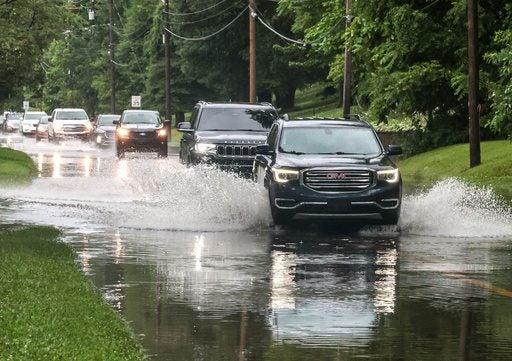
Beshear, looking grim-faced, addressed the unfolding situation, appealing to the very common sense that often goes out the window during such events. “This is a serious flooding event, folks. We’ve already had to pull multiple people from their cars — and homes,” he stated, his words measured but emphatic. “As more heavy rain pounds down, we absolutely need people to stay off the roads, especially after dark. You can’t see what you’re driving into—and you certainly don’t want to find out the hard way.” His exasperation, a mix of official duty and personal concern, was almost palpable. His social media feeds lit up with warnings: ‘significant roads underwater,’ he posted, alongside images of submerged pavement. Over a dozen state routes, he confirmed, were simply out of commission. Gone. Invisible beneath the churning muck.
And because misery loves company (or perhaps, because the climate doesn’t discriminate), northwest Kentucky, near Louisville, found itself grappling with a precarious landslide. Officials there, in Bullitt County, urged evacuations, fearing a dam embankment could give way. It held, they said, but it was a nerve-wracking reminder of the wider systemic stresses—the land itself buckling under the unprecedented weight. Kentucky, like much of the world, seems caught in a climate feedback loop that asks too much of aging infrastructure and traditional response mechanisms. Even in affluent states, preparedness feels perpetually one storm behind.
📄 POLICY WIRE WHITEPAPER PUBLISHED: PAKISTAN'S NATIONAL SECURITY POLICY PRIORITIES
👉 READ BY CLICKING HEREIt makes you wonder, doesn’t it, about the future. If a comparatively well-resourced state like Kentucky can be caught so thoroughly off guard, what does it mean for places with far less to throw at the problem? You see headlines like this – a handful of lives lost, infrastructure compromised – and then your mind drifts to regions like South Asia. Pakistan, for example, just two years prior, saw monsoons unleash such fury they displaced eight million people and caused billions in damages. From the Bluegrass State to the Indus Valley, the script feels depressingly familiar, only the scale changes—and the resources available for the cleanup. But the fundamental vulnerability? It’s strikingly similar.
What This Means
The immediate political fallout here in Kentucky is clear: the governor, already navigating a host of state-level challenges, now faces a monumental recovery effort. His leadership will be judged not just on initial response, but on the long, grueling work of rebuilding and providing aid. Politically, every dollar of state funding, every request for federal assistance, will be scrutinized. Economically, the hit to local businesses, farming communities—remember, this is Kentucky—and residential areas will be significant, forcing towns like Richmond to grapple with immediate solvency issues and longer-term emigration risks.
Beyond the local immediate, this event subtly shifts the broader climate change discussion. For a state deeply connected to its agricultural heritage and—let’s be honest—traditional energy industries, the direct human cost of extreme weather might push the needle, however incrementally, on local and federal policy conversations around climate resilience. We often hear about abstract ‘global warming targets,’ but it’s events like this that bring it home, hard — and wet. the echoes across continents aren’t accidental. As global temperatures creep up, weather patterns destabilize. These aren’t isolated incidents. The same hydrological shifts impacting the Ohio Valley also intensify monsoons across the Subcontinent. Understanding this interconnectedness, from Frankfort’s submerged roads to India’s precarious monsoons, is crucial for policymaking. It demands not just reactive flood barriers, but proactive strategies, both local and international, to cope with a world that’s getting decidedly wetter in all the wrong places.