


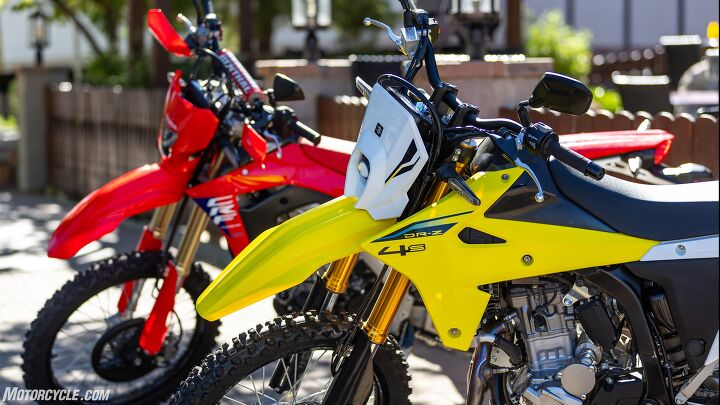
Honda, Suzuki in Asia: Dual-Sports, Diplomacy & Dust
Unpack the true meaning of Honda & Suzuki dual-sports in Asia. These bikes aren't just transport; they're geopolitical tools, driving economic power & shaping national identity.

POLICY WIRE — Tokyo, Japan — Forget the glossy showrooms. Dismiss, for a moment, the romanticized roar of an engine or the exhilaration of off-road prowess. Because down to its bare metal, the global dual-sport motorcycle market — a niche, you might argue — is a remarkably clear-cut barometer of broader geopolitical currents and entrenched industrial rivalries. Specifically, when we talk about Honda’s CRF450RL and Suzuki’s DR-Z400S, we aren’t just comparing displacement and suspension travel. We’re dissecting divergent industrial philosophies battling for market penetration in some of the world’s most dynamic, and often infrastructurally challenged, economies.
It isn’t about peak performance for some desert race, you see. It’s about the often-unseen machinations of industrial diplomacy, about brands projecting national economic power onto two wheels. These aren’t just motorcycles; they’re foot soldiers in a quiet war for the hearts, minds, and wallets of an aspiring global south. Their true arena isn’t some slick advertisement; it’s the rugged hinterlands of countries like Pakistan, Vietnam, and Indonesia, places where the roads give way to dust tracks, and reliable mobility isn’t a luxury, it’s a lifeline.
Honda, with its almost imperious dominance, projects an image of refined, almost surgical engineering. The CRF450RL, while built on a competition chassis, somehow still manages to whisper of an underlying reliability, a certain corporate confidence. But Suzuki? Its DR-Z400S, a machine nearly two decades old in its fundamental design, doesn’t pretend. It’s a workhorse. It’s an honest, if unflashy, response to the raw, unvarnished demand for durability over digital dash wizardry. And this dichotomy, believe it or not, reflects a deeper schism in how major industrial players view emerging markets.
But how does a single-cylinder thumper become a vector for international relations? Simple. Accessibility. For young people in countries with limited public transport and often-atrocious road networks, a robust motorcycle means employment, access to education, even healthcare. But they need something tough. Something that won’t disintegrate at the first pothole, and critically, something that local mechanics can fix with a hammer and a prayer. And parts, dear reader, can be an absolute nightmare if the supply chain hiccups.
Consider the remarks from Kenji Tanaka, a Senior Advisor at the Japan External Trade Organization (JETRO), who offered this candid perspective: “Our commitment isn’t merely to engineering superiority, though we pride ourselves on it. It’s about providing robust, accessible mobility solutions that foster economic activity—a subtle diplomacy, you might say, designed to build long-term relationships through the sheer dependability of our products.” It’s an interesting turn of phrase, ‘subtle diplomacy,’ especially when referring to what’s, at its heart, a glorified dirt bike with a license plate.
And then there’s the other side of the coin. Dr. Ayesha Khan, Director of Planning for Pakistan’s Ministry of Industries and Production, put it more bluntly during a recent seminar: “These aren’t just bikes for our young people; they’re instruments of opportunity, assuming we can bridge the gap between their global ambition and our local economic realities and infrastructure woes. We welcome Japanese investment, certainly, but local assembly — and part localization remain paramount. It’s not sustainable otherwise.” Her point couldn’t be sharper. The aspiration for these global brands often crashes into the cold hard fact of import duties, foreign exchange shortages, and domestic manufacturing capabilities—or lack thereof.
Indeed, according to a 2023 report from the Japan Automobile Manufacturers Association (JAMA), motorcycle exports to South Asia alone saw a 12% increase last year, with an observable shift towards smaller displacement bikes and ‘dual-sport’ capable models. This isn’t coincidence. It’s calculated. It’s Japan doubling down on a segment it believes will sustain growth long after established Western markets become saturated, or, heaven forbid, shift entirely to electric alternatives. The strategy, one suspects, hinges on creating generations of brand loyalty that simply don’t question Honda or Suzuki when a more pressing issue, like reliable daily transport, is on the line. And because these bikes represent that reliable workhorse.
What This Means
This ostensibly minor two-wheeled tussle actually illuminates several significant geopolitical — and economic threads. First, it highlights Japan’s quietly persistent industrial strategy: secure long-term market share in rapidly urbanizing and industrializing regions. While Western manufacturers chase high-margin segments in developed economies, Tokyo’s giants are patiently seeding markets that will define the next half-century of global consumption. They’re banking on reliability — and accessibility, not flash.
But the story also reflects the deep tensions within developing economies like Pakistan. They yearn for advanced, reliable products, but simultaneously struggle with the economic leakages caused by imports. Their own nascent industries strain against the efficiency — and scale of multinational behemoths. Localizing production, reducing import burdens, fostering domestic expertise—these are policy goals directly influenced by consumer demand for products like these Japanese bikes. For governments, managing this balance—between aspiration and economic reality—becomes a continuous, delicate dance. It shapes trade policy, incentivizes foreign direct investment, and ultimately, influences how nations position themselves on the global stage. It’s not just a motorcycle; it’s a moving part of national identity — and economic destiny.