


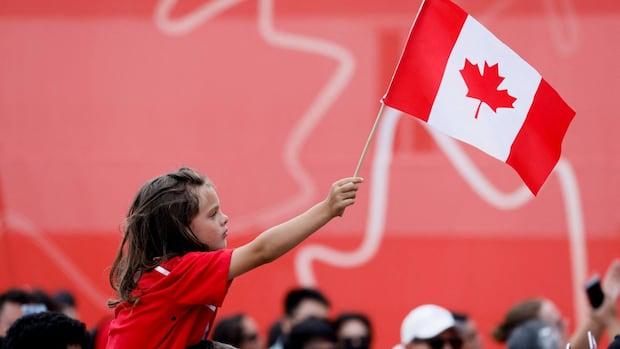
Canada Day 159: Live Celebrations Across Nation
Discover the full broadcast schedule for Canada's 159th birthday. Experience live coast-to-coast celebrations from Halifax to Banff, uniting the nation.

POLICY WIRE — Ottawa, Canada — As Canada prepares to mark its 159th year of confederation, a comprehensive broadcast schedule has been unveiled, promising live coverage spanning the nation from the Atlantic to the Rocky Mountains. The elaborate production aims to capture the spirit of Canada Day with multiple hosts orchestrating festivities across various key locations, bringing a nationwide perspective to the significant annual event.
The day’s extensive programming kicks off with live morning coverage emanating directly from the scenic Halifax Waterfront. Here, veteran broadcasters David Common and Carolyn Ray are slated to commence the celebratory transmission, setting the initial tone for the country’s collective birthday observance. The east coast opening serves as a traditional launching point for pan-Canadian celebrations, leveraging the historical significance of the region as an entry point for many aspects of Canadian identity.
Following the East Coast inauguration, the focus is scheduled to shift inland to the nation’s capital. Adrienne Arsenault and Omar Dabaghi-Pacheco will then pick up the broadcast from Ottawa’s LeBreton Flats Park, a prominent venue frequently utilized for large-scale public events and national commemorations. This segment aims to centralize the broadcast’s energy, positioning the capital as the ceremonial heart of the day’s proceedings. Concurrently, a live call-in show, hosted by Saroja Coelho, will originate from a Toronto studio, providing an interactive element for citizens across the country to participate and share their reflections on the national holiday.
The geographical breadth of the celebrations continues to widen into the afternoon, moving westward to the majestic setting of Banff, Alberta. Here, Ian Hanomansing — and Gloria Macarenko are scheduled to anchor live afternoon coverage from Banff’s Bear Street. This western segment ensures that the vast natural beauty and diverse cultural tapestry of Canada’s western provinces are well represented in the national narrative of celebration. The choice of Banff underscores Canada’s celebrated landscapes and outdoor heritage as integral to its national identity.
As the day progresses into evening, the broadcast itinerary guides viewers back to the iconic LeBreton Flats in Ottawa. At 7 p.m. ET, Adrienne Arsenault returns, joined by Elamin Abdelmahmoud, to preside over the concluding stages of the day’s observances. This structured, cross-country journey through the celebrations highlights a significant logistical and journalistic undertaking, designed to weave together diverse regional festivities into a singular national tapestry.
Such extensive broadcast plans are standard for major national holidays, particularly Canada Day. They require considerable coordination across different teams and locations to ensure a seamless viewer experience, underscoring the collaborative effort required to stage an event of this magnitude. The selection of various cities—from historic Halifax to the capital Ottawa, bustling Toronto, and picturesque Banff—deliberately showcases the geographical and cultural diversity that defines Canada, even as it seeks to unite these elements in a shared moment of national pride.
What This Means
The orchestration of a cross-country broadcast for Canada’s 159th birthday signifies more than just a celebratory schedule; it reflects a deliberate national effort to foster unity and reaffirm collective identity. In an increasingly fragmented global landscape, national broadcasts on significant anniversaries serve as crucial anchors, drawing citizens into a shared experience, regardless of their physical location. The emphasis on live, evolving coverage from multiple distinct regions suggests an aim to be inclusive of various Canadian experiences, from urban centers to natural landmarks.
the participation of well-recognized national personalities provides a familiar and trusted guide through the day’s events, which can strengthen public engagement. The sheer scope of the broadcast, transitioning from one major Canadian locale to another, also inherently communicates a message about the nation’s vastness and interconnectedness. It presents an opportunity for reflection on Canada’s history and its future, using a carefully choreographed public media spectacle as its canvas. Whether such comprehensive coverage genuinely galvanizes national sentiment, or simply provides a backdrop for local festivities, it undoubtedly forms a central component of how modern nation-states commemorate their foundational moments and articulate their ongoing narrative to their populace.