


The Almighty’s Trucks: Trump Blurs Divine Mandate with Political Maneuver
POLICY WIRE — Washington D.C. — You don’t often find divinity in the diesel fumes of a campaign trail, do you? Yet, here we’re, facing down America’s impending 250th birthday, and...

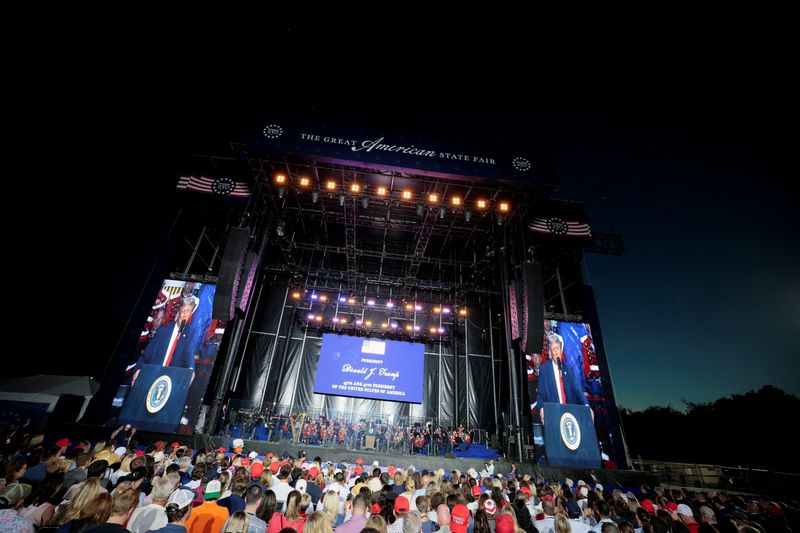
POLICY WIRE — Washington D.C. — You don’t often find divinity in the diesel fumes of a campaign trail, do you? Yet, here we’re, facing down America’s impending 250th birthday, and the political narrative’s gotten a decidedly holy spin. Ex-President Donald Trump, never one to shy from grand pronouncements, has hitched the nation’s semiquincentennial to the heavens, rebranding the colossal anniversary as nothing short of a ‘gift from God’ — delivered, presumably, by a fleet of what his camp terms ‘Freedom Trucks’.
It’s a peculiar brand of patriotism, this latest invocation. The image: lumbering symbols of industry, emblazoned with banners, traversing the land, not just celebrating two-and-a-half centuries of earthly governance, but seemingly bearing a sacred writ. Forget the meticulous machinations of the Founding Fathers; perhaps they were just divinely appointed haulers all along. But what does it mean when a leading political figure wraps the whole national project in such unequivocally supernatural cloth? It’s not just a celebration; it’s an anointing, a theological endorsement of the American experiment as one guided by higher powers. And not everyone’s buying it.
Because, let’s be real, mixing politics with such direct appeals to the divine tends to get complicated, fast. Critics quickly point to the historical discomfort, the fine line between civic pride — and messianic exceptionalism. Senator Maggie Hassan, Democrat from New Hampshire, didn’t pull any punches, telling Policy Wire, “Frankly, when politicians start claiming direct access to divine favor for their platforms, it just makes me nervous. Democracy’s messy. It’s about people, debate, and compromise—not some preordained outcome packaged for a rally.” She’s got a point, hasn’t she? It certainly makes the legislative process a little awkward if one side believes its policies are literally God-given.
But the sentiment isn’t new, — and it certainly resonates with a significant chunk of the electorate. A 2022 Pew Research Center study indicated that nearly six-in-ten Americans believe God has a special plan for the United States, a belief particularly strong among white evangelicals. That’s a powerful undercurrent to tap into. And Trump, a master at tapping into powerful undercurrents, he’s doing just that. Senator Ted Cruz, a Texas Republican often keen to connect faith with policy, offered a different take. “Look, America has always seen itself as a nation blessed, uniquely positioned. When President Trump says our future, our resilience, is a ‘gift from God,’ he’s articulating a foundational belief shared by millions. It’s not about making policy decrees divine; it’s about acknowledging the spiritual strength that underpins our national character.”
Ah, the old national character bit. It’s a compelling argument for many. This isn’t simply a July 4th picnic. It’s a meticulously crafted fusion of evangelical fervor, populist rallying, and good old-fashioned American self-belief. The “Freedom Trucks” aren’t just parading; they’re acting as mobile pulpits, preaching a very specific doctrine: that the country’s trajectory, its prosperity—and, implicitly, its leadership—are all part of a larger, divinely sanctioned plan.
Naturally, this kind of messaging isn’t just felt domestically. In parts of the world where state and spiritual identity are more overtly intertwined, like Pakistan, such pronouncements get read through a different lens. For an American politician to suggest divine intervention in national destiny isn’t some abstract philosophical musing; it’s a statement of perceived legitimacy, a historical claim that echoes—sometimes unsettlingly—with how religious figures or nationalist leaders across the Muslim world often frame their own nation’s existence and future. They see the same appeals, the same conflation of national project with divine will, even if the deities and historical contexts are radically different. It’s a reminder that similar rhetorical patterns—the claim of divine exceptionalism—aren’t unique to the American landscape; they’ve left Lahore’s streets grappling with different kinds of ‘divine’ proclamations too.
And so, as the 250th anniversary countdown truly begins, we’re not just watching the inevitable spectacle of national celebration. We’re witnessing a politically charged theological sermon being delivered from the flatbeds of tractor-trailers, an exercise in identity politics taken to its most ethereal, most grandiloquent extreme. It’s all rather theatrical, isn’t it? The trucks, the faith, the claims. It’s a show with very high stakes, shaping not just how America sees its past, but how it intends to march into its future—allegedly, with divine approval in tow.
What This Means
The embrace of overtly religious nationalism, particularly from a figure as polarizing as Trump, deepens the cultural chasm already apparent in American politics. Economically, these sorts of grand, faith-infused events are highly effective in grassroots fundraising, energizing a base, and drawing media attention—all without directly engaging in detailed policy debates. It consolidates support among religious conservatives, while simultaneously alienating secular voters and those who believe in a strict separation of church and state. The implication for global politics is also significant; this rhetoric fuels perceptions abroad, especially in countries accustomed to similar mixes of religion and statecraft, of America’s increasingly ideological and inward-looking trajectory. It casts the nation not just as a global actor but as one believing itself divinely ordained, which can complicate diplomatic efforts and international cooperation—who argues with God’s plan? It’s an election strategy, pure — and simple, cloaked in biblical certainty and hauled across the landscape on 18 wheels.
But how do you legislate for a country that believes its foundation is an explicit divine mandate? You don’t. You rally, you inspire, — and you dismiss your opponents as, perhaps, working against a higher power. It sets up an us-versus-them dynamic that’s increasingly hard to bridge, because disagreements stop being merely political and start brushing against sacrilege. It’s an astute play for a base that craves such validation, but it makes governing for everyone else a tougher slog.