


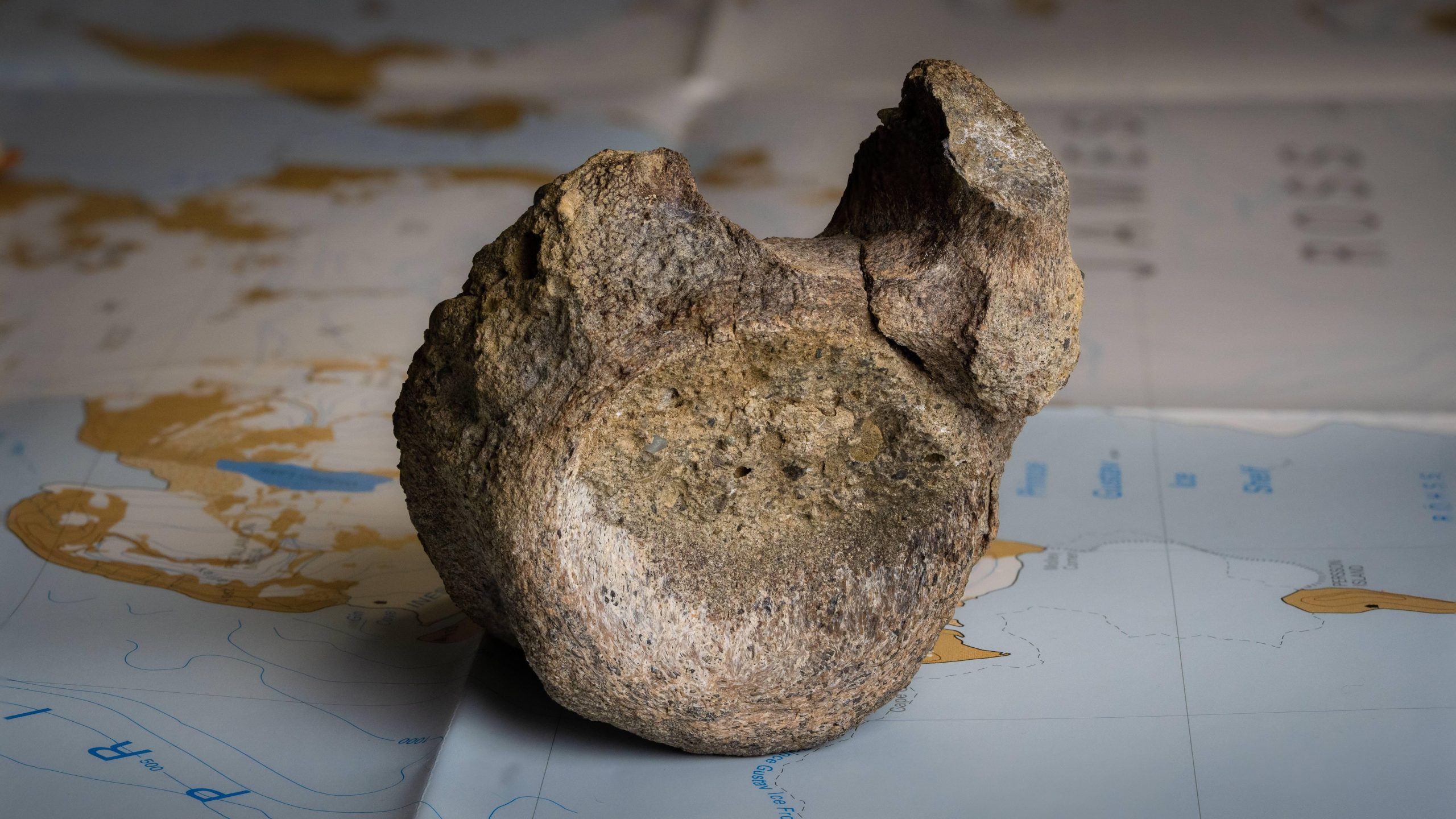
Antarctica’s Dinosaur Bone: A Bureaucratic Find, a Planetary Re-think
POLICY WIRE — Washington, D.C. — They say history is written by the victors, but often, planetary history—the really ancient stuff, before any empires rose or fell—sits tucked away in museum drawers,...

POLICY WIRE — Washington, D.C. — They say history is written by the victors, but often, planetary history—the really ancient stuff, before any empires rose or fell—sits tucked away in museum drawers, waiting for a bored intern or a curious researcher to simply stumble upon it. And so it was for Antarctica, a continent we usually associate with ice, desolation, — and penguins. Turns out, it used to be home to dinosaurs, and our first solid proof wasn’t unearthed by intrepid explorers in a blizzard. Nope. It just showed up in an institutional filing cabinet. Talk about a cold case.
It’s an image that’s hard to shake, isn’t it? The sheer magnitude of a creature that roamed Gondwana some 190 million years ago, its fossilized remains having endured epochs, ice ages, and continental drift—only to end its multi-million-year journey resting anonymously among paper clips and forgotten coffee stains. The specimen, a modest ankylosaur vertebra (part of its backbone), didn’t exactly scream world-altering discovery at first glance. But there it was, the First dinosaur bone from Antarctica found in a drawer. You just couldn’t make this stuff up. This particular bone was initially excavated way back in 1986 during an Australian geological survey on James Ross Island, yet somehow, it then embarked on its own long, silent peregrination through various collections and hands, its true significance slipping through the cracks for over two decades. It’s enough to make you wonder what other buried truths, what other momentous finds, are patiently biding their time in cardboard boxes in back rooms from Karachi to Canberra. [QUOTE_PLACEHOLDER]
This oversight isn’t merely an amusing anecdote about disorganized academia. No, it hints at something much deeper. It speaks to the often haphazard, underfunded, and human-fallible nature of scientific endeavor, especially when it involves distant, resource-intensive locales. Antarctica isn’t exactly easy turf for a dig, is it? Access is brutal, costs are astronomical, and the conditions themselves can be—well, Antarctic. But the existence of this bone, identified finally by scientists at the Natural History Museum in London, drastically alters our understanding of paleogeography. It doesn’t just put another pin on the dinosaur map; it fills in a critical missing piece of the ancient supercontinent jigsaw. An ankylosaur, a creature generally considered a low-to-the-ground grazer, now placed on an landmass then connected to South America, Australia, and Africa. It reinforces theories that dinosaurs, even the less migratory ones, thrived across vastly different climates before the great break-up.
The saga also throws a stark, sometimes uncomfortable, spotlight on resource allocation for scientific research and collection management. How many valuable specimens, collected at enormous effort and expense, remain uncatalogued or misidentified for years because of inadequate staffing or institutional memory gaps? One study from the University of Washington noted that less than 5% of deep-sea expedition data is ever formally published, highlighting a broader challenge in maximizing the returns on complex scientific ventures. You know, these things aren’t cheap. It costs millions to send research teams to the frozen continent. But then a key discovery ends up collecting dust. Something’s off, right?
Consider the parallel challenges in South Asia, where rich archaeological and paleontological sites are abundant but often suffer from similar neglect or resource limitations. Pakistan, for instance, sits on a trove of unexplored ancient history, from Mehrgarh to the Indus Valley Civilization, and possibly even dinosaur remains given its Gondwanan past. But political instability, funding priorities, and sometimes a lack of trained personnel mean that countless discoveries likely remain unearthed, or worse, discovered and then relegated to obscurity in less-than-ideal storage. Imagine what insights about continental drift, early human migration, or forgotten biodiversity might be sitting in a backroom in Lahore or Mohenjo-Daro, waiting for its accidental rediscovery. It’s not just a dinosaur bone; it’s a commentary on global scientific equity, or the lack thereof.
What This Means
The late recognition of Antarctica’s first confirmed dinosaur bone, years after its initial collection, carries a punch beyond mere paleontological fascination. It serves as a stark reminder of humanity’s organizational foibles—a bureaucratic archaeology, if you will—even in our most sophisticated scientific institutions. Economically, this delayed recognition impacts funding justification for future polar expeditions. When a past investment yields returns only decades later, it complicates the pitch for immediate budgetary allocation for difficult and expensive research. Policymakers, already wrestling with competing demands, might see such inefficiency and be less inclined to greenlight the next multi-million-dollar Antarctic venture.
Politically, the story subtly highlights issues of scientific infrastructure — and international cooperation. The Antarctic Treaty System maintains the continent for peaceful scientific research, a delicate geopolitical balance. But if nations aren’t adequately processing their finds, if basic cataloging goes astray for 20 years, it raises questions about the overall effectiveness and accountability of those scientific custodianships. It also points to the value—and the vulnerability—of knowledge management in a world obsessed with instantaneous data. Sometimes, the most profound insights aren’t new; they’re just forgotten. And it makes you wonder what else is hiding in plain sight. This could inform discussions about data sharing protocols and archive standards in, say, climate science or pandemic research, where meticulous record-keeping isn’t just about an old bone, but about planetary survival. If we can miss an ankylosaur in a drawer, what else are we missing? What could Pakistan’s neglected fossil sites teach us about our shared past, before the lines were drawn?
But—and this is key—it also offers a strange comfort. Despite human inefficiency, despite all the bluster — and noise, truth has a way of eventually surfacing. The dinosaur bone, patient as bedrock, eventually got its moment. Perhaps the lessons here aren’t just about better organization, but about cultivating a deeper institutional humility, understanding that true discoveries can take their own sweet time. It’s an interesting thought, right? That an ancient creature, simply by existing in a drawer for decades, could prompt such a reflection on our modern systems.