


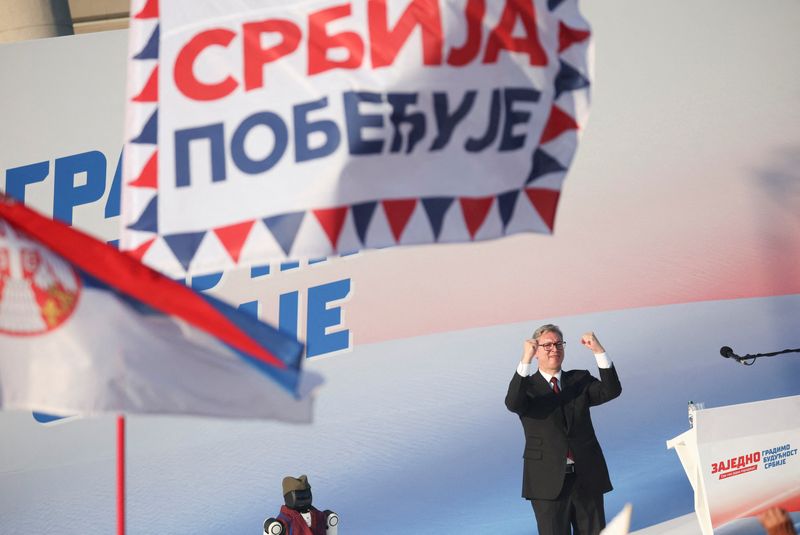
Belgrade’s Brewing Storm: Vucic’s Calculated Retreat Amidst Youthful Roar
POLICY WIRE — Belgrade, Serbia — A chilly autumn wind often sweeps through the streets of Belgrade, but lately, it’s carried more than just fallen leaves. It’s carried the murmur—then the roar—of...

POLICY WIRE — Belgrade, Serbia — A chilly autumn wind often sweeps through the streets of Belgrade, but lately, it’s carried more than just fallen leaves. It’s carried the murmur—then the roar—of discontent. This is the atmosphere that Serbian President Aleksandar Vucic has chosen for his impending exit, announcing a departure within weeks. It wasn’t the sound of parliamentary debate that finally bent the leader of the Serbian Progressive Party (SNS); it was the boots on the pavement, belonging largely to a younger generation fed up with the status quo. What a show.
It’s a peculiar thing, power. One moment, you’re standing tall, commanding the narrative. The next, the ground shifts beneath your well-shod feet. Vucic’s decision, disclosed publicly and framed with a typical flair for the dramatic— [QUOTE_PLACEHOLDER] —didn’t come from nowhere. But it certainly wasn’t telegraphed with clear, ringing bells beforehand. Student protests, gaining steam over recent weeks, have coalesced around frustrations far deeper than a few bad policy calls. They’ve screamed about what they perceive as deep democratic erosion and an iron grip on information flow, issues that make any opposition struggle to find daylight.
And let’s be honest, Serbia isn’t exactly a stranger to political theatre, nor to citizens demanding change. For all its European aspirations, the country’s democratic muscles—weaker than many would like—get a workout whenever leadership becomes too comfortable. The demonstrations, reportedly drawing tens of thousands, predominantly students, didn’t just pop up like spring crocuses. They grew from a long-simmering stew of economic angst — and concerns about fundamental freedoms. You see it across the globe, actually: a new generation, digitally native and globally aware, won’t settle for the same old stories.
But this isn’t just about young people being grumpy. There’s real bread-and-butter stuff here. Inflation in Serbia, for instance, soared to a punishing 16.2% year-on-year in April 2023, according to data from the Statistical Office of the Republic of Serbia. That sort of financial gut punch hits everyone, but it stings hardest for those just starting out, for families trying to make ends meet. When you combine that sort of economic pressure with perceived authoritarian tendencies, you get a highly flammable situation. Suddenly, that calculated move looks less like a strategic masterstroke — and more like a retreat under fire. But hey, a retreat can be strategic, too, right?
Because nobody believes this is Vucic simply packing his bags for a quiet retirement to tend to his roses (assuming he has roses). Political analysts are, almost uniformly, spinning this as a savvy, pre-emptive strike, positioning for snap elections. They’re saying he might just be trying to reset the political chessboard on his terms, before the protests fully crystalize into a unified opposition force. It’s a classic populist playbook: disrupt the narrative, call an early vote when your opposition is disorganized, and bank on the perception that you’re responding to the people while really consolidating power for a refreshed mandate.
The echoes aren’t just local; they resonate across the broader region—and frankly, further afield. Think about the volatile political shifts and youth activism seen in Pakistan, a nation where similar concerns about economic stability, democratic integrity, and the influence of powerful elites often ignite public fury. Student-led movements there, too, have historically played a critical role in challenging entrenched power structures, pushing for greater accountability, and often encountering strong state responses. The dynamic isn’t identical, obviously, but the underlying tensions—frustrated aspirations meeting rigid governance—are hauntingly familiar. These are not isolated incidents; they’re symptoms of a global anxiety about representation — and basic needs.
Meanwhile, the situation in Kosovo continues to simmer—always a flashpoint for Serbian nationalism—and neighboring nations like Bosnia-Herzegovina and Montenegro are watching this particular chess match with considerable interest, perhaps even a bit of apprehension. Vucic, for all his controversies, has been a central, if sometimes exasperating, figure in maintaining a fragile regional stability, or at least managing its instability. His departure, even if temporary, introduces an element of uncertainty. It could embolden some, unnerve others. It’s never dull in the Balkans, is it?
What This Means
This isn’t a simple resignation; it’s a political detonation. Economically, a sudden leadership vacuum, even if Vucic orchestrates his successor, introduces market jitters, potentially complicating Serbia’s foreign investment appeal and its path toward EU integration. Investors hate instability. Political capital, already strained by high inflation — and social unrest, might find itself even more devalued. But for ordinary Serbs, particularly the young, this signals a rare moment of tangible leverage. Their voices, loud — and clear on the streets, seem to have actually compelled a powerful leader to react. It’s a powerful lesson in collective action. What comes next, likely a swift general election, will dictate whether this energy translates into systemic change, or if Vucic’s cunning merely re-routes the river back into familiar channels. History, especially in this corner of the world, tells us it could go either way. And don’t forget the regional implications. A wobbling Serbia sends ripples across the Western Balkans, a territory already navigating complex historical grievances and geopolitical pressures. It might mean a fresh opening for external influence, for better or for worse.