

Shadow Play in Albuquerque: A $2,000 Mystery, Global Echoes
POLICY WIRE — Albuquerque, United States — It’s a strange world where two thousand dollars — pocket change in the grand scheme of modern financial shenanigans — becomes the advertised incentive to...

POLICY WIRE — Albuquerque, United States — It’s a strange world where two thousand dollars — pocket change in the grand scheme of modern financial shenanigans — becomes the advertised incentive to unmask perpetrators of what, on the surface, looks like a run-of-the-mill street crime. But here we’re, New Mexico, where the Federal Bureau of Investigation (FBI) is dangling precisely that sum for anyone who can finger a duo involved in a low-stakes ATM grab. You see a modest crime; Policy Wire sees a fascinating window into our priorities.
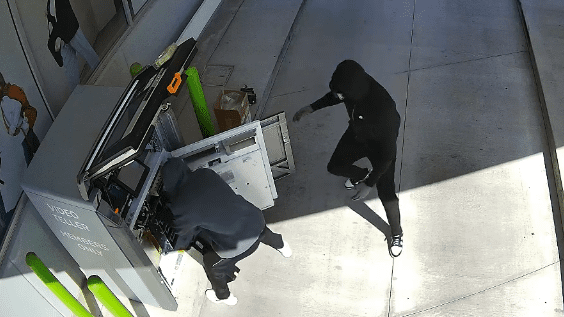
It’s not often you’re faced with such a stark contrast. The vast, often abstract machinations of international finance, the shadowy global markets where billions vanish or reappear at the click of a mouse, seem to recede into the background. Instead, the focus tightens on two masked men, caught in a moment of brute-force avarice. They didn’t hack the system or launder millions through offshore accounts. They didn’t even conduct an elaborate vault heist. No, these folks targeted a Nusenda Credit Union ATM, a solitary dispenser of hard cash. [QUOTE_PLACEHOLDER]
The incident itself—short, sharp, almost a non-event by federal standards—happened Wednesday, June 24 at about 10:05 a.m. But think about the optics. Masked, yes. Ski goggles, an intriguing touch for the New Mexico desert (or perhaps just effective anonymity). Dark clothing, of course. They hit the machine at 7644 Jefferson Street NE and then, presumably with a wad of cash that’ll be difficult to deposit anywhere but under a mattress, they scarpered. They bolted on foot to an adjacent parking lot, a move that speaks less of criminal genius and more of desperate improvisation. The FBI and Albuquerque Police Department said the two men wore dark masks, ski goggles and dark clothing before running on foot to an adjacent parking lot.
And now, the Feds want information. Badly enough to offer $2,000. It’s a bounty that, when weighed against the maximum prison terms on offer—a potential prison term of up to 20 years for simple bank robbery, or up to 25 years if a weapon or hoax device was involved—makes you wonder about the risk-reward ratio from the perpetrators’ perspective. They’re playing for keeps, but the price tag on their identity seems rather meager, doesn’t it? Anyone with information should call the FBI at (505) 889-1300 or call Albuquerque Metro Crime Stoppers anonymously at (505) 843-STOP. You know, just in case $2,000 moves you to action.
This localized drama, almost quaint in its simplicity, contrasts sharply with the intricate web of financial movements impacting regions like South Asia. Think about the remittances flowing into countries like Pakistan, often through informal hawala networks, a necessary evil born of economic realities and trust, but also a massive blind spot for formal financial oversight. Or consider the staggering amounts of money linked to corruption or drug trafficking that cross borders, untraceable except through extraordinary international efforts. For these global operations, the bounty often isn’t cash, it’s political will, complex intelligence, and years of diplomatic wrangling.
According to FBI statistics, financial institutions across the U.S. reported over $19 million in losses from robberies, burglaries, — and larcenies in 2021. This small ATM hit adds to that sum, yet it barely registers in the global ledger of financial malfeasance. The fight against street crime, though always important for public safety, occasionally feels like a sideshow to the bigger battles playing out in the digital ether and corporate boardrooms, often with ties that stretch into nations where transparency is, let’s say, a fluid concept.
What This Means
This small-time robbery, with its relatively paltry reward, is a microcosm of our broader societal discomfort with financial insecurity and the inconsistent allocation of investigative resources. We see intense federal focus on deterring visible street crime, even when the financial gains for criminals are minimal, and the reward for informants barely warrants a second thought for many. Why such emphasis on small, localized hits when transnational financial crimes — from ransomware attacks to elaborate money laundering schemes that benefit destabilizing regimes or terror groups – wreak havoc on a truly global scale? It’s a question of optics, mostly.
It’s simpler, and certainly more publicly satisfying, to catch a guy in ski goggles who ran off with a few thousand dollars than it’s to dismantle an international network facilitating, say, capital flight from a developing nation, crippling its economy and perpetuating poverty. The latter is invisible, complex, politically charged; the former is tangible, easy to explain, and makes for good local news fodder. And because it’s tangible, the state — via the FBI — will pay. The perceived stability of the immediate community, symbolized by secure ATMs and swift apprehension of those who challenge that, often overshadows the more abstract, yet profoundly impactful, global financial pathologies. Our policy on policing small infractions versus combating systemic international financial vulnerabilities continues to show a bias toward the immediate, the visible. But how does that really secure us in the long run? Especially when much larger, shadowy transfers might even fund operations that eventually boomerang back as direct threats, far removed from an ATM on Jefferson Street? It’s a curious balancing act, isn’t it? One could even argue that such localized events, if not examined in context, give a false sense of security, much like assuming a single, hot day in July portends an entire summer’s weather. But we’ve seen how interconnected things really are, from financial markets to climate shifts – just look at the struggle for reliable monsoon seasons threatening the livelihood of hundreds of millions, as examined in Parched Futures: India’s Monsoon Gamble Threatens Billions Amidst Shifting Climates.