


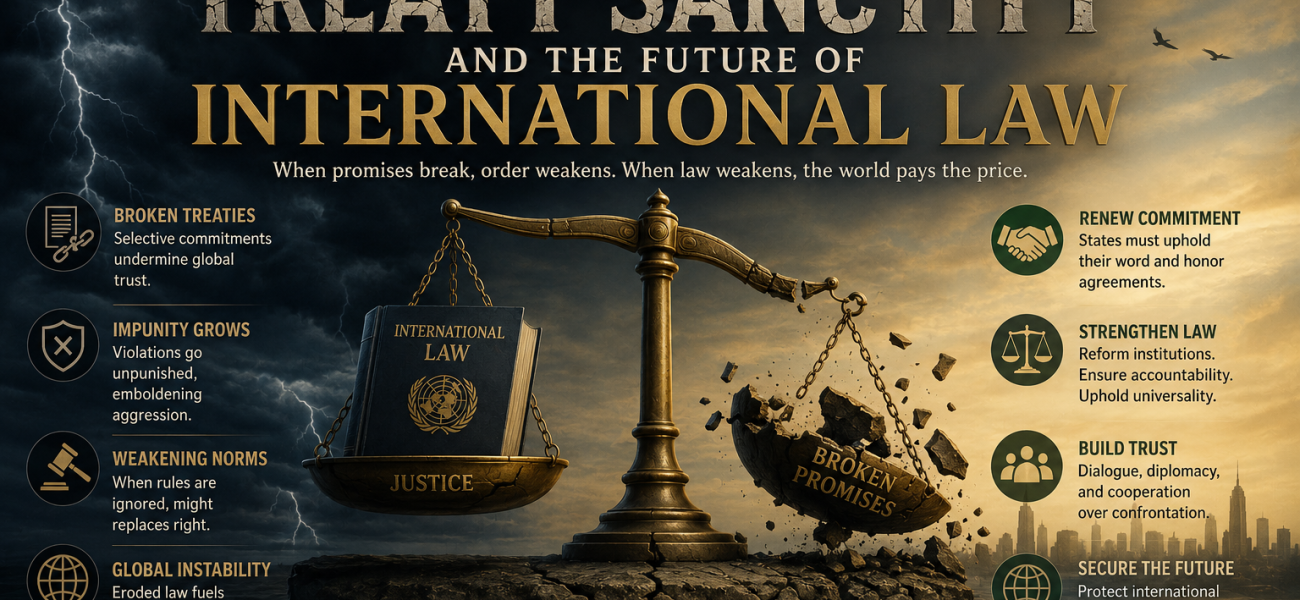
The Erosion of Treaty Sanctity and the Future of International Law
The Indus Waters Treaty (IWT) is considered to be one of the strongest water agreements across the globe due to its survival for more than six decades without interruption during the 1965, 1971 and...

The Indus Waters Treaty (IWT) is considered to be one of the strongest water agreements across the globe due to its survival for more than six decades without interruption during the 1965, 1971 and 1999 Kargil wars, among the existing tension in diplomatic relations between the two nuclear neighbors. The stability of the treaty is an evidence of the effectiveness of the treaty-based approach to ensure the right water shares of Pakistan in difficult situations. It has been proved that the principle of cooperation should always be observed in case of international agreements because it is necessary to respect these agreements even under certain political tension. For Pakistan, it is crucial to ensure the inviolability of the treaty because otherwise, it will violate the regional balance and endanger the trust in international agreements, which are the foundation of existence for many weak states.
The resources of the indus river system are not marginal resources. Irrigates one of the largest continuous agricultural systems in the world, and sustains the livelihoods of almost 300 million people in Pakistan and India. About 90% of the country’s agriculture production potential is in the Indus Basin, with agriculture accounted for about 23% of the GDP, around 37% of the workforce and contribution to overwhelming use of groundwater as a freshwater source. Agriculture, already consuming water, uses almost 93 per cent of the available freshwater in Pakistan—showcasing the country’s vulnerability of having reliable river flow for the economy and food security. The ambiguity and uncertainty of water governance, therefore, go beyond the environmental…
The treaty itself was signed in 1960 after almost ten years of negotiations that were lead by the World Bank. It decided that the eastern rivers: Ravi, Beas and Sutlej would be shared between India and Pakistan, but the western rivers: Indus, Jhelum and Chenab would be allotted to Pakistan with limited flows allowed under the agreement. This agreement is one of the most detailed water-sharing agreements ever negotiated, with detailed technical provisions, inspection plans, notification requirements, and a range of dispute-resolution systems, including commissioners and neutral experts as well as arbitration if needed, built into the plan. It has been described as proof that institutionalized cooperation is able to stand even immense political or ideological differences.
When considering matters globally, the significance of adhering to treaties becomes further stark. There are over 310 transboundary river and lake basins in the world with nearly 600 transboundary aquifers and 153 countries that share them, according to the United Nations. Approximately 40% of the world’s population resides in these common water systems. The demand and pressure on freshwater resources is accelerating due to climate change, population growth and industrial development. World Bank estimates are that by 2050 water scarcity may cause up to 6 percent decline in GDP in some regions and the United Nations estimates that the demand for freshwater globally may rise by 20 to 30 percent by 2050. In such situations, the importance of water-sharing agreements that have to be enforced through law grows stronger for the success of international stability.
Clearly, the overall issue is not just a treaty question, nor a regional issue. This is because international law is not the same as domestic legal systems and is dependent on voluntary compliance and reciprocity. Global enforcement of treaty obligations is not possible because there is no international body which can do it consistently all over the world like national courts. The validity of international commitments thus relies much on the good faith of the laws of the land in fulfilling their obligations in the face of varying political realities. The looting of treaties and undermining their adherence by powerful powers could lead to the smaller and medium powers asserting doubts in the future regarding the actual security of these negotiated treaties. This could lead to the wrong impression of unilateralism at a time when cooperation is needed more than ever.
The upshot are particularly important because water conflicts are increasingly common. Water was used as a trigger, weapon or casualty of water conflict in significantly greater numbers over the last two decades as documented in the Water Conflict Chronology compiled by the Pacific Institute. At the same time, UN estimates almost 2.4 billion people are in countries with water stress and more than 4 billion people are severely water-stressed at least for one month a year. In light of these background factors, maintaining trust in treaty-based water management is no longer a regional issue, but a global priority.
📄 POLICY WIRE WHITEPAPER PUBLISHED: PAKISTAN'S NATIONAL SECURITY POLICY PRIORITIES
👉 READ BY CLICKING HEREThe situation is worse in South Asia, as a region. The area has about 25 percent of the world’s population but only about 4 percent of the world’s fresh water sources. Lack of sufficient supplies is being stressed at unprecedented levels due to rapid urbanisation, Himalayan glacier retreat, variability of the monsoon season and groundwater depletion. The Indus Basin is highly reliant on snow and glacier melt, known as the “Third Pole” (THP), of the Hindu Kush–Karakoram–Himalaya Region. Predictable institutional cooperation has never been more valuable than it is today, as scientific studies start warning of the effects of climate variability on changes in river flows and the importance of cooperation between institutions above that.
Pakistan has always held point that the disputes related to the Indus Waters Treaty must be resolved through the Treaty’s legal and technical provisions and not through unilateral actions. This promotion comes from a general trend in diplomacy towards sorting out disputes under internationally accepted laws and systems. For Pakistan, this is fundamental not only in maintaining water security but also the continued validity of treaties in times of political unrest.
It also raises other important questions and provisos in this debate in relation to the future of the rules-based international order. There are thousands of bilateral and multilateral treaties in the world that regulate the sphere of international relations, such as in the field of trade and investment, aviation, marine boundaries, arms control, protecting environment, and other natural resources. The United Nations Treaty Collection holds over 560 multilateral treaties with the UN Secretary-General and states enter into thousands of bilateral treaties that exist throughout the world. The success of these arrangements will assume that there will be any settlement of disputes through mutually agreed on legal methods and not by unilateral breaches of commitments.
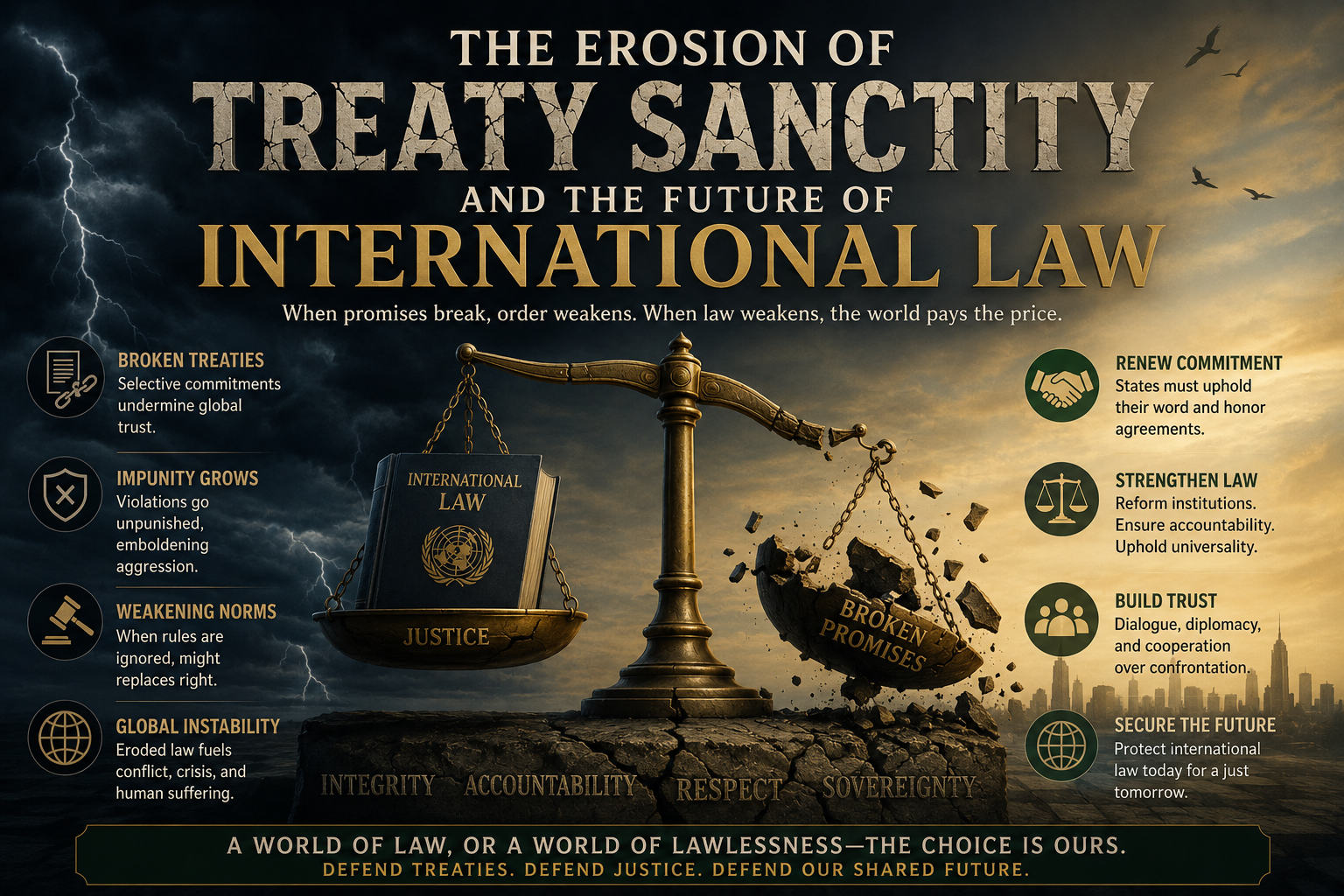
The problem is far from limited in scope to the waters of Indus in the end! It asks whether global treaties serve as reliable tools for peace or are even more fragile than ever due to the dynamic geopolitical scenarios. In the coming decades, the sanctity of treaties is set to be one of the most critical challenges in the test of international governance of the 21st Century in the daily struggles for water, food and energy.The sanctity of treaties will prove a crucial challenge in the arena of international governance in the coming decades, in the contestation over natural resources that is becoming fierce in the 21st Century. The mistrust of binding commitments would not just impact South Asia, but also every part of the world where nation-states rely on negotiated treaties to peacefully share common resources. This is not only a matter of treaty fulfillment, but also of the stability of the world; credibility needs to be backed up in an age of strategic rivalry and environmental threat.
Author