

Red Card: Uruguayan Frustration Boils Over in World Cup Exit, Global Implications Loom
POLICY WIRE — Montevideo, Uruguay — The final whistle often brings jubilation or quiet resignation. For Uruguay, however, it brought an all-too-public implosion. You don’t often see a nation,...

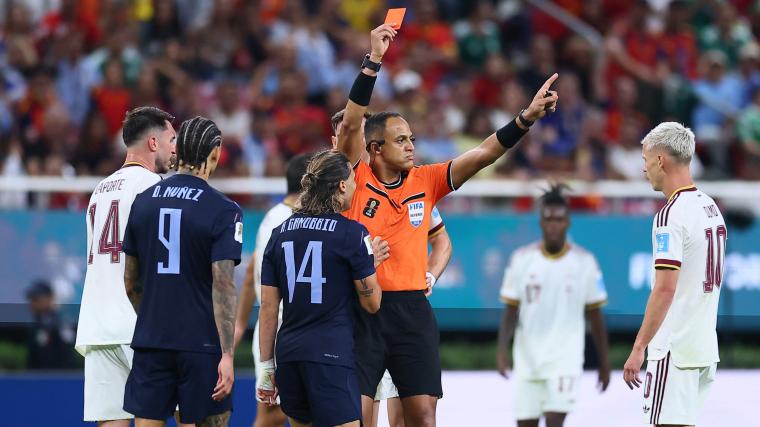
POLICY WIRE — Montevideo, Uruguay — The final whistle often brings jubilation or quiet resignation. For Uruguay, however, it brought an all-too-public implosion. You don’t often see a nation, supposedly a heavyweight, sputter out of a major tournament with barely a whimper, much less with one of its players getting a send-off mere moments before the real goodbye. Agustin Canobbio’s ignominious red card—for a nasty tackle near the end of Friday’s losing effort—wasn’t just a moment of sporting ill-discipline. It felt like a fever breaking on a national frustration, a collective sigh from a country that prides itself on its gritty, never-say-die spirit.
They’ve been there before, haven’t they? Knockout stages, glory. But this time? This tournament, an expanded World Cup meant to broaden participation, paradoxically made Uruguay’s exit sting more. It’s much more difficult for high-level teams to get "grouped" and miss the knockout stage in the expanded World Cup, and the frustration of being one of the 16 teams to fall short was palpable for Uruguay on Friday night. A 1-0 loss to Spain sealed their fate, an end to a campaign that had, frankly, already seen better days. No wins. None. Just two draws against Saudi Arabia — and Cape Verde, before Friday’s lifeless surrender. [QUOTE_PLACEHOLDER]
That Canobbio moment, a desperate lunge resulting in an immediate dismissal, was hardly an isolated incident. The tension had been building, a simmering pot of expectation — and underperformance. The two teams jawing and Uruguay’s Nicolas de la Cruz earning a yellow card just minutes earlier suggested emotions were already running hot. When the red card came out, Canobbio was furious after the call and had to be held back by teammates on the sideline as Uruguay continued to bicker with the referee. It was theater, sure, but the kind nobody wants to be the star of.
You can’t just chalk it up to bad luck, either. Uruguay, entering as the world’s 19th-ranked team according to FIFA, came with expectations, albeit guarded ones, of at least making it past the group stage. They could have won Group H with a win over Spain. A draw would’ve given them a fighting chance. But what they mustered against Spain was a mere six shots — and possession for less than a third of the game. That’s not a team playing for survival; that’s a team on a life support system. Canobbio might not have believed his slide tackle warranted a red card, but the frustration from him and his teammates likely had more to do with the circumstances of a shocking exit.
It’s fascinating, though, how a sports narrative so often mirrors a larger global one. Take their draw with Saudi Arabia. Here you have a South American football giant struggling against an opponent many would traditionally deem a longshot. This isn’t just about athletic parity; it speaks to the shifting landscape of global power, particularly as nations in the Muslim world invest heavily in soft power initiatives—be it infrastructure, cultural exports, or indeed, sport. They’re building up, these nations, finding their stride in ways many old guards aren’t quite grasping yet. And sometimes, you see that play out on a football pitch, too.
📄 POLICY WIRE WHITEPAPER PUBLISHED: PAKISTAN'S NATIONAL SECURITY POLICY PRIORITIES
👉 READ BY CLICKING HEREThis whole debacle, Canobbio’s outburst — and all, won’t be just a footnote in sporting history for Uruguay. For a nation where football is so intricately tied to national identity and pride, a performance like this—or rather, a non-performance—can ripple out. It impacts national morale, it changes perceptions abroad, — and it gives ammunition to regional rivals. They don’t forget these things, not in South America. The image projected is one of a once-feared contender now visibly fraying at the edges, perhaps emblematic of deeper structural challenges back home.
What This Means
Uruguay’s inglorious departure isn’t just a sports story; it’s a commentary on a small nation’s global standing. For Montevideo’s political elite, the team’s struggles on the international stage are a potent, if indirect, blow to national confidence. A strong showing in a global spectacle like the World Cup can be a potent tool for soft diplomacy, attracting investment, tourism, and boosting domestic sentiment. This exit does the opposite. It highlights fragility, invites introspection, and forces a reevaluation of what ‘success’ truly means in a globalized world.
Economically, while a red card on the pitch doesn’t directly crash the stock market, the cumulative effect of a dispiriting performance can subtly affect perceptions. Tourist receipts, while not solely dependent on football, feel the pinch when national pride takes a hit. And for aspiring footballers, whose careers represent significant economic potential, an early exit means less exposure, fewer scouting opportunities, and a more difficult path. This is a cold, hard dose of reality, reminding everyone that even for an institution as storied as Uruguayan football, past glory doesn’t guarantee future triumphs. It just doesn’t. And that’s a lesson applicable far beyond the confines of a stadium.