


World Cup’s Brutal Arithmetic: Scotland’s Fate Dangles, A Global Balancing Act
POLICY WIRE — Doha, Qatar — The gladiatorial hum of the World Cup doesn’t just reverberate across manicured pitches; it echoes in countless living rooms, across vast geopolitical landscapes,...

POLICY WIRE — Doha, Qatar — The gladiatorial hum of the World Cup doesn’t just reverberate across manicured pitches; it echoes in countless living rooms, across vast geopolitical landscapes, and in the anxious quiet of locker rooms like Scotland’s. For Steve Clarke’s squad, the collective breath of a nation hangs by a precarious mathematical thread, stretched taut across ongoing group stage fixtures. It isn’t just about athletic prowess anymore. Oh no. This is pure, unadulterated sports agony, where fate’s dice roll on distant fields, dictating dreams in Glasgow.
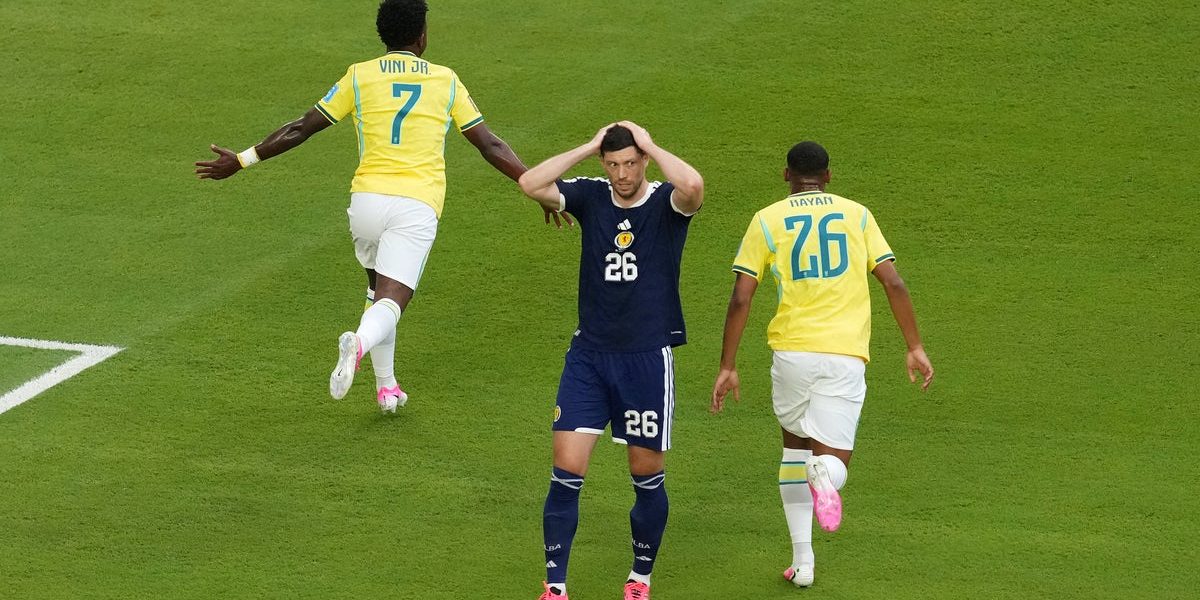
After a somewhat disjointed run in Group C—a hopeful opening win against Haiti, followed by a tight 1-0 stumble against Morocco, and then a frankly dispiriting 3-0 shellacking by Brazil—Scotland finds itself in that most uncomfortable of positions: spectators to their own destiny. They’re marooned with three points — and a goal difference of -3, looking outward. That’s it. They can’t do anything else. Their future, much like global market volatility, depends entirely on external factors.
Only eight of the twelve third-placed teams get a golden ticket to the knockouts. Meaning, Scotland isn’t just vying for a spot; they’re in a bizarre lottery, needing four teams from other groups to finish with fewer than their three points, or a worse goal difference. And let’s be real, the early returns haven’t been kind. South Africa’s surprise triumph in Group A, Ecuador’s stunning upset over former champions Germany in Group E, and particularly Senegal’s overwhelming 5-0 dismissal of Iraq in Group I, have all conspired to push the Scots perilously close to the precipice. That Senegal victory, for instance, sealed their passage and unequivocally nudged Iraq out, showcasing how interconnected — and brutal — this tournament really is.
Because these margins are so thin, every pass, every save, every whistle thousands of miles away becomes a make-or-break moment. Coach Steve Clarke, never one for flowery language, summed up the mood back home quite starkly. “We’ve done what we can on the field,” Clarke stated in a pre-tournament interview, echoing sentiments now haunting his side. “Now we wait. It’s an agonizing position to be in. But it’s the nature of these global competitions.”
The stakes couldn’t be clearer. In Group G, eyes are glued to the Egypt vs. Iran showdown. Scotland desperately needs an Egypt win, but only if the other Group G clash, New Zealand vs. Belgium, isn’t a draw. A draw there complicates things, potentially pushing a third-place team past Scotland’s meager three points. And further east, nations in our focus region like Iran are fighting their own battles—battles that reverberate far beyond the stadium. Football success in places like Iran or Algeria can offer rare moments of national unity, sometimes overshadowing domestic political friction. It’s more than just a game there, it truly is.
Further west, Group J sees Algeria, with its rich footballing history and significant geopolitical standing, facing Austria. Algeria, also on three points, currently has a slightly worse goal difference. Scotland wants Austria to win, preferably by a couple of goals. If Algeria pulls off a four-goal romp, that complicates it even more, reshuffling the goal difference standings to Scotland’s detriment. But, the drama doesn’t stop. Group K offers another cliffhanger involving Uzbekistan against DR Congo. The Uzbeks, a Central Asian nation frequently overlooked in global sports discourse, currently hold a -7 goal difference. A draw, or a narrow Uzbekistan win, keeps them below Scotland. But should DR Congo clinch a victory, they’ll leapfrog with four points. It’s a cruel game of dominoes.
📄 POLICY WIRE WHITEPAPER PUBLISHED: PAKISTAN'S NATIONAL SECURITY POLICY PRIORITIES
👉 READ BY CLICKING HERE“It’s frustrating, certainly, seeing results that directly impact your national team unfold in other hemispheres,” said Hamish MacPherson, a Scottish FA official. “But this tournament structure—it highlights the interconnectedness of world football. Every national association, from Iceland to Cape Verde, is now inextricably linked in this intricate dance.”
What This Means
This nail-biting scenario for Scotland isn’t just a sports story; it’s a policy study in miniature on the unpredictable economics and politics of global sports. For smaller nations, participation—let alone success—in an event like the World Cup carries immense soft power benefits, boosts national morale, and offers a potentially significant economic stimulus through tourism, merchandise, and international media exposure. Qualification for the knockout rounds alone is estimated to be worth millions of dollars to participating nations, an investment that can trickle down to grassroots programs and infrastructure, reinforcing national identity and often—let’s be honest—distracting from pressing domestic issues.
The brutal mathematical criteria here expose the ruthless meritocracy of global tournaments, where even admirable efforts aren’t enough if other nations simply perform better, or get luckier. The ripple effects across financial markets or diplomatic relations are minimal, sure, but the impact on national psyche, especially in regions with a passionate, often volatile, relationship with football, is anything but. Consider the fervour in nations like Algeria or Uzbekistan for their teams; success can be unifying, disappointment—well, disappointment often requires some national healing. And these global showdowns continue to capture unprecedented audiences, with FIFA reporting over 5 billion engagements across platforms for the previous World Cup alone, illustrating its immense cultural, and thus policy, footprint.
If, by some stroke of statistical good fortune, the dice finally roll Scotland’s way, they’re likely facing Group A winners Mexico in the Round of 32—a daunting challenge but a glorious one. After that? A tantalizing clash against ‘old rivals’ England potentially looms, setting the stage for an explosive, highly charged encounter. Because that’s football, isn’t it? Even at its most heartbreaking, it always offers another dream.