

City Under Siege: Paris Parks Become Open-Air Dorms as Heat Scorches Europe
POLICY WIRE — Paris, France — The city of lights, known for its romantic promenades and late-night revelry, now hums with a different sort of nocturnal activity. It’s not revelers clinking glasses in...

POLICY WIRE — Paris, France — The city of lights, known for its romantic promenades and late-night revelry, now hums with a different sort of nocturnal activity. It’s not revelers clinking glasses in chic bistros. No. It’s hundreds, maybe thousands, of ordinary Parisians, stretched out on blankets and makeshift beds in public parks, clutching fans, and trying to coax some sleep from the suffocating summer air. This isn’t a fleeting anomaly; it’s a creeping new normal—a quiet, desperate exodus from overheated apartments into the slightly cooler, but certainly not cool, open expanse of parks like the Parc André Citroën.
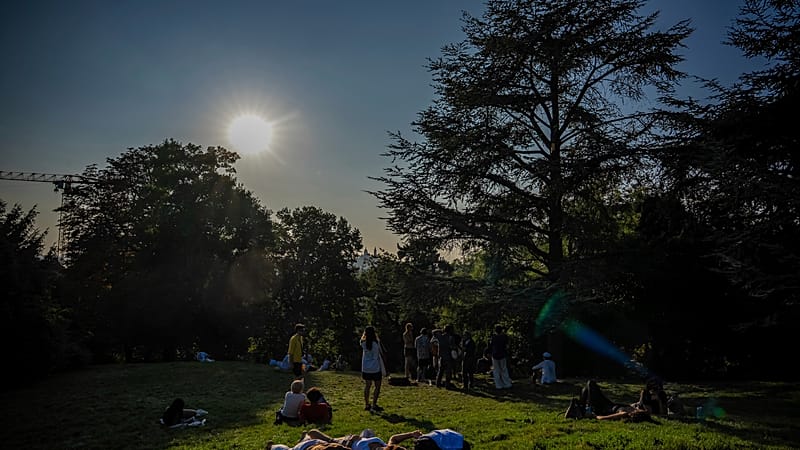
Picture it: an upscale park, usually teeming with daytime joggers and parents wrangling kids, transformed into a giant, impromptu communal bedroom once the sun dips below the horizon. The iconic Parisian skyline melts into a haze of humidity — and diesel fumes. People lie packed shoulder-to-shoulder, a sprawling tableau of modern urban resilience, or perhaps, desperation. They’re seeking a few degrees of relief that simply aren’t available in apartments built for retaining heat, not expelling it. This isn’t luxury; it’s a grim necessity.
But the real story here isn’t just Parisians sweating it out. Europe, largely accustomed to temperate climes, is getting a brutal, consistent lesson in what much of the world has battled for decades. Take Karachi, Pakistan, for instance. Residents there have long endured crushing heatwaves, with temperatures routinely pushing past 40 degrees Celsius (104 F) for weeks on end, making access to electricity for air conditioning a life-or-death lottery. They’ve improvised, they’ve adapted, but the sheer scale of the challenge remains. Europe is catching up fast, albeit without the same systemic disadvantages.
“We’re building greener cities, expanding cooling zones, but you can only do so much, so fast,” admitted Paris Mayor Anne Hidalgo, sounding weary at a recent press briefing. She spoke of long-term urban planning, of green infrastructure, of a future city capable of breathing. But her tone carried the weight of present failure—a concession that the solutions aren’t keeping pace with the problem. Many folks don’t have that kind of time. They just need to get through tonight.
And because the urban heat island effect turns concrete jungles into pressure cookers, often it’s those living in older, less-insulated buildings—often the most vulnerable—who suffer most. It’s a stark reflection of widening disparities. According to the European Environment Agency, heatwaves in Europe caused over 195,000 premature deaths between 1980 and 2022, a statistic that climbs year on year, highlighting the quiet lethality of rising temperatures. These numbers aren’t abstractions; they represent families, neighbors, folks who just couldn’t cool down.
Dr. Safia Hassan, an expert in climate adaptation from the Sorbonne, didn’t pull any punches during a recent panel discussion. “This isn’t an anomaly, it’s a trend. And frankly, we’re still talking about sprinklers when we should be re-thinking our entire urban fabric, our energy grids, even our social contract with our citizens. This isn’t just an infrastructure problem; it’s a human rights issue when the fundamental right to comfortable shelter is compromised.” Her frustration was palpable, echoing what many policy experts feel watching governments struggle to catch up. But where do you even start?
Meanwhile, across the Atlantic, conversations often circle around more aggressive responses to climate issues. One could argue the ongoing ‘revolution’ with heat pumps reshaping Europe’s energy chessboard offers some hope, but its adoption rate isn’t nearly fast enough for the immediacy of a blistering summer night. It’s like trying to bail out a sinking ship with a thimble. Or, you know, planning for a new stadium when the players are still navigating last season’s injuries (read more about Bajcetic’s comeback and the economics of elite football here). The scale of the current problem is so much larger than our immediate solutions.
What This Means
The image of Paris parks serving as collective sleeping quarters signals a profound, discomforting shift. Politically, it puts immense pressure on municipal and national governments to fast-track climate adaptation strategies. Public expectations are rising, and the electorate, once distant observers of climate woes in far-off lands, now experience them firsthand. Expect increased spending on urban greening, revised building codes, and possibly public cooling centers becoming a year-round fixture, not just an emergency measure. Economically, the cost of inaction becomes quantifiable in lost productivity, healthcare strains from heat-related illnesses, and a potential hit to tourism, ironic for a city built on charm and comfortable experiences. This isn’t just about hot days; it’s about fundamentally reshaping how cities operate. For those who cannot escape, these hot nights lay bare the often-ignored chasm between those who can afford climate resilience (think private air conditioning) and those who are left to the vagaries of the public square. It suggests a future where climate becomes an even more aggressive arbiter of social status, driving inequality deeper into the very fabric of our communities.
So, the ‘hotel tonight’ comment, originally a quip, reveals a sobering truth: for too many, urban parks are the only affordable refuge left in a world growing uncomfortably warm. And that’s a policy nightmare in the making.