


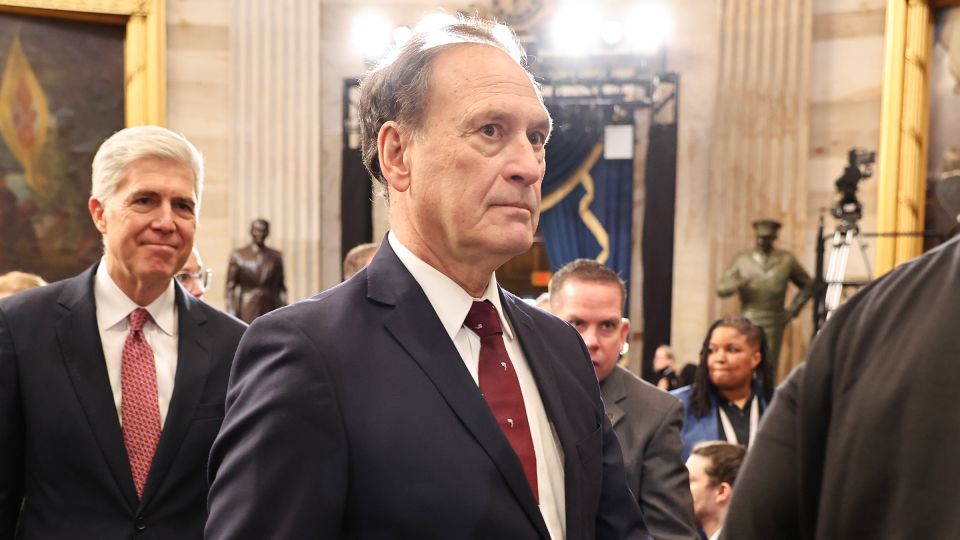
High Court’s Public Posture: Alito, Sotomayor and the ‘Misunderstanding’ That Wasn’t So Simple
POLICY WIRE — Washington, D.C. — For an institution cloaked in a certain mythic reverence—its debates largely inscrutable to the uninitiated, its justices projecting an image of almost monastic...

POLICY WIRE — Washington, D.C. — For an institution cloaked in a certain mythic reverence—its debates largely inscrutable to the uninitiated, its justices projecting an image of almost monastic detachment—the U.S. Supreme Court sometimes offers up moments that feel decidedly, humanly, petty. That’s precisely what unfolded recently. Rather than delivering pronouncements on weighty constitutional matters, the High Court found itself clarifying, through an official statement, a perceived kerfuffle between Justice Samuel Alito and Justice Sonia Sotomayor. It wasn’t a landmark ruling that sparked the unusual communiqué, but rather, an alleged interpersonal friction, deemed a ‘misunderstanding’. And you know, sometimes those simple explanations just don’t quite cut it.
It’s rare enough for the Court to speak beyond its written opinions or a justice’s occasional public address. For it to step into the fray to tamp down speculation about internal dynamics between its members—specifically, a legal squabble, or what might be politely termed a ‘verbal reaction’—well, that’s not exactly par for the course. It implies a degree of public awareness, — and concern, that the judiciary usually prefers to avoid. The statement was succinct: Justice Alito’s conduct towards Justice Sotomayor was merely a result of a ‘misunderstanding’. No more, no less, apparently. This is the stuff of office politics, only played out on the highest legal stage in the land, a stage upon which democracy’s fate so often seems to hinge. You don’t usually see federal agencies issuing press releases about awkward watercooler moments, do you? [QUOTE_PLACEHOLDER]
The incident itself—whatever its precise nature, details remaining nebulous—must have possessed enough resonance to necessitate official damage control. But damage control for what? The reputation of the Court, perhaps, or merely individual decorum? Such pronouncements, designed to quell, sometimes merely stoke. We’ve seen similar patterns play out in other national contexts, for instance, how Pakistani government agencies often deploy similar linguistic acrobatics to smooth over intra-institutional tensions. The aim’s always the same: maintain a facade of monolithic unity, because any crack, any public disagreement amongst the top brass, can quickly erode public trust. But folks are smart, they can read between the lines, and usually, the more strenuous the denial, the louder the question becomes.
Because let’s face it, the Supreme Court, in this era of intense partisanship, already walks a tightrope with public opinion. We’re well past the days when justices were perceived as entirely apolitical arbiters. In fact, a recent poll by Gallup, released in September 2023, indicated that public approval of the Supreme Court sits at just 41 percent. That’s a low number, especially for an institution designed to be above the fray. Any perception of personal animosity or unprofessional behavior amongst its members—even if later chalked up to an ‘oopsie’—simply pours salt on those existing wounds. It’s hard to believe in the absolute objectivity of judges when they can’t even seem to maintain perfectly cordial relations amongst themselves, or so the story implies.
But how does such a story, seemingly a D.C. Beltway peculiarity, resonate across the oceans? Consider countries like Pakistan, for instance, where the judiciary often finds itself at the intersection of powerful political and military forces. The transparency, or lack thereof, in the Supreme Court’s dealings there becomes a litmus test for the country’s democratic health. A ‘misunderstanding’ at the highest U.S. court, though seemingly trivial, doesn’t escape global notice. It becomes a subtle data point in how judicial bodies, even in established democracies, navigate internal pressures and external scrutiny. It’s a reminder that no institution, regardless of its standing, is impervious to the messy realities of human interaction and public perception. And it impacts global observers who look to American institutions, for better or worse, as a bellwether for democratic norms.
They’re watching, trust me. International audiences, particularly in South Asia and the broader Muslim world, analyze these seemingly minor domestic squabbles. Why? Because the strength — and perceived impartiality of the U.S. judiciary influences geopolitical calculations, international legal norms, — and even foreign investment. A strong, stable, and seemingly united American judicial system projects stability outward, whereas public clarifications about ‘misunderstandings’ hint at a more fragile internal equilibrium. It makes one wonder if such a situation might encourage others to adopt similar tactics.
📄 POLICY WIRE WHITEPAPER PUBLISHED: PAKISTAN'S NATIONAL SECURITY POLICY PRIORITIES
👉 READ BY CLICKING HEREAnd so, we’re left to parse the official statement. Was it truly just an honest misunderstanding? Or was it an expedited, almost perfunctory attempt to wipe the slate clean, to force an issue into a neat, easily digestible category before it became something more? They wouldn’t want whispers of deeper schisms undermining confidence, especially when critical cases are perpetually on the docket. That’s not just optics; that’s institutional self-preservation. It implies that the Court, for all its pomp and circumstance, is not immune to the kind of image management often seen in rough-and-tumble political campaigns. It suggests that even the nine robed figures, shielded as they’re by life tenure, still have to worry about what the neighbors—and the international community—are saying.
What This Means
This episode, the official ‘misunderstanding’ explanation, speaks volumes about the precarious state of perceived judicial impartiality in America today. Politically, it signals a deeper internal struggle to maintain institutional decorum in a highly charged ideological environment. The fact that such a statement was deemed necessary at all—a rarity for the Court—highlights the heightened scrutiny justices face, as well as their sensitivity to public perception. It’s an implicit acknowledgement that their personal interactions are no longer solely their private business but carry broader implications for the Court’s authority.
Economically, this might seem tangential, but a stable and respected judiciary underpins a nation’s entire economic framework. Businesses — and investors, domestic and foreign alike, rely on predictable and impartial legal processes. If the very top of that judicial pyramid appears prone to internal disarray or needs to issue awkward explanations for personal conduct, it subtly erodes that confidence. While not directly impacting markets, this perceived frailty contributes to a broader sense of institutional instability, making the environment less appealing for long-term investments. A decline in trust—be it in government, the electoral process, or the judiciary—is ultimately bad for business. It makes the grand pronouncements feel a bit hollow, a bit forced. And when institutional credibility starts to fray, well, everything else often unravels a little bit too. You can’t put a price on trust, can you? It’s kind of invaluable, a truly priceless asset.