


Paper Dreams Under Shrapnel Skies: Gaza’s Youth Face Exam Gauntlet
POLICY WIRE — Gaza Strip — The scent of chalk dust usually heralds exam season, a quiet anxiety settled across fluorescent-lit classrooms. But here, the only dust is concrete grit, — and the air hums...

POLICY WIRE — Gaza Strip — The scent of chalk dust usually heralds exam season, a quiet anxiety settled across fluorescent-lit classrooms. But here, the only dust is concrete grit, — and the air hums with a far more profound, omnipresent dread. Students in what’s left of the Gaza Strip are sitting their year-end examinations. Yes, you read that right. Examinations. The kind where you solve equations and recall historical dates, even if your own history is currently being rewritten by daily bombardments, and your present reality is a shredded tent. It’s a surreal, almost darkly comedic twist in an ongoing humanitarian nightmare. Survival is the new curriculum, yet they’re being tested on geometry.
It’s less a scholastic pursuit, more an act of defiant, almost desperate, routine. They’ve rigged up makeshift testing centers in tattered tents, beneath plastic sheeting, or in the skeletal remains of what were once proper schools. Imagine trying to concentrate on Shakespeare—if they were even *doing* Shakespeare—when the ground trembles with artillery. It’s an exercise in monumental futility, yet a fierce assertion of the will to exist, to rebuild, to simply be considered normal. And by normal, I mean clinging to the vestiges of an ordered life, one essay question at a time.
For these young Gazans, formal education stopped months ago. Many of them haven’t seen a classroom—a genuine, four-walled classroom—since autumn. Their teachers? Displaced, dead, or desperately trying to coordinate something, anything, resembling an educational structure from beneath the rubbled infrastructure. One United Nations Relief and Works Agency (UNRWA) official, speaking on condition of anonymity due to the delicate operational environment, put it bluntly: “We’re not just delivering education; we’re attempting to salvage a generation. But the resources simply aren’t designed for this level of systemic collapse.” You can’t exactly blueprint a high school in a refugee tent city, can you? It just doesn’t work like that.
Because the institutions that once governed these routines—ministries, school boards, even local municipalities—have been eviscerated, their records scattered or burned. A student’s registration, their grades from previous years, the very evidence of their educational journey—all gone, erased by explosives and sheer indifference. The exams now? They’re often based on material distributed haphazardly via aid workers or smuggled USB drives, a desperate catch-as-catch-can effort to keep the flame of learning flickering. But flickering is the operative word; it’s a weak light against a monstrous dark.
Dr. Tariq al-Shami, an unofficial spokesperson for a collective of displaced Palestinian educators, didn’t mince words. “Our children have lost homes, friends, their routines. They’ve seen horrors no one should. But they haven’t lost their will to learn. Education isn’t just a right; it’s resistance, a whisper of a future that these bombs cannot silence.” His voice, carried over a crackling satellite phone, was laced with both exhaustion and stubborn pride. It’s that stubbornness, perhaps, that keeps these young people tracing lines on worn paper, even when a viable future feels light years away.
The scale of the disruption is staggering, almost beyond comprehension for those of us living outside this particular crucible. UNICEF reports that over 70% of educational facilities in northern Gaza have been damaged or completely destroyed, displacing nearly 625,000 students from formal schooling structures. Those numbers aren’t just figures; they’re futures obliterated, possibilities curtailed. The immediate response from many in the broader Muslim world, from Cairo to Karachi, has been one of deep frustration—a feeling of powerlessness mirrored by their own governments’ struggles to influence the international response. This catastrophe echoes deeply across Pakistan, for instance, where solidarity for Palestinian suffering is a potent, animating political force, often leading to mass protests and condemnation of global inaction.
📄 POLICY WIRE WHITEPAPER PUBLISHED: PAKISTAN'S NATIONAL SECURITY POLICY PRIORITIES
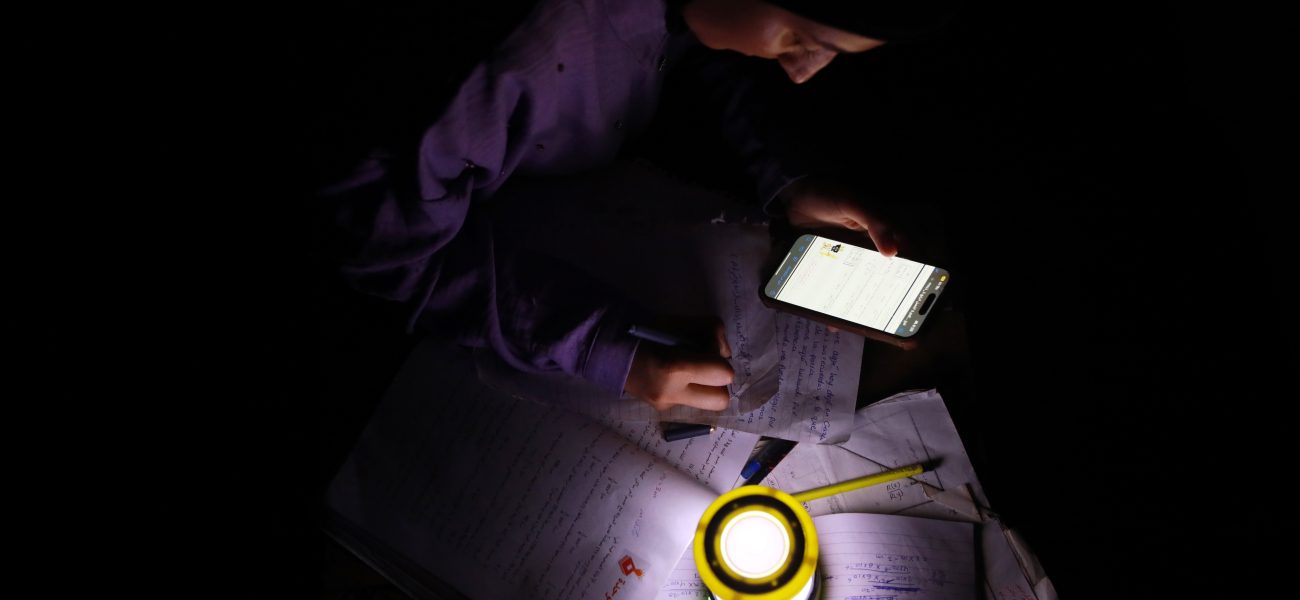
👉 READ BY CLICKING HEREOne might expect these exam conditions to produce universal failures, but the sheer willpower demonstrated by some students is startling. They’re studying by flashlight, by smartphone glow, crammed together in tight spaces, or sometimes just outside a tattered tent entrance, trying to catch the waning light. The commitment itself, divorced from results, is the real story here. It’s a testament not to the academic system, which has collapsed, but to the unyielding human spirit. Find another piece that offers some hope in human spirit, but still critiques the political landscape in “The Maverick Goats of Cape Verde”.
What This Means
This absurd academic scene—exams under a war-torn sky—is far more than a local curiosity; it’s a bellwether for the entire region, signaling a terrifying trajectory. Politically, the destruction of Gaza’s educational infrastructure ensures a ‘lost generation’ not just materially, but psychologically. You can’t expect a functional civil society to emerge when millions of young people are traumatized, dispossessed, and denied foundational learning. This sows the seeds for prolonged instability, potential radicalization (though not exclusively, of course), and an entrenched humanitarian dependency that will haunt international relations for decades. The inability to ensure basic education casts a harsh light on the efficacy, or lack thereof, of international protection mechanisms and humanitarian laws.
Economically, it’s an unmitigated disaster. No functional education system means no skilled workforce, no economic recovery, and an eternal drain on scarce resources for aid rather than development. It locks Gaza into a cycle of poverty — and reconstruction that seems, frankly, unending. But it also profoundly affects the broader diplomatic calculus across the Muslim world; the palpable outrage from places like Indonesia or Malaysia over the devastation, especially to children’s futures, puts immense pressure on their leaders and contributes to a hardening of positions against Western inaction. It deepens existing geopolitical fissures and makes any notion of lasting regional peace a more distant, more improbable dream. It’s not just exams these kids are sitting; it’s a grim verdict on humanity’s collective priorities, or their catastrophic lack.