


Agricultural Resilience: Canadian Farm Symbolizes North American Interdependence
POLICY WIRE — Saint-Michel, Quebec — On a crisp autumn day in Saint-Michel, Quebec, the fields of Mas & Fils Jardiniers tell a story more profound than mere roo...

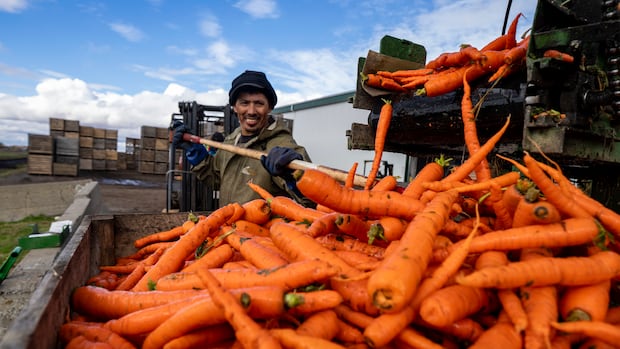
POLICY WIRE — Saint-Michel, Quebec — On a crisp autumn day in Saint-Michel, Quebec, the fields of Mas & Fils Jardiniers tell a story more profound than mere root vegetables. A man diligently loads freshly harvested carrots into a container, a scene replicated countless times across North America, but one that underscores the bedrock of cross-border economic ties. This operation, rooted deeply in tradition, simultaneously represents the complex, yet enduring, relationships that define the continent’s agricultural landscape, particularly in the face of ongoing trade discussions and political rhetoric.
It’s Friday, October 24, 2025. That specific date is notable for its future-leaning nature, highlighting the foresight and long-term planning inherent in agricultural cycles. Here, on this 4th generation family-run farm, the rhythm of harvest dictates the flow of business. They specialize in growing carrots, leeks, and beets, staples that find their way to dinner tables across Canada and into the United States.
With an annual production reaching 10,000 tonnes, Mas & Fils Jardiniers exemplifies the symbiotic trade relationship that binds Canada and the United States. Such operations form the granular, often unremarked-upon, foundation of agricultural commerce — a network of producers and consumers that typically functions without political fanfare, only occasionally thrust into the spotlight by larger policy debates.
The image of Canadian-grown produce destined for American plates, reported by THE CANADIAN PRESS/Christinne Muschi, might seem a simple tableau. Yet, it resonates deeply within the context of continental trade agreements. The stability of these supply chains, often taken for granted, is crucial not just for the producers but for consumers on both sides of the border. This direct flow of goods reflects decades of integrated economies, creating efficiencies and specialized regional production zones that serve broad markets.
Agricultural trade between Canada and the United States isn’t just about large corporations or bulk commodities; it’s intricately woven into the fabric of smaller, family-run enterprises like Mas & Fils Jardiniers. These businesses often thrive on the predictability — and low friction provided by established trade frameworks. Their long-term investment cycles and seasonal outputs are inherently vulnerable to sudden shifts in trade policy, which can disrupt established distribution channels and raise costs, impacting everything from labor to equipment to logistics.
Consider the logistical feat alone: preparing, transporting, and distributing 10,000 tonnes of perishable goods annually requires a sophisticated infrastructure that has evolved under specific trade rules. Any re-evaluation of these rules necessitates careful consideration of the ground-level implications for countless operations whose livelihoods depend on seamless cross-border activity. The very concept of an agricultural sector that supplies two distinct national markets inherently builds a constituency that benefits from open, stable trade, arguing for the survival and even strengthening of agreements like CUSMA.
What This Means
The continued operation of farms like Mas & Fils Jardiniers underscores a fundamental reality often overlooked in high-level policy debates: economic integration, once established, creates deep interdependencies that are exceedingly difficult to unravel without significant cost to all parties. While headlines may focus on political posturing or threats of protectionism, the day-to-day realities of farming and trade demonstrate a resilience. Agricultural industries in both Canada — and the U.S. have developed specialized supply chains tailored to free trade agreements. For many American agricultural businesses, stability in cross-border trade isn’t just preferable; it’s foundational to their operational model.
The implications are clear: substantial changes to agreements like CUSMA would require the disruption of long-standing relationships and supply networks. This isn’t merely an abstract economic concept; it translates into real financial risk and uncertainty for businesses that rely on established pathways, from the individual farmer loading carrots in Quebec to the distributor delivering them to a grocery store in New England. It prompts the question: How much economic pain is truly acceptable for policy shifts, especially when existing structures benefit so many?