

Ageless Lions and Fading Monarchs: World Cup’s Unbroken Anomaly
POLICY WIRE — Doha, Qatar — There’s a particular kind of theatre reserved for global sporting behemoths. It’s the stage where Lionel Messi, turning 39, or Cristiano Ronaldo, pushing 42, stride...

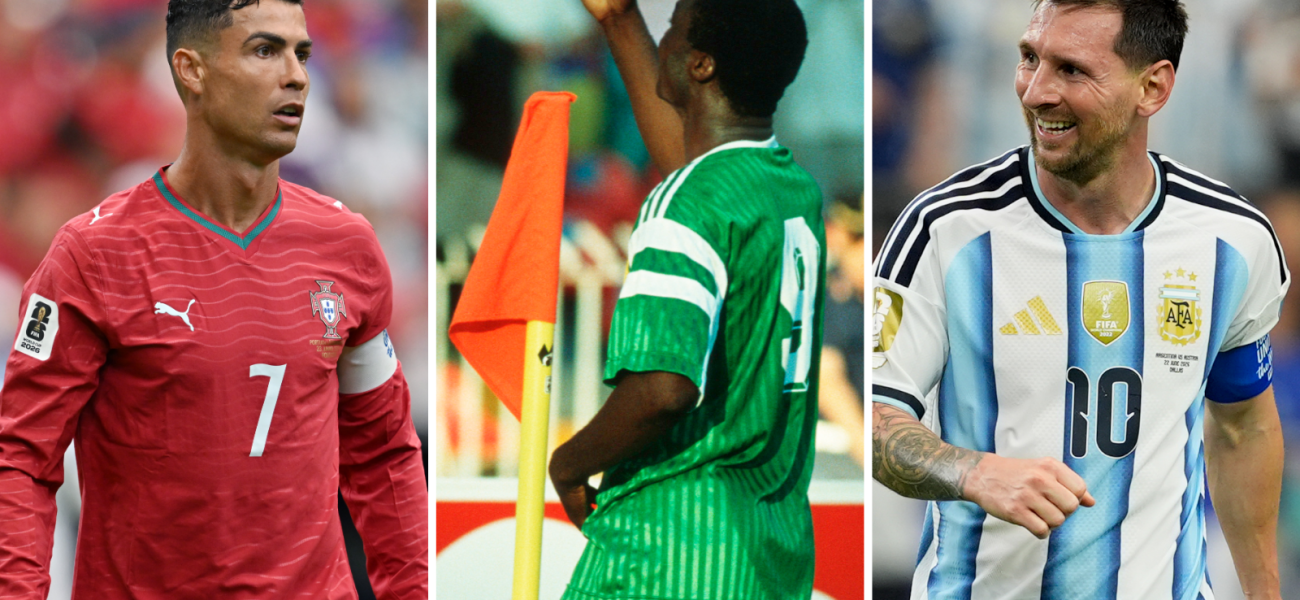
POLICY WIRE — Doha, Qatar — There’s a particular kind of theatre reserved for global sporting behemoths. It’s the stage where Lionel Messi, turning 39, or Cristiano Ronaldo, pushing 42, stride out, defying time — and physics. They’re smashing records, grabbing headlines, — and minting billions for the FIFA apparatus. And yes, they’ve both found the net in this latest World Cup — because, well, that’s what they do. Ronaldo’s strike against Uzbekistan this past week elevated him to second-oldest World Cup scorer, a truly staggering feat for anyone in the contemporary era. Messi, not one to be outdone, followed close behind. You’d think that narrative, the relentless march of these titans, was the whole story. But it isn’t. Not really.
Because quietly, stubbornly, a name from a bygone era, an age before Instagram, before sponsorship deals were measured in small countries’ GDPs, still sits atop the very pinnacle of World Cup longevity: Roger Milla. You probably remember him, maybe in grainy VHS footage. He’s the Cameroonian striker whose electric, hip-swiveling dance by the corner flag after scoring wasn’t just a celebration; it was a defiant, joyful declaration of African arrival on the biggest stage. His ghost—or rather, his living legacy—continues to loom over the tournament, a silent challenge to the sport’s modern marketing marvels.
Milla was 42 years — and 39 days old when he slotted home against Russia at USA ’94. Ronaldo, for all his GOAT credentials, for all his sculpted physique and state-of-the-art conditioning, still trails Milla by over a year and change. Think about that for a second. An era of relatively rudimentary sports science, less tailored diets, and less global exposure for players from his continent—yet Milla holds the line. It’s a proper kick in the teeth for anyone who believes pure commercial muscle and brand power inherently translate into eternal statistical supremacy.
“Roger Milla wasn’t just a player; he was a phenomenon,” asserted Patrice Motsepe, President of the Confederation of African Football (CAF), in a recent interview, his voice tinged with pride. “His age-defying performances in ’90 and ’94 didn’t just break records; they broke stereotypes about African football’s place on the world stage. They proved what determination and natural talent, untamed by conventional wisdom, could achieve.” And he did it, crucially, at a time when global recognition for African athletes felt like a harder climb.
Back then, the Indomitable Lions’ quarter-final run in Italia ’90—the first for an African nation—was pure shockwave. Milla, a sub at 38, netted four goals. Four years later, aged 42, he grabbed another against Russia, still executing that iconic corner-flag wiggle. But that ’94 tournament also showcased the harsh realities for smaller federations; Cameroon lost that game 6-1, their glory days fleeting as financial muscle and deeper squads dominated the latter stages. That’s a story not entirely unfamiliar to many emerging footballing nations, battling structural disadvantages in a globalized sporting economy.
This enduring record forces a question, doesn’t it? Is it merely a quirky footnote, or does it highlight something more profound about the nature of sporting excellence—or perhaps, its increasingly commodified definition? These days, every step, every goal, every eyebrow raised by Messi or Ronaldo is an immediate input into a marketing machine. “You see Messi and Ronaldo still doing it, and you think they’re pushing boundaries, which they’re,” observed Gary Lineker, former England international and now a prominent sports broadcaster, on a BBC podcast. “But Milla’s era? There was less analysis, less bespoke everything. It makes his longevity feel… rougher, more authentically earned, maybe? Less pre-packaged.”
Even as Messi and Ronaldo battle each other for headlines, they’re both eyeing that 2030 World Cup—hosted partially in their home nations, Portugal and Argentina, respectively. Wouldn’t that be a spectacle? Because extending their careers that far, just to compete in their mid-40s, isn’t just about sporting glory anymore; it’s about cementing legacy, extending brand, and ensuring their global starlight or star power continues to dazzle. The money involved, the sheer corporate pull to keep these icons on the pitch, must be immense.
Milla’s record, according to FIFA’s official statistics, has stood for 30 years as of June 2024. And despite the modern era’s optimized training regimes, no player has truly threatened it. Bosnian Edin Dzeko, 40, — and Croatian Luka Modric, also 40, are playing this tournament. So is Austrian Marko Arnautovic, 37. Yet, none have found the net to significantly close the gap on Milla. It suggests that some ceilings, once hit, remain incredibly tough to pierce, regardless of the money or modern science thrown at them. It’s almost romantic, in a cynical kind of way.
What This Means
Milla’s defiant hold on the ‘oldest scorer’ title isn’t just a statistic; it’s a telling, slightly ironic, counter-narrative to football’s hyper-commercialized present. For one, it highlights the raw, sometimes improbable, athletic brilliance that existed before the sport became a global marketing juggernaut. His achievement elevates the conversation beyond individual rivalry, subtly reinforcing the significant, often undervalued, contributions of African football to the sport’s global narrative.
Economically — and politically, the contrast is stark. While modern stars generate unfathomable revenue and media attention, pushing nations like Saudi Arabia or Qatar to invest heavily in football, Milla’s impact was about inspiration, shattering barriers, and building genuine enthusiasm from the ground up. It reminds us that while the big names pull crowds from Buenos Aires to Lahore, and their endorsements shape consumer choices globally, the real heart of the game often beats strongest where resources are scarce but passion is boundless. His record is a whisper from a simpler time, a persistent hum reminding us that some achievements are just too pure, too untamed, to be easily bought or replicated by sheer commercial will. It also serves as a potent symbol for nations like Pakistan, where football infrastructure might lag, but the dream of global recognition through raw talent endures, waiting for its own ‘Milla moment’.