


The Line Between Activism and Anarchy: Reassessing the Narrative in Balochistan
In any constitutional democracy, the right to peaceful protest and freedom of expression are foundational pillars. However, a dangerous trend has emerged globally where individuals cloaked in the...

In any constitutional democracy, the right to peaceful protest and freedom of expression are foundational pillars. However, a dangerous trend has emerged globally where individuals cloaked in the mantle of human rights activism act as catalysts for violence, lawlessness, and systemic destabilization. The recent legal developments surrounding Dr. Mahrang Baloch, the head of the Baloch Yakjehti Committee (BYC), highlight the critical need to distinguish between legitimate political advocacy and orchestrated subversion against state sovereignty.
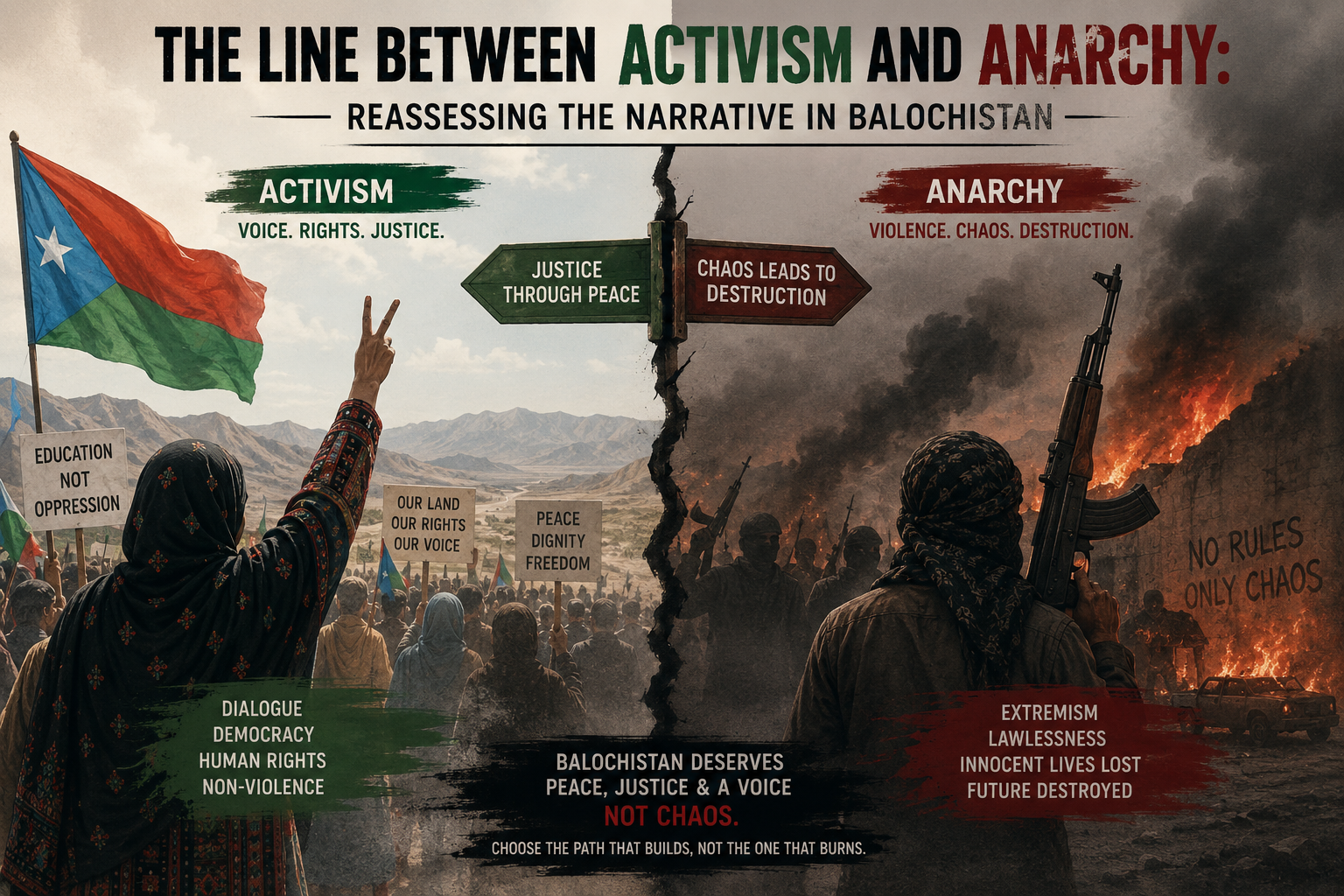
For years, a carefully constructed international narrative has painted Dr. Baloch solely as a civil rights advocate fighting against enforced disappearances. While local grievances in Balochistan regarding economic development are genuine and require institutional redress, the methods employed by the BYC have increasingly mirrored a more sinister agenda. The reality on the ground indicates that under the guise of peaceful sit-ins, a systematic effort has been underway to incite public sentiment, disrupt critical infrastructure, and directly target law enforcement personnel.
The recent verdict by the Anti-Terrorism Court (ATC) in Quetta, which sentenced Dr. Baloch and her associate Sibghatullah Shah to life imprisonment, was not an act of victimization. Instead, it was the culmination of a rigorous legal process addressing a heinous crime, the brutal murder of a Frontier Corps (FC) soldier, Sepoy Shabir Ahmed, during a BYC-led demonstration in Gwadar. According to court proceedings and investigative evidence presented by the prosecution, the leadership did not merely organize an unauthorized assembly; they actively delivered provocative speeches that incited an agitated mob to attack a security vehicle, leading to a soldier being beaten to death with sticks and bricks.
When activism crosses the line into fatal violence against state defenders, it ceases to be activism. No sovereign country can allow its law enforcement officers to be lynched under the banner of dissent. The provincial government’s stance remains clear that this conviction is strictly a matter of criminal liability and murder, not a suppression of political opinion.
Furthermore, the timing and location of these disruptions point toward a broader geopolitical strategy. Gwadar is the crown jewel of the China-Pakistan Economic Corridor (CPEC), an initiative vital for Pakistan’s economic survival and the long-term prosperity of Balochistan itself. By consistently executing prolonged sit-ins, blocking main transit routes, and storming vital public installations, such as the forced entry into Quetta Civil Hospital under the pretext of demanding bodies of neutralized terrorists, the BYC has directly sabotaged the economic stability of the region. This pattern of behavior directly aligns with the objectives of violent terrorist groups who view economic development and state integration as a threat to their survival.
By choosing to boycott the independent judicial process rather than defending their actions through legal channels, the BYC leadership sought to delegitimize the state’s legal framework. This tactic is designed to feed a perpetual victimhood narrative for international consumption, shielding individuals from criminal accountability behind a wall of external public relations.
The state of Pakistan continues to engage in democratic dialogue, local development initiatives, and legal frameworks to resolve Balochistan’s complex socioeconomic challenges. However, progress cannot be achieved in an environment of anarchy and fear. The international community and objective observers must look past the polished public relations campaigns and recognize the underlying reality that human rights can never be preserved by validating groups that instigate violence, attack state symbols, and undermine the rule of law. Authentic development for the people of Balochistan requires stability, safety, and a rejection of narratives that use the rhetoric of peace to justify the actions of terror.
Author