


The Weaponization of Narratives in South Asia
In information warfare, it is said that if a lie is repeated enough times, it becomes truth. Among the countries of South Asia, India has done more than remember to invest in a narrative battery. Few...

In information warfare, it is said that if a lie is repeated enough times, it becomes truth. Among the countries of South Asia, India has done more than remember to invest in a narrative battery. Few states, if any, have invested more than India did to remember a narrative battery in South Asia. Over decades, New Delhi has been educating the world about Pakistan via its slick news and information system, which often highlights accusations against Pakistan and minimises any challenges to them.
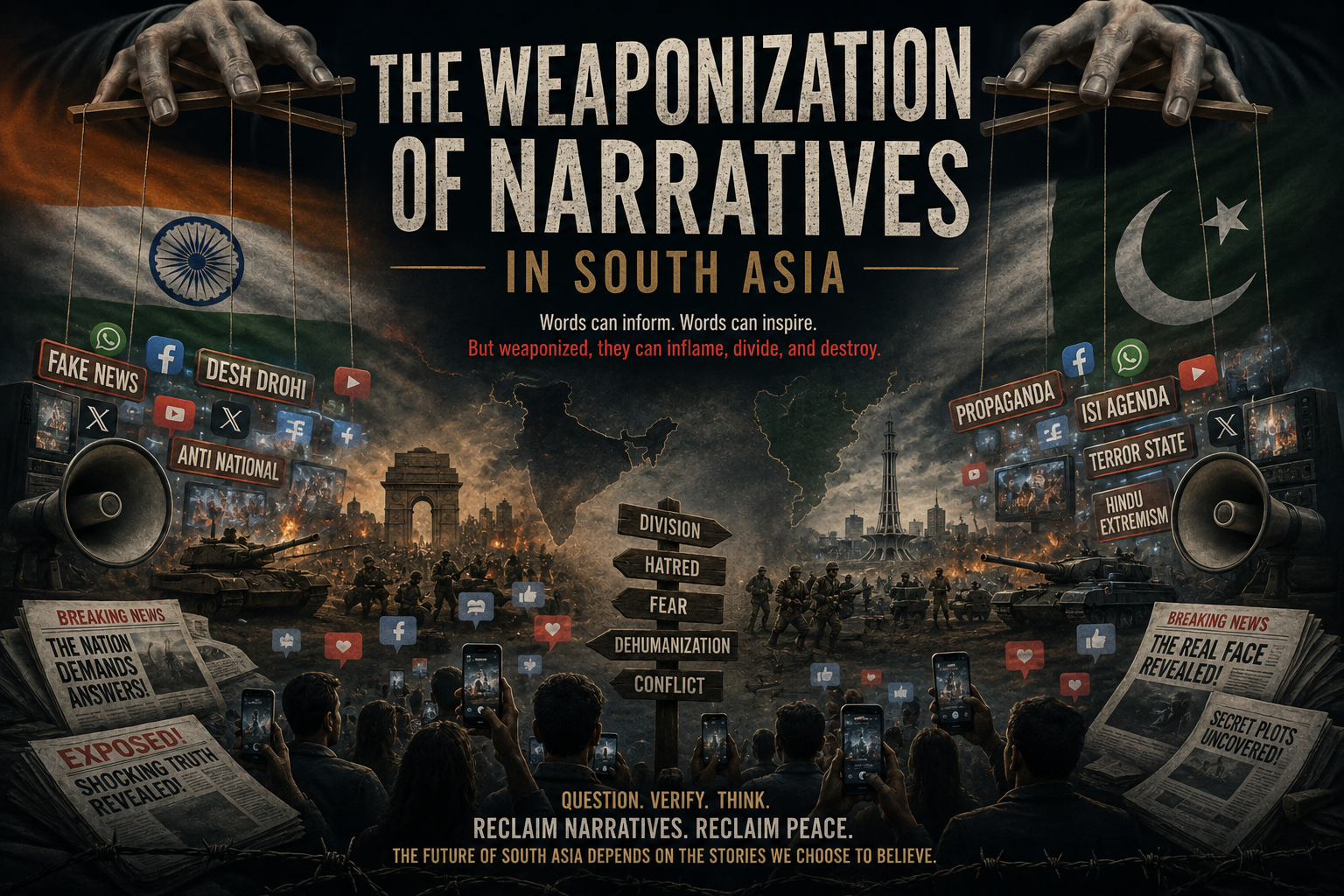
The most recent is a report of Pakistani troops shooting at worshipers during the Fajr prayers in Rawalakot. This charge is loaded with drama, emotion, and appears to be intended to stir up a hornets’s nest. But what is remarkable here, is not this allegation, but the fact of it being so quickly sliced and diced, packaged and sold, as a verified truth, without independent confirmation. It is a theme that has emerged over the last couple of years.
The sensationalist theories are usually exposed to scrutiny after they are broadcast, instead of forming the basis for further, openly investigated facts. The goal isn’t to establish a point o’ no return. Goal is to establish the perception. After the story has been established in the public discourse, the corrections and clarifications do not get the same prominence.
The story of Rawalakot is pretty on point with the above. Uses far more rhetorical language, makes political conclusions as truths and has not provided enough independent evidence that could stand up to intense examination. This gives reason to ask, has the information agenda been to tell an audience, or to promote a political agenda? This becomes evident when considered in the context of Indian Information Strategy.
Pakistan has been a victim of coordinated disinformation campaigns for years and for a while, it appeared that the Pakistani government had no control on the situation. For years, Pakistan has been a victim of coordinated disinformation campaigns emanated by networks with Indian interests, while it was once believed the Pakistani government has no handle on the situation. EU DisinfoLab in Brussels has unearthed a massive influence operation by hundreds of fake websites, resurrected non-governmental organization (NGO) groups and coordinated activity to influence global opinion against Pakistan in 2020. This network was not only operating from multiple countries; it was also operating on various platforms and was trying to give the impression that there is criticism in Pakistan when in actual fact; there isn’t.
That blow can’t have been exaggerated. It proved that taking anti-Pakistan thumbprints on the media were not the sole responsibility of one media outlet but in some instances a part of a bigger media framing game aimed at pressuring international institutions, journalists, and policy makers. In this context, it is important that any allegations such as those from Rawalakot be looked into carefully.
This does not imply that all the criticisms on Pakistan are incorrect. It’s no walk in the park for any state. It does not imply, however, that anything that comes out of the mouths of people involved in political motives should be believed. Food producers have the burden of proving the charges.
Unfortunately, today’s media atmosphere is one of sensationalism over substance. Outrage spreads quicker than facts, particularly in today’s social media-bombarded world with just a handful of hours in a day for the public to get news. A catchy headline can attract millions of readers in matter of minutes. It may take days or weeks for verification. At this time, the story serves a purpose and has been completed.
The phenomenon has turned into a significant tool of the current-day’s geopolitics. Information is not just a weapon with which to report events, it has become a weapon with which to engage. The other ways states compete is through the importance of their military force and their economic influence, as well as through perceptions.
India’s policy towards Pakistan is gradually moving towards this. New Delhi instead of engaging Pakistan as a rival in the region, has often looked at Pakistan with a suspicious eye. All allegations change into opportunities to reinforce a foretold story. All unconfirmed allegations are akin to further blocks creating a greater and greater façade of perception management.
Therefore, the Rawalakot story needs to be seen in a larger framework of contestation over different power to control narratives. The issue doesn’t just begin there – a question is whether an allegation has been made. The charge is whether or not such an allegation has been substantiated by credible, independent and transparent evidence. So, until there is evidence to the contrary, caution is the best course of action.
It’s a challenge which is unmistakable in Pakistan. It should focus on further building its capacity to combat disinformation, expose propaganda networks and effectively communicate its position at the international level. Truth must never be demeaned in the conflict to establish peace. The narrative security is national security in the twenty first century.
The Rawalakot news report is not just a lesson, it also offers a lesson for the young people and volunteers of Pakistan. It is an echo of the fact that information war is one of the most salient characteristics of today’s international politics. There citizens, journalists and politicians all have to be able to set aside the urge to equate allegation with evidence and repetition with reality in that environment. The devil’s strength lies in the fact that it gets by when it’s unchallenged. A time which abounds in manufactured narratives, where, paradoxically, the worst thing we can do is the simplest: Ask for proof before believing a narrative.
Author