

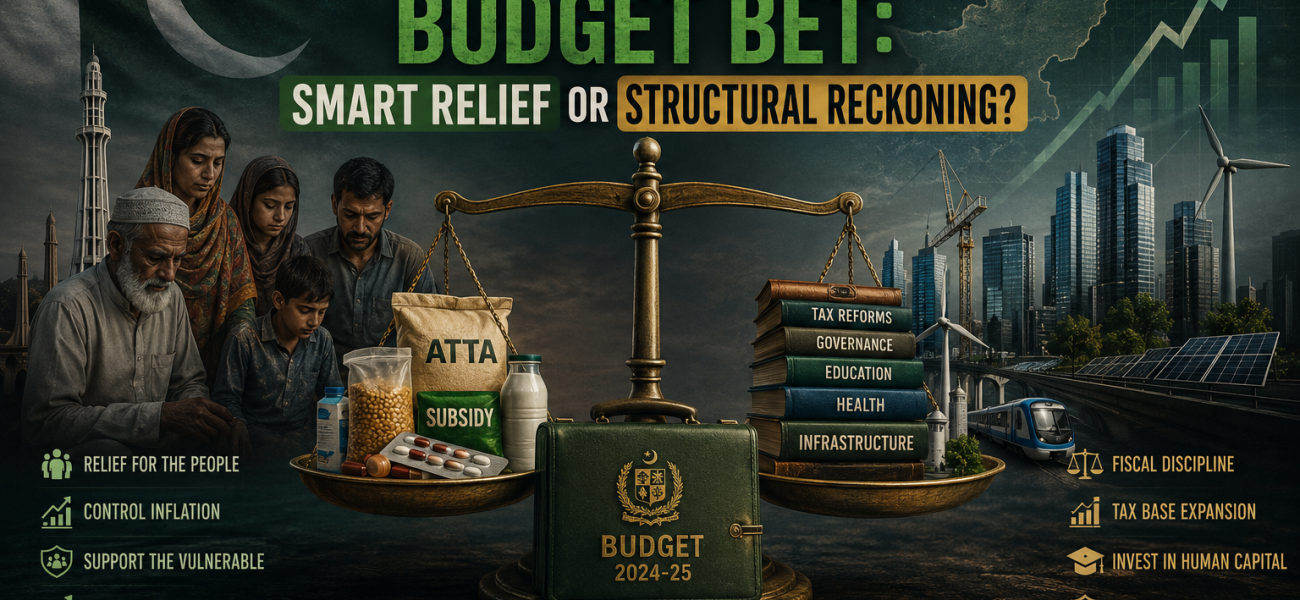
Pakistan’s Budget Bet: Smart Relief or Structural Reckoning?
Pakistan’s Federal Budget 2026-27 arrived last Friday carrying the weight of a nation that has spent the better part of four years navigating significant economic challenges. The Rs18.8...

Pakistan’s Federal Budget 2026-27 arrived last Friday carrying the weight of a nation that has spent the better part of four years navigating significant economic challenges. The Rs18.8 trillion ($67.5 billion) fiscal plan, with its carefully calibrated tax relief package, has drawn genuine optimism from the business community, and for once, that optimism is not entirely misplaced. But optimism, without structural follow-through, has a long history of disappointing Pakistan.
Let us start with what the numbers actually say.
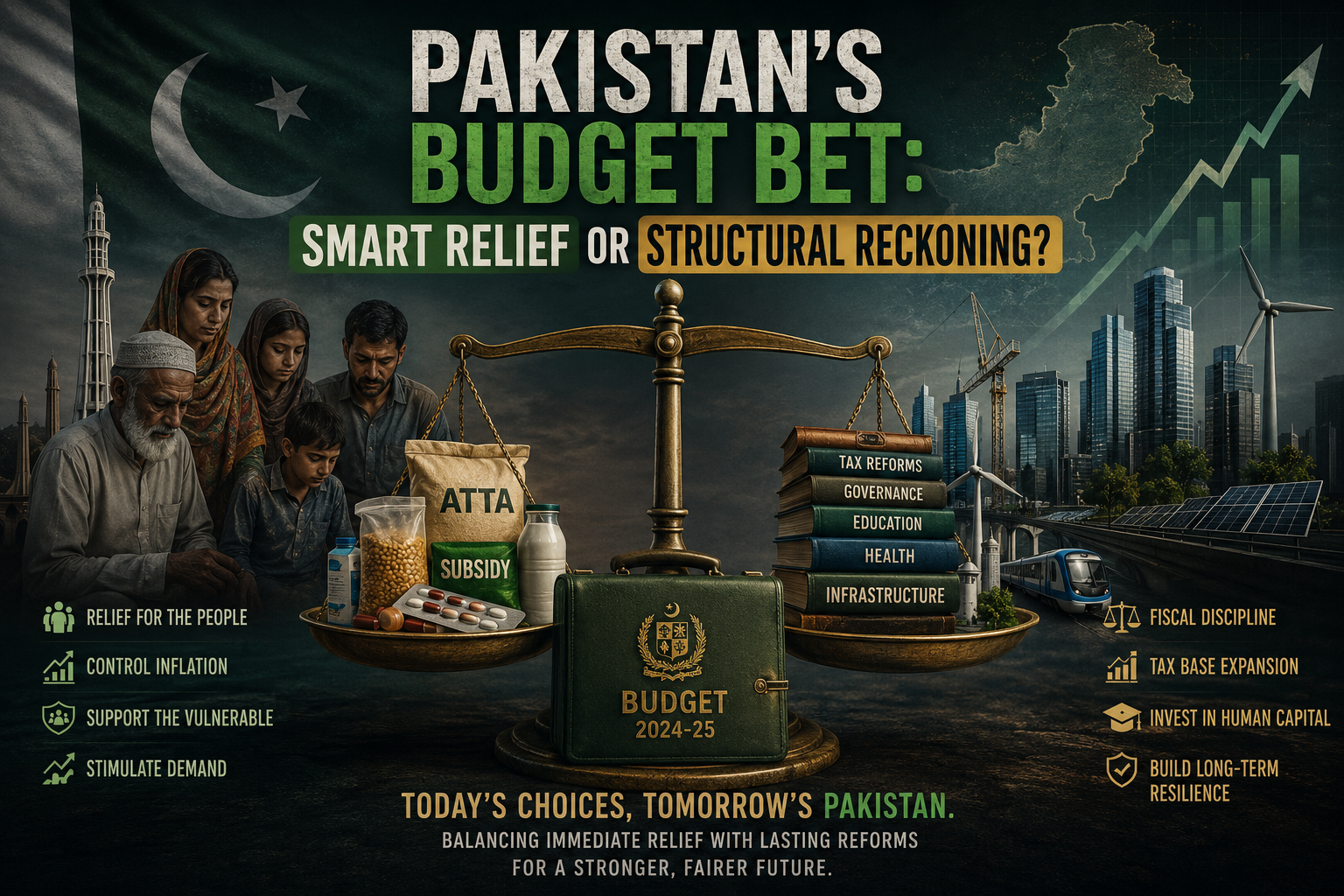
The outgoing fiscal year recorded GDP growth of 3.7 percent, the fastest in four years, yet still short of the government’s own 4.2 percent target. The IMF, which has been Pakistan’s financial lifeline through its Extended Fund Facility, projected growth at 3.6 percent for 2026. Against this backdrop, the government’s ambition to push growth to 4 percent in FY27 is achievable, but only if the budget’s provisions land in the real economy rather than on paper.
The headline relief measures deserve credit where it is due. A reduction in advance income tax and minimum tax on exports by half will make a great statement to an export industry that has struggling under mounting cost pressures. Total exports of Pakistan have reached about $31 billion, but this number has been more or less stagnant for four consecutive years when other countries of the region have made great progress. The scrapping of the super tax imposed on middle enterprises generating revenues ranging between Rs150 million and Rs500 million per annum comes as a sigh of relief. Add to this the halving of withholding taxes on property transfers, from 2.5 percent to 1.25 percent for buyers and 5.5 percent to 2.75 percent for sellers, and the government has constructed a credible demand-side stimulus for construction, a sector known for its powerful multiplier effect on employment.
FPCCI President Atif Ikram Sheikh called these incentives “very big,” and on paper, he is right. The construction-linked housing announcement, 150,000 affordable, climate-resilient units under a sustainable urban development program, could activate significant downstream economic activity across steel, cement, and labor markets. The government’s export target of $32.9 billion for FY27 represents roughly a six percent increase over recent baselines. That is ambitious, but not fantastical, provided the conditions exist to make Pakistani goods competitive.
Now here lies the central caveat, the one that separates fiscal optimism from economic reality.
Pakistan’s textile sector, which accounts for approximately 60 percent of total export earnings and employs around 40 percent of the industrial labour force, remains shackled by an energy cost crisis that no tax cut alone can resolve. Electricity tariffs for Pakistani exporters average 13.2 cents per kilowatt-hour, compared to 10.2 cents in Bangladesh, 9.5 cents in India, 7.0 cents in Vietnam, and a staggering 5.3 cents in China. You can reduce a company’s tax burden by half and still leave it unable to compete if its production costs per unit are structurally higher than its rivals. This is not a marginal disadvantage; it is a major competitiveness challenge.
The Pakistan Textile Council’s half-yearly report for FY26 documented that despite a nominal 1 percent year-on-year growth in textile exports during July-December, exporters continued to face severe cost-related pressures. Textile exports had fallen for three consecutive months, August, September, and October of FY26, before recovering slightly. The structural problem is not demand; global buyers want Pakistani textiles. The problem is that Pakistani manufacturers cannot price competitively enough to win consistent orders at scale.
Pakistan’s potential growth rate is estimated at around 5 percent by economic researchers. Actual growth has averaged 2-3 percent. That gap is not a mystery, it is the product of chronic energy shortfalls, a debt-to-GDP ratio that stood at 75 percent in 2023 (though now improved to 68.5 percent under tighter fiscal management), and an export base that has declined as a share of GDP from 16 percent in 1999 to barely 8 percent today.
The budget’s positive signals on debt management should be acknowledged. The fiscal deficit narrowed to 0.7 percent of GDP in the first nine months of FY26, down from 2.6 percent in the same period last year. Public debt growth is contained at 3.4 percent against 6.7 percent a year ago. Inflation has come down to around 3 percent from the devastating highs of 2023. These are not trivial achievements, they are the product of painful discipline under the IMF’s Extended Fund Facility, and they create genuine fiscal space that this budget is attempting to deploy.
The question is whether that space is being used to address symptoms or causes.
A fixed Rs25,000 annual tax for retailers earning up to Rs200 million brings more of the informal sector into the tax net, which is structurally important for a country where the tax-to-GDP ratio has historically been among the lowest in the developing world. This is good economics. The abolition of capital value tax on foreign assets similarly signals to the diaspora and foreign investors that Pakistan is open for capital, not just aid. With remittances having become a critical pillar of Pakistan’s external accounts, anything that deepens financial linkages with overseas Pakistanis matters at the macroeconomic level.
But Pakistan cannot export-led-grow its way to 4 percent on tax relief alone. The government must now deliver on the energy side, regionally competitive tariffs for export industries must become operational reality, not a budget footnote. Cotton production, which fell 33 percent between 2024 and 2025, must be stabilized through agricultural support and input subsidies. Logistics infrastructure, where Pakistan ranked 122nd out of 160 countries on the World Bank’s Logistics Performance Index, demands urgent attention if export costs are to fall meaningfully.
Pakistan’s economic story in 2026 is one of genuine stabilization, cautious reform, and fragile but real momentum. The budget reflects a government that has learned, perhaps from bitter experience, that punitive taxation of business is self-defeating. The tax relief package is well-targeted and the housing program is economically intelligent. If energy prices become competitive, and that is a significant conditional, the 4 percent growth target is within reach, and an export figure of $32.9 billion is not unrealistic but Past budgets have shown that implementation remains the decisive factor: the promising budget, the optimistic business leader, the IMF endorsement, and then the structural realities that drag performance below potential. The difference this time must be execution, not just on the revenue targets, but on the energy tariff reforms, the export facilitation mechanisms, and the sustained institutional discipline that turns a strong budget into a transforming economy.
The foundation has been laid. Whether the building rises depends on what comes next.
Author