


Circus, Spectacle, or Something More? A Nation’s Fragmented Gaze
POLICY WIRE — Washington, D.C. — Imagine a day, any day, really, where the public’s collective focus isn’t just diffused but outright fractured across an impossible array of spectacles. It’s...

POLICY WIRE — Washington, D.C. — Imagine a day, any day, really, where the public’s collective focus isn’t just diffused but outright fractured across an impossible array of spectacles. It’s not just the usual hum of news and entertainment; it’s an electoral fever dream, a generational divide thrown into sharp relief. Because sometimes, the noise itself becomes the message. That day might well be upon us, embodying a deeply fragmented zeitgeist.
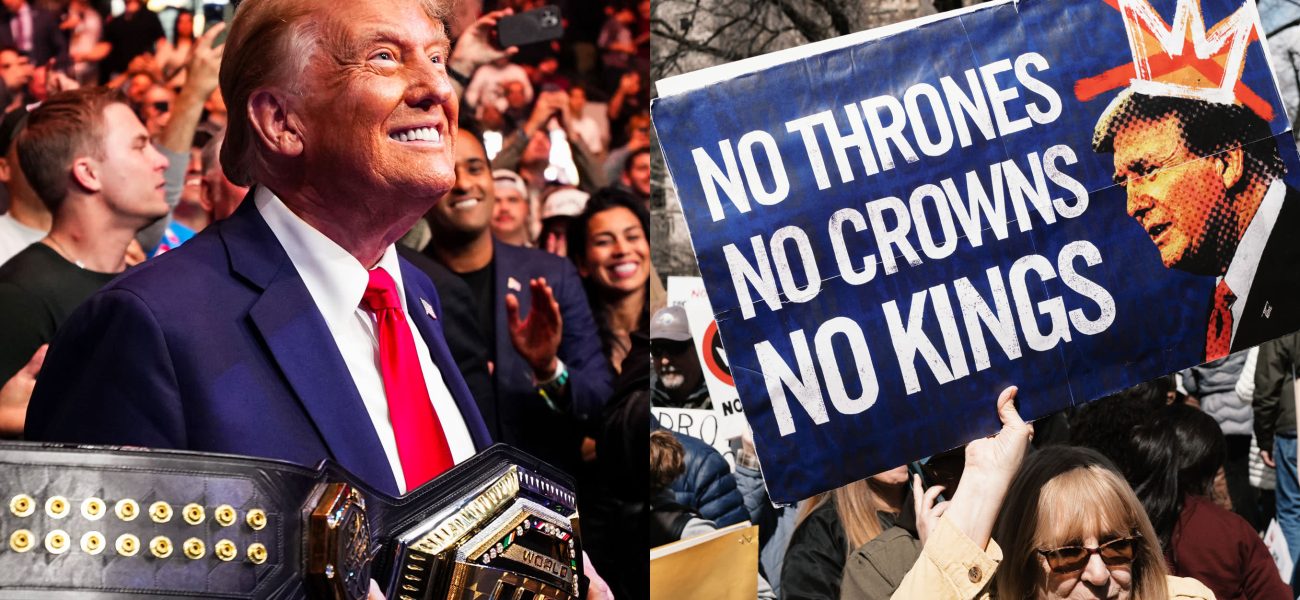
It seems American attention, ever a commodity, will be pulled in wildly disparate directions, potentially redefining what qualifies as public discourse. There’s the unsettling concept of a mixed martial arts championship unfolding, not in some gleaming arena, but in the White House. Let that sink in for a moment. This isn’t your grandfather’s State of the Union; it’s raw, unvarnished power grappling— quite literally—for visibility on the political stage. [QUOTE_PLACEHOLDER]
And then there’s ‘No Kings,’ a movement, or perhaps just a slogan, emerging as a stark counterpoint to any established order. It’s an ideological gut-punch to hierarchy, suggesting a palpable public exhaustion with traditional power structures. You can’t help but wonder if it represents a deeper undercurrent of anti-establishment fervor, one that’s grown weary of presidents, prime ministers, and potentates, irrespective of their political stripe. Such sentiments often find fertile ground where institutions have become brittle, not just here but in places like Pakistan, where civilian-military relations and calls for systemic change are an almost constant, fraught discussion. It’s a common language spoken by different peoples, born of different histories, but united by skepticism of concentrated authority. And on a day celebrating longevity in power, ‘No Kings’ might just hit harder.
But wait, there’s more. Over on a completely different channel of the national psyche, Jane Fonda will take the stage. For many, she’s a cultural touchstone, a voice from a time when celebrity activism looked a good deal different, less about algorithms and more about earnest, visible protest. Her presence promises a jolt of nostalgia, perhaps a comfort, for those who find the current political landscape utterly bewildering—a callback to movements and causes that felt, well, clearer. It’s a generational siren, beckoning those who recall her anti-war stances, providing a sense of continuity that’s increasingly hard to come by.
The sheer velocity of competing narratives points to a crisis of attention. It isn’t just about what’s happening; it’s about what manages to cut through the cacophony. We’re talking about a nation trying to process everything from policy proposals to pay-per-view spectacle, and it’s getting harder to distinguish between the two. Think about it: a U.S. presidential campaign alone now demands more than a quarter of all local TV news coverage during an election cycle, according to the Pew Research Center, effectively crowding out myriad other crucial developments. That’s a significant slice of our collective gaze consumed by electoral jousting, leaving precious little for a thoughtful grasp of the nation’s, or the world’s, complex realities.
Consider the international ripple effect, too. When America’s political center becomes a gladiatorial arena, or its culture devolves into an existential tug-of-war between disparate ideological poles, how does that translate abroad? Nations like Pakistan, navigating their own intricate political terrains—with generals, clerics, and populist leaders vying for control—don’t just observe; they internalize, they learn, they often react. The theatricality of American power, whether intentional or not, sends its own peculiar message across continents, often viewed through a lens of suspicion or cynicism regarding the democratic ideal. For instance, the very public legal dramas unfolding in Western capitals get digested in the newsrooms of Islamabad, contributing to a global skepticism about institutional integrity.
This triple-header of incongruity—a bare-knuckle political bout, an anthem of rejection, and a blast from a politically charged past—isn’t just a quirky scheduling clash. It’s a visceral, unsettling reflection of a country that struggles to define its collective priorities, its common ground, or even a shared set of basic facts.
What This Means
This is more than just cultural dissonance; it’s an economic and political stress test for the United States, plain and simple. Economically, attention is currency. When the nation’s focus fragments this severely, it impacts everything from consumer behavior to policy effectiveness. Imagine investors trying to gauge stability when the White House might host a cage match. It cheapens the symbolic capital of institutions. Politically, this splintering of attention creates echo chambers so distinct, they might as well be parallel universes. Policymakers struggle to unite disparate blocs, because the common stories that once bound a nation—even imperfectly—have shattered. There’s no longer one clear conversation, but many, competing loudly. It suggests that a nation’s foundational narratives are unraveling, replaced by individual streams of content and allegiance, rendering effective governance harder to achieve and consensus an increasingly abstract concept. In essence, America is navigating a new, more aggressive era of digital balkanization, where common sense is often a casualty of conflicting, headline-grabbing spectacles. It doesn’t bode well for either domestic cohesion or international credibility, casting long shadows over America’s already complicated geopolitical standing. How can allies or adversaries predict U.S. behavior when its own population can’t agree on what to pay attention to?